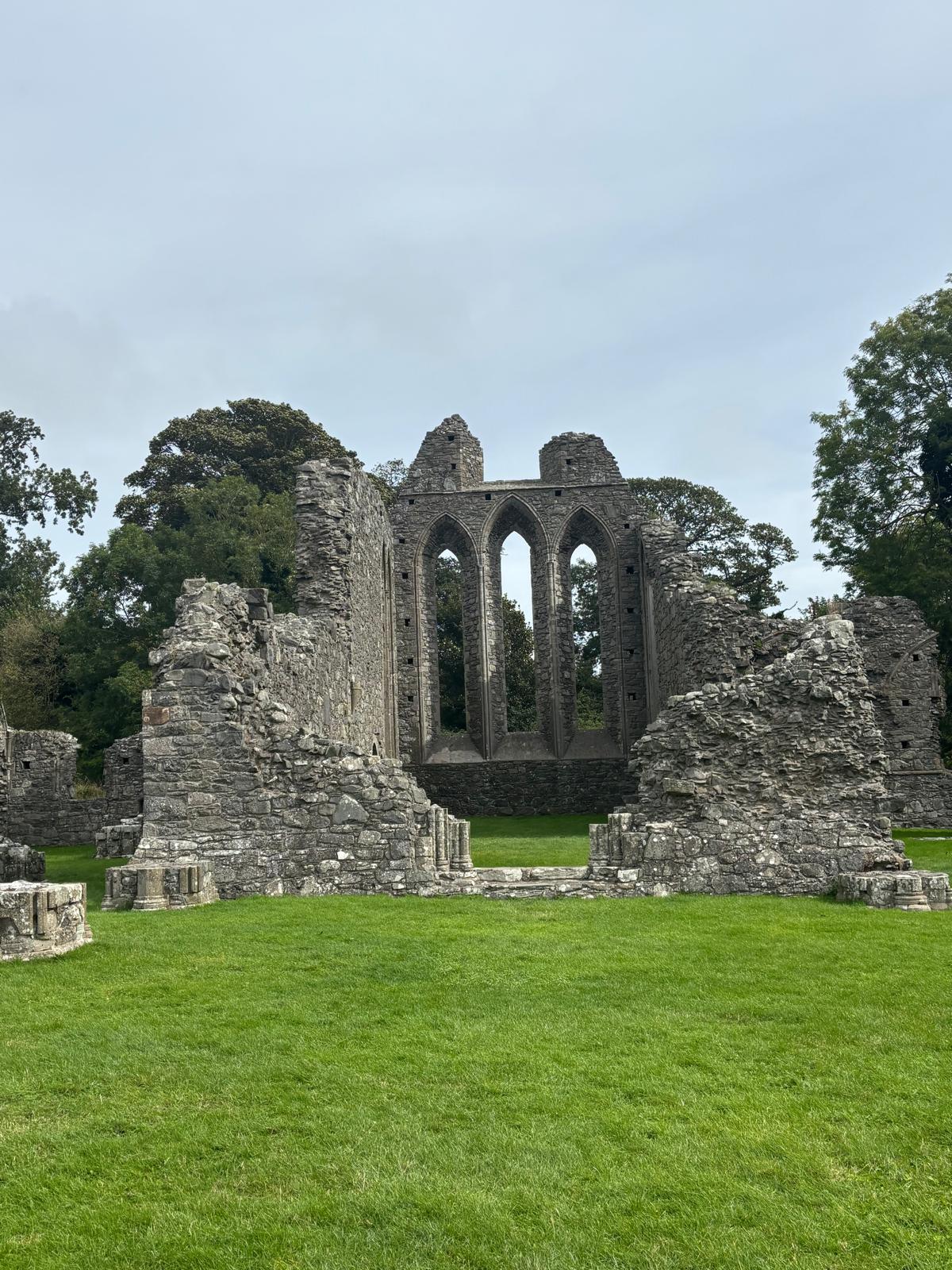
TO Inch Abbey just outside Downpatrick on Sunday for a visit to the ruins of the Cistercian settlement on the banks of the Quoile. It’s been some time since Squinter was last there – 15 years perhaps – and he had forgotten what a perfectly idyllic setting the monks chose for their life of prayer and service.
Some two or three hundred yards from the imposing ruins lies the Inch Parish Graveyard, which for some reason Squinter overlooked on his previous visits. While the Abbey was built in the twelfth century, the adjacent cemetery is considerably newer, having opened for bodily business in the early 17th century, around the time of the Plantation.
There was much to grab the attention on the headstones tucked in a small valley among the verdant drumlins of County Down. But most prominent among the historical attractions are two mausoleums, one in the familiar Greco-Roman style, the other an entirely less attractive edifice which resembles a stone Nissen hut and bears the inscription

Erected by Doctor Hutton
Bellshill A.D. 1840
Belshill. Hmmm.
For a few seconds Squinter couldn’t recall why the name seemed so familiar, and then the blustery autumn wind coming in off the water blew away the cobwebs and he remembered that the one, the only, Gerry Fitt picked that name when he was elevated to the Lords. Or, in the language of the constituency he represented for so long: when he sold out.
Baron Fitt of Bell’s Hill was the name he gloried under as he spent the last years of his political life being Oirish for his aristocratic pals; ie drinking heavily and singing amusing songs for his colonial betters.
West Belfast being West Belfast, he was immediately dubbed Baron Fitt of Hell’s Bells, although nobody ever got the chance to call him that to his face because once he wrapped himself in ermine he was never to return to the part of the city on which he made his name and his career. And while it never caught on the way that Fitt the Brit caught on, it’s a useful mnemonic in relation to the reality of the last years of Gerry’s career.
Whether as Gerry Fitt or Baron Fitt of Bell’s Hill or Fitt the Brit, the former docker’s punishment for selling out the hunger strikers and for ditching his working class hero persona on the first sniff of a red leather bench is to have been written out of Irish political history by his former SDLP colleagues with a ruthlessness and efficiency that Stalin would have envied.
There can surely be no substantial figure throughout the long centuries of occupation and partition whose name is so pickled in embarrassment and shame. On SDLP anniversaries, you’ll be reminded of John Hume, Seamus Mallon, Bríd Rodgers, Ivan Cooper, Austin Currie and the other grandees who either co-founded the party (like Gerry did) or who drove it forward in the early days towards influence and electoral success.
But of Baron Hill of Hell’s Bells there is not a mention. And you get the impression that bringing up the name of Gerry Fitt in the company of current SDLP members would be the social equivalent of balloting a Jeffrey Donaldson portrait at a DUP fundraiser.
Squinter’s not entirely sure why this is so. The aforementioned hunger strike betrayal was his most infamous act, and that was compounded by the speed at which he decamped to the Lords. But aversion to the IRA and its most notable members is SDLP dogma and there has always been a steady queue of party members willing to take Empire baubles of whatever size and brightness was on offer. Seamus Mallon, for instance, was bitterly anti-republican and is still well-regarded inside the party. And former SDLP leader Margaret Ritchie is currently in the Lords as Baroness Ritchie of Downpatrick and while she takes her place among the dozing former ministers and majors as an Independent, she remains in good odour with the party.
Maybe the answer lies in a graveyard in County Down. Maybe there’s a Halloween story in it.
Watch this space.
Ballynoe’s the place to go
SQUINTER’S been caught out once with the pound-glued-to-the-ground trick. It was a long, long time ago, so long ago that it took place outside a shop that’s no longer there.
We all know the high-class delicatessen Sawers in the Fountain Centre. Facing it now is a bakery, a coffee shop and a cigar emporium, but once upon a time there was a clothes shop there, and one day while young Squinter was walking past it he spotted the pound coin on the deck and stooped to pick it up. Two young bucks who worked in the clothes shop burst out laughing from the shop door and while Squinter couldn’t prove that it was they who had placed the trap, their intense interest in passers-by on what was clearly a slow business day was heavily suggestive of guilt. Squinter still remembers the heat in his ears as he hurried on, the laughter mocking him from behind.
The Ballynoe stone

After visiting Inch Abbey on Sunday (see above) Squinter motored a handful of miles to the far side of Downpatrick to see the neolithic stone circle at Ballynoe – and the rather charming gorse tunnel that leads up to it.
As he ambled through the tunnel, an autumn chill in the blustery air, he spotted a painted stone on the beaten earth path. Of course he stopped and picked it up, only to read in bright pink lettering: ‘Weird thing to pick up, but okay…’
The gorse tunnel
Of course there were no pranking youths looking on in the lonely countryside of County Down, but Squinter nevertheless felt that familiar heat return to his ears as he replaced the stone on the path for another victim to discover.