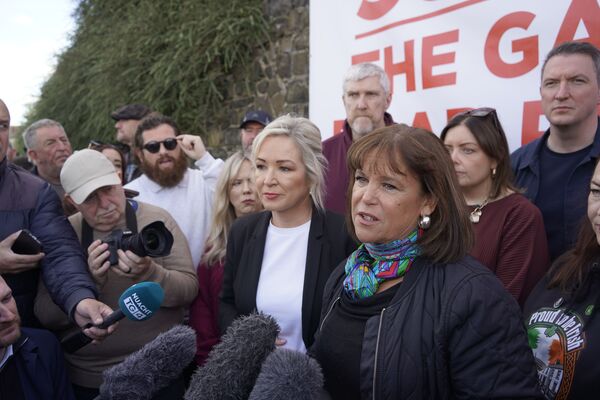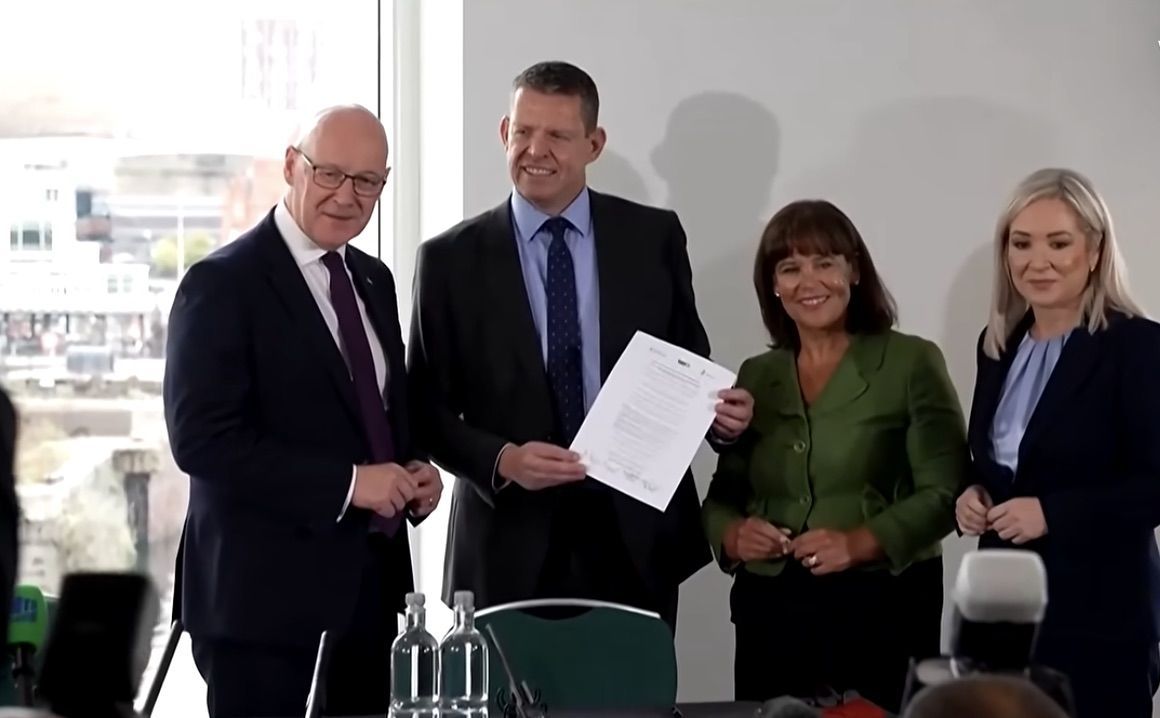
THERE is nothing performative, minimal or ordinary about what happened in Cardiff this week as Sinn Féin, Plaid Cymru and the Scottish National Party signed a memorandum of understanding which brought mature 21st century politics into the British colonial denial of self-determination to our Celtic nations. A united front from the parties that want to disunite the union.
In agreeing to highlight that Westminster’s time is coming to an end and identify common interests, Michelle O’Neill, Mary Lou McDonald, John Swinney and Rhun ap Iorwerth have set the political temperature for the decade to come. And they have made it relevant and practical to all citizens, not just their own constituencies.
They have agreed to share ideas and experience on the economy in the face of Westminster’s “broken economic model”. That first headline is a missile into the false narrative that nationalists are ideologues and disconnected from realities. Importantly, this approach has highlighted social justice and equality. For us in Ireland, shackled to Westminster misers who see us in 2026 in the same light as Trevelyan in 1846, responsible for our own partitioned misfortune, this is a statement of intent and disruption to prevailing right wing economic theology, where London City bankers’ bonuses are more important than the lives of those on unending hospital waiting lists.

Focusing on energy resources is intriguing in the context of the current climate crisis, and the criticism of many that Ireland is over-reliant on foreign fossil fuels as waves and wind surround our every island breath.
It will be fascinating to see the reaction of European partners to the statement tying the matter of self-determination to membership of the European Union. Following the fracture of the EU caused by Brexit, and the great fears of contagion, one has to imagine the potential for this move to ultimately further isolate English nationalism will be privately embraced, if not publicly.
But the boldness of the cohesive approach is further strengthened by the upfront engagement with the differences of the parties, and the movements behind them. Plaid Cymru and Welsh nationalism are in an entirely different place to the Scots, who as highlighted last week are in an entirely different place to the Irish people with the promise of a peaceful route to self determination with the Good Friday Agreement. Facing into and acknowledging that, while identifying where agreement is possible, is the most mature and confident political development in decades. These are leaders who know when to find agreement, and seize the moment when it arrives.
For Dublin, though, this poses big questions. The SNP and Plaid Cymru have arrived at this historic place with Sinn Féin as their partners. Fianna Fáil and Fine Gael could have been at that table too. That they were not, and those at the table were not asked about them, tells a huge story. And an uncomfortable one. Uncomfortable for the Irish patriots who reside in those parties and whose hearts lie in Irish unity.
In the last 26-county general election all parties mentioned planning for a united Ireland. In different ways. But all felt it relevant and important. The newly-elected Irish President openly calls for consitutional planning. It is surely time for an Irish summit of all Irish parties to agree a similar memorandum on Irish self-determination. Before history leaves some of them behind.