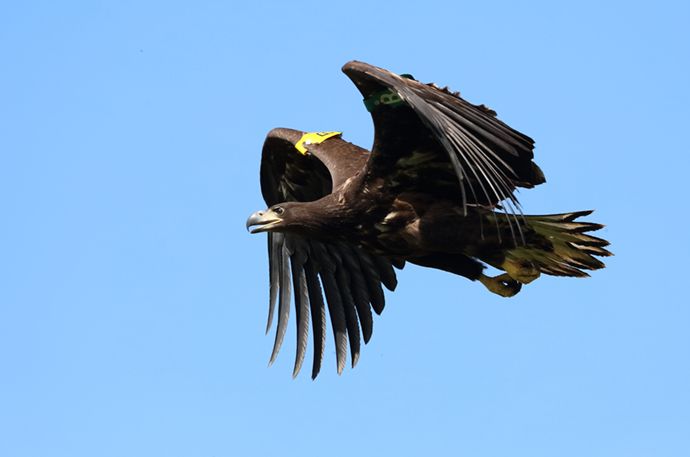
DÚLRA is doubly jealous – because a reader reports seeing two things this week that he would dearly love to see – firstly the hidden village of Galboly in the Glens of Antrim and, secondly, while there, two glorious white-tailed sea eagles soaring overhead.
The reader took a video – it’s far from perfect but what it shows is indisputable – two birds with wingspan so big that their identity is unmistakable. The wingspan of the larger female sea eagle is more than 2.5 metres – a truly massive bird that blows the golden eagle out of the water. So big that they’re often described as flying barn doors!
Dúlra is sort of embarrassed to say he’s never seen an eagle in Ireland – but that says a lot about their status here. Golden and sea eagles used to breed on almost every major cliff face and mountain top – but they were wiped out in a few short decades.
The 1800s were a century of hell for them and the last very last Irish white-tailed sea eagle – iolar mara in Irish – nested in Mayo in 1898.

At the start of that century, one traveller wrote how he saw “30 or 40” of them soaring above Horn Head in Donegal. And this bird was just as happy nesting inland on lake islands – they prefer fish, but will feast on animal carcasses just like vultures.
During that devastating century, their destruction was relentless and multi-pronged. They were trapped and shot, mainly by gamekeepers who wanted to attract aristocratic shooting parties to estates at a time when the native population was in dire straits.
And then farmers started hunting them as they were accused of carrying off hens and sheep, especially in the Glens of Antrim.
In the mid-1800s the poison strychnine was intruded as a bait on carcasses – mainly to kill foxes – but that took a heavy toll on the sea eagle. One gamekeeper in Achill in Mayo poisoned 11 in one year.
The Horn Head eagles were shot and their cliff eyries destroyed.
And as they became rarer, they achieved trophy status. Eagle eggs fetched high prices from colonial collectors – no collection was complete without an egg from the biggest raptor of them all, even though it’s just plain white. These collectors, often travelling from Britain for shoots, were happy to pay danger money to local daredevils who would scale rock faces in the west of Ireland to raid the last of the nests.
But our natural history was to take a dramatic turn once more a century after the eagle became extinct. In 2007, 15 chicks were taken from their nests in Norway – where sea eagles are thriving – and released in Killarney National Park in Kerry. Over the next four years, 100 were released, and then in the second leg of the project, a further 145 were freed across the south west from 2020 to 2025.
This wasn’t just a hopeful punt – it was a strategic plan to ensure this incredible bird makes Ireland its home once more. As the eagles over Galboly prove, it has worked.
Dúlra may not have ever seen one, but our sea eagle population is now self-sustaining, the birds breeding right up the west coast and even inland in Fermanagh, where a single pair settled down two years ago, successfully raising a family. And with a few beats of their wings high up in the thermals, they can travel the length and breadth of the country in just a few weeks.
All the released birds were tagged and one female bird released in Cork did a complete circuit of Ireland in 48 days.
The hidden village of Galboly above Glenarm is once again attracting visitors decades since its residents left – and it’s on Dúlra’s to-see list. He’s seen many similar ghost villages along the west coast, where whole communities left due to famine and hardship, many to emigrate, never to return. These villages stand – usually in the most stunning parts of the country – as relics to a terrible past. Where the laughter of children was once heard, you hear only the screams of seagulls.
When Galboly was full of life, sea eagles would have been a constant in the sky above. Now that we've coaxed the eagles to return, who knows – maybe some day the laughter of children will be heard once more in the famine villages of Ireland.
• If you’ve seen or photographed anything interesting, or have any nature questions, you can text Dúlra on 07801 414804.