We look at the stories that were making the headlines in the Andersonstown News this week back in 1985...
Plastic bullet debate 'too sensitive'
A MEETING of the prestigious British Association for the Advancement of Science has been accused of stifling a debate on plastic bullets because it is politically sensitive.
At its annual conference last week, the Association, which includes all Britain's top scientists in its membership, attempted to deny members attending its annual meeting information about a scheduled discussion because it was too politically "sensitive”.
The discussion on the subject of plastic bullets was organised by the British Society for Social Responsibilty in Science in conjunction with the Campaign Against Plastic Bullets.

Speakers included Brenda Downes, whose husband John Downes was killed by a plastic bullet in August 1984. Leaflets advertising the meeting were repeatedly removed from notice boards where they were posted, in the press centre and elsewhere on campus. This culminated in an instruction from the British Association authorities to university staff to remove and destroy copies of the leaflets which had already been distributed on chairs in the lecture theatre for Sir John Mason's talk on Acid Rain.
Lá Twinbrook survey suggests there may be 100,000 Irish speakers in Six Counties
THE results of a survey published today by the Irish language daily Lá, suggest that there are upwards of 100,000 Irish speakers in the Six Counties.
The Lá survey of 1,138 households in Twinbrook, reveals that almost one-out-of-every-two families in the area contains an Irish speaker.
"If the ratio for other Nationalist areas is as high", said a Lá spokesperson, "and there is no reason to suppose otherwise, then we are talking about somewhere in the region of 100,000 Irish speakers, of all ages and of various degrees of fluency, in the North as a whole."
Of the 1,138 households surveyed in Twinbrook, 540 replied 'Yes' to the question: "Does anyone in your household have a knowledge of Irish?" 598 replied 'No' to the same question.
"More than three-quarters of the households in Twinbrook answered our questionnaire, so we regard it as quite accurate," explained Gearóid Ó Cairealláin, editor of Lá.
"Nearly fifty per cent said that there is someone in the family who has some Irish and in many cases there was more than one person in the family with Irish. One would hope that in view of these findings, educational, community, political, social and sporting bodies would re-assess their attitude towards the Irish language.
“Many of those surveyed in Twinbrook complained about the down-grading of Irish in local schools at a time when Irish is being used more frequently in Belfast than ever. This is one area which could be tackled immediately."
A spokesperson for the Irish media pressure group, MEAN, said the results of the survey weren't surprising.
"These results are in line with what we have been saying for some time now, namely that there are at least 60,000 Irish speakers in the North. The neglect of these Irish speakers reflects badly on many organisations but it has biggest implications for the media.
"This large body of people has been completely ignored by the television and radio authorities for years. We will be embarking on a new campaign in the near future to highlight this gross injustice and to bring it to an end."
The Gaelic League in Twin brook also welcomed the findings.
THROWING A LINE: Ardoyne fishermen at a presenation in Ard Eoin CLG back in August 1985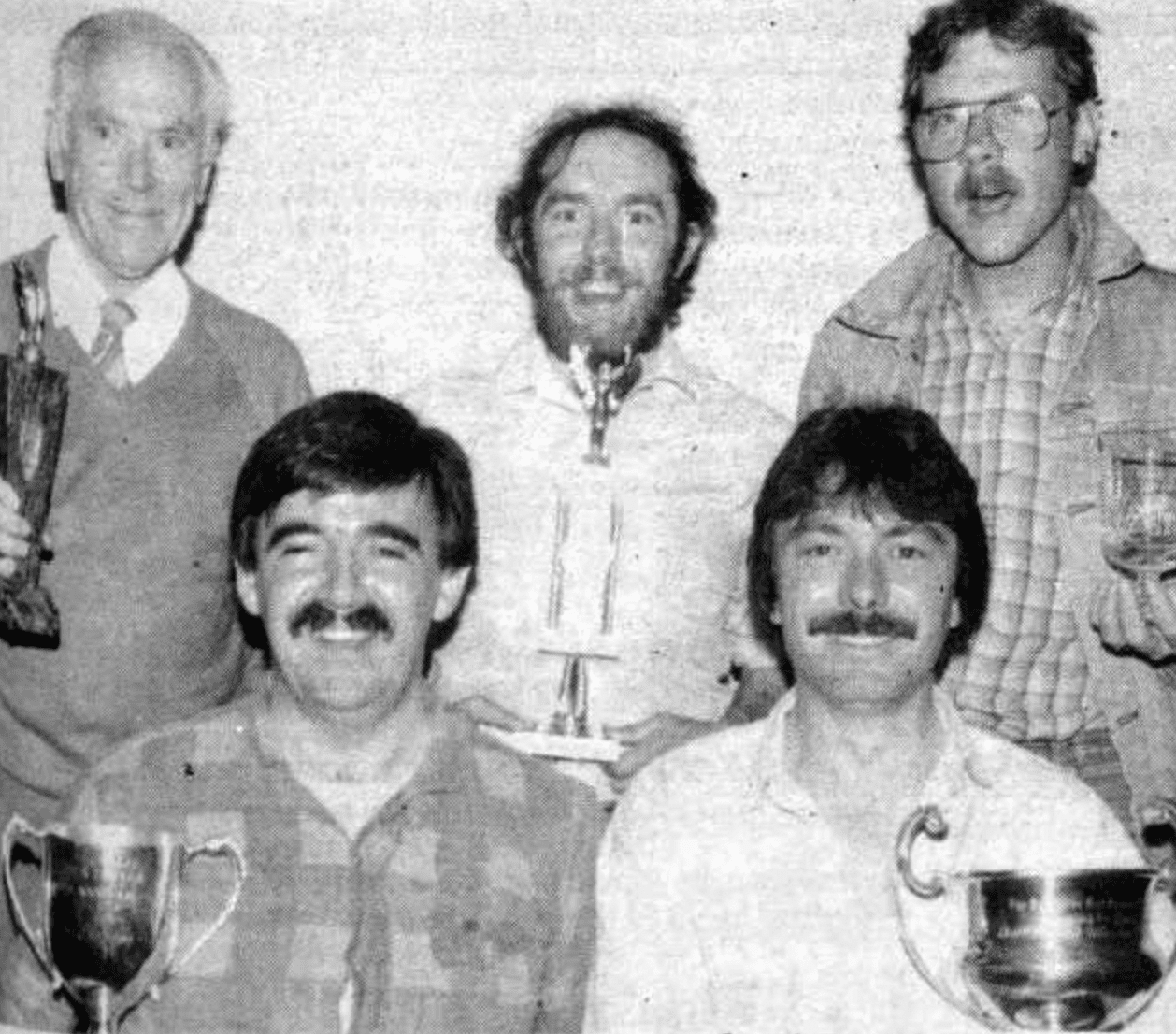

Editorial
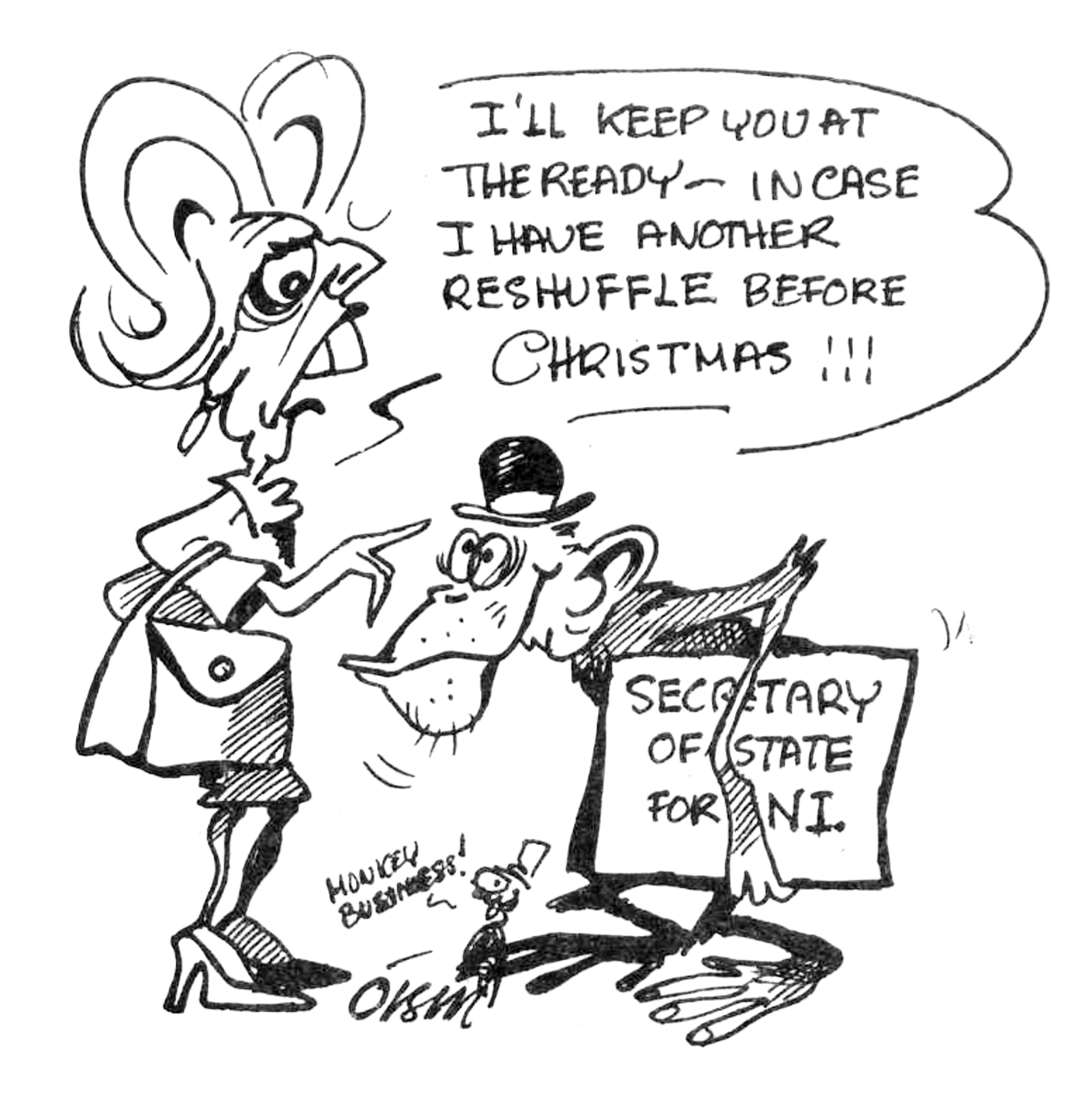
AT the rate they're going, the Secretaries of State for 'Northern Ireland' will soon be changing with every new British army battalion coming in.
Douglas Hurd hardly got time to write a chapter in one of his far-fetched spy stories before they sent in the snatch squad to take him out. This more than anything else highlights the bewilderment of the "memsahibes" in Westminster who have tried everything they know (which is not much), from bribing the natives with beads, to bashing their heads in with plastic bullets, and yet they are still restless.
What is happening here is following the classic pattern of Britain's colonial involvement throughout the world, whether it be in India, Kenya, Aden, Cyprus or anywhere else.
After a period of brutal occupation, the unruly natives realised that these "pink cheeked Brit chappies" hadn't much grey matter between the ears, and decided to give them the push. And in each and every case the master race shouted "Foul! How is it possible," they said, "that these half-educated natives, who, after all, couldn't even speak English before we came, could resent our presence in their country? Why is it, after all we have done for them, by way of civilising influence, that they keep on harping about freedom and self-determination? Why can't they be sensible and wait until we give them their freedom? What amazes us more than anything, is the fact that they refuse to listen to their Shamans and Holy Priests, civilised, educated and reasonable individuals to a man, who understand the very difficult task we have in bringing divorce, abortion, cultural deprivation and unemployment, and other benefits of civilised society to this primitive country. It's not cricket you know."
Having said that much, we must admit that Douglas Hurd is absolutely right when he says that it is here in Ireland and not through "Anglo-Irish" talks that our problems will be solved. Why then doesn't he pack up the whole paraphernalia of British imperialism and take it with him back to "God's own country."
That really would be a "jolly good show!"