We look at the stories that were making the headlines in the Andersonstown News this week in 1985...
Attacked and beaten by the RUC
A 24-year-old Twinbrook man who says he was attacked and beaten up by an RUC patrol on Saturday 5th October will be pressing charges of wrongful arrest and assault against the force.
However, Thomas Cullen who sustained a fractured wrist and more bruising in the late night attack has been told by the RUC that the RUC officers involved will press counter-charges. Thomas Cullen was just yards from his home at around 12.30 a.m. on Saturday night when an RUC Land Rover stopped nearby and a voice shouted "Hey boy, come over here." Thomas Cullen said he didn't look round at the Land Rover but moved on towards his own pathway. However, two RUC men ran after him and brought him back to the Land Rover.

Explained Thomas: "I protested at being arrested for no reason, but they pushed me into the back of the jeep. One RUC man then grabbed me by the hair and started to punch me in the face. I tried to grab his hands, but the rest of them pushed my face up onto the floor of the jeep.
"They then stamped on my face and kicked me around the neck and shoulders. I don't know how long this went on for but at one point I tried to force my way up. But one of them grabbed my hand and twisted it round pushing me back onto the floor of the jeep. That's when my wrist was fractured."
Thomas Cullen was taken to Woodbourne Barracks where he was allowed to see the RUC 'doctor' who took details of his injuries. Thomas also told him he wished to make a complaint. Shortly afterwards, he was taken to an interview room and asked if he was determined to go ahead with his complaint.
When he said that he was, the RUC said that he would be charged with resisting arrest and "assaulting a police officer”. At 3.30 a.m. Thomas was released on personal bail of £50 and told to make his own way home. The next morning he went to the RVH where he had a plaster of paris placed on his fractured wrist. Doctors also told him they suspected a fracture of the bridge of the nose. Other injuries included external and internal bruising of the right eye, welts to his back and severe facial bruising, especially around the neck, jaw and forehead.
Editorial
THE British have hundreds of years of experience in diplomacy, which means in effect that they have hundreds of years of experience in hoodwinking people into accepting what they would like them to accept.
There are no right or wrong, moral or immoral issues for them in their dealings with other people. What is best for the British is their one and only criteria and to hell with morality.
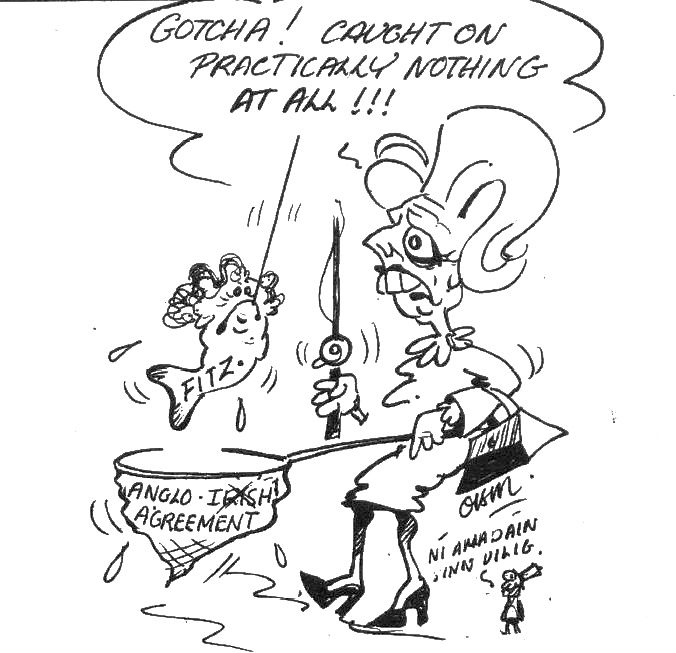
It is with some apprehension therefore, that we would view the forthcoming summit between Fitzgerald and Thatcher. He will be savaged in the interests of British diplomacy, of that there can be no doubt. Even Mr Robert Mugabe of Zimbabwe had great difficulty in extricating himself from the Lancaster House agreement, even though he was utterly suspicious of British motives, and stated publicly that he would break any agreement at the first opportunity, and that he was not bound by any diplomatic constraints.
Garret Fitzgerald has none of Mugabe's attributes. Not only is he a weak individual and a strong Anglo-phile, but he has no will for the task in hand except political expediency, and that has never been enough to get concessions from the wily British.
If our reading of history be correct, then the only people to get the upper hand of the British were those who were able to wrong foot them on these two issues. There is an interesting precedent in Anglo/Irish relations that Fitzgerald or any future negotiator might ponder. About 500 years ago, when the British had only a toe-hold in Ireland and were concentrated in and around the Dublin Pale they had great difficulty in militarily defeating Aodh Ó Neill, so they did what they always do in such circumstances, and asked for a parley in the hope that what they couldn't get by force they would get by deception. The negotiations were duly arranged and the two groups met on the edge of the Pale close to Drogheda. The English were at their beguiling best and flattered Aodh with all kinds of compliments, even offering to take his children and educate them in the English way of life. Needless to say all the negotiations were in English, even though it was only a very minority language in Ireland at the time. Aodh listened dutifully to their speeches and made arrangements to see them the next day. The following morning when the two groups met again, he announced from the outset that he wasn't prepared to negotiate in English any more, and demanded that the negotiations continue in Irish.
Even going as far as to offer them an interpreter. With their linguistic superiority gone, the English were so wrong footed that they had to retire with their plans unfulfilled.
Garret Fitzgerald and John Hume please note!
BON VOYAGE: Off on a trip abroad is Maria Hassett and she was given a send off by her colleagues at the Whiterock Leisure Centre back in October 1985. Manager Danny Corrigan presented her with a gift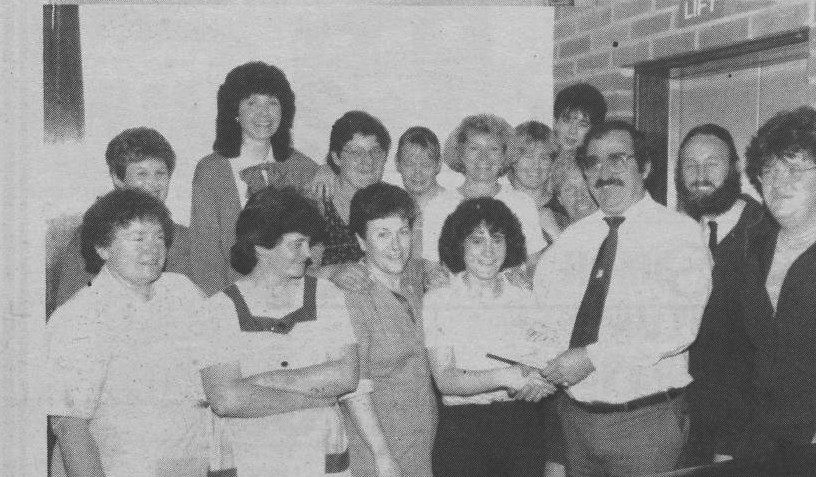

Housing Executive respond to Lenadoon complaints
HOUSING Action Group have reported an improvement in the Housing Executive's response to the complaints of local people.
Last week the Executive's local district manager accompanied group members on a walkabout of the area and later attended a committee meeting. As a result, he promised to investigate why a planned maintenance scheme for the area had been cancelled again. He would also investigate the alleged lack of response by the Executive to repair complaints.
A Housing Executive representative will now operate an advice office each Monday between 2.30 and 4.30 in the Horn Drive Community Centre. Advice on transfers, housing benefits and repair work will be available. Local community workers are urging the residents of Lower Lenadoon to report their housing problems to the advice office.