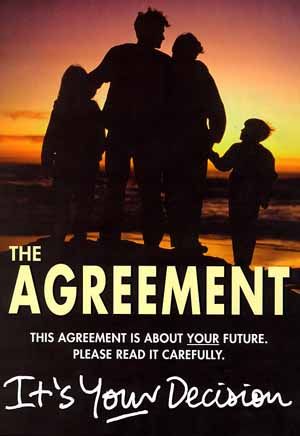
I WASN'T sold on the Good Friday Agreement when I read it for the first time.
I was worried that it sold our nation short. The things I was most conflicted on were the idea that British rule would be administered in Belfast by the proposed new Assembly and that Articles 2 and 3 of the Irish constitution would be replaced by a notion of “consent” that effectively handed Ulster unionism and Britain a veto on Irish national self-determination.
It felt a heavy compromise.
It was a heavy compromise.
I ended up voting yes, though. I voted yes because I had innate confidence in the genius of the Irish people to maximise this untested and vague document to deliver lasting peace and a new future to my four-year-old daughter and the son we were expecting that Christmas.

I voted yes because I took a chance that the pathway to an agreed peaceful transfer from British occupation to Irish self-determination was baked in and writ large in the document. And I was willing to be patient. Persuaded by the “They have been here for 800 years, what is another few?” argument.
I had many friends who did not agree with me. Some of them simply didn’t agree to disagree and we have not spoken for many years. Some of them I am glad to say still chew the cud with me.
While never regretting my decision, it has been tested in recent years by the need for the Irish government to have a serious conversation with the British government about Irish citizens’ right to the fulfilment of the Good Friday Agreement’s promise, and not to pretend our right to self-determination can be dismissed.
The implications of partition, the legacy of inevitable conflict and the failure of unionism and Britain to implement the Good Friday Agreement has led us to utter public sector financial ruin. Simultaneously, this sepulchre of failure has led to systemic collapse of much of the Health Service. It stands in the way of effective, human rights-compliant policing that commands the confidence of the people. It stands in the way of renewed and rebuilt relationships or any hope of whatever reconciliation might mean. It drives our children out of the jurisdiction. And sucks the life out of every single positive public policy, from cleaning up Lough Neagh to protecting nurses from racists.
Partition, and all efforts to maintain it, has failed. Sometimes that’s called, “Politicians have failed” or “Stormont’s failed” or “Efforts to agree a budget have failed." Which can all take heat and focus, meanwhile the root cause is conveniently ignored.
Andy Burnham can bring his guitar-playing act to Belfast to patronisingly convince us that our mammies in Stormont aren’t managing the measly weekly pay well enough. He can tell us he wants to focus on the results of partition, by telling us how important they are, as if we don’t know. And he can try to tell us what we really need and what is not on the table, which is partition itself. But he is wasting our time, never mind his own.
No man, not even one in a black t-shirt singing Christy Moore, can put a stop to the march of a nation. We know the source of our ills, and we know what is required to fix it.