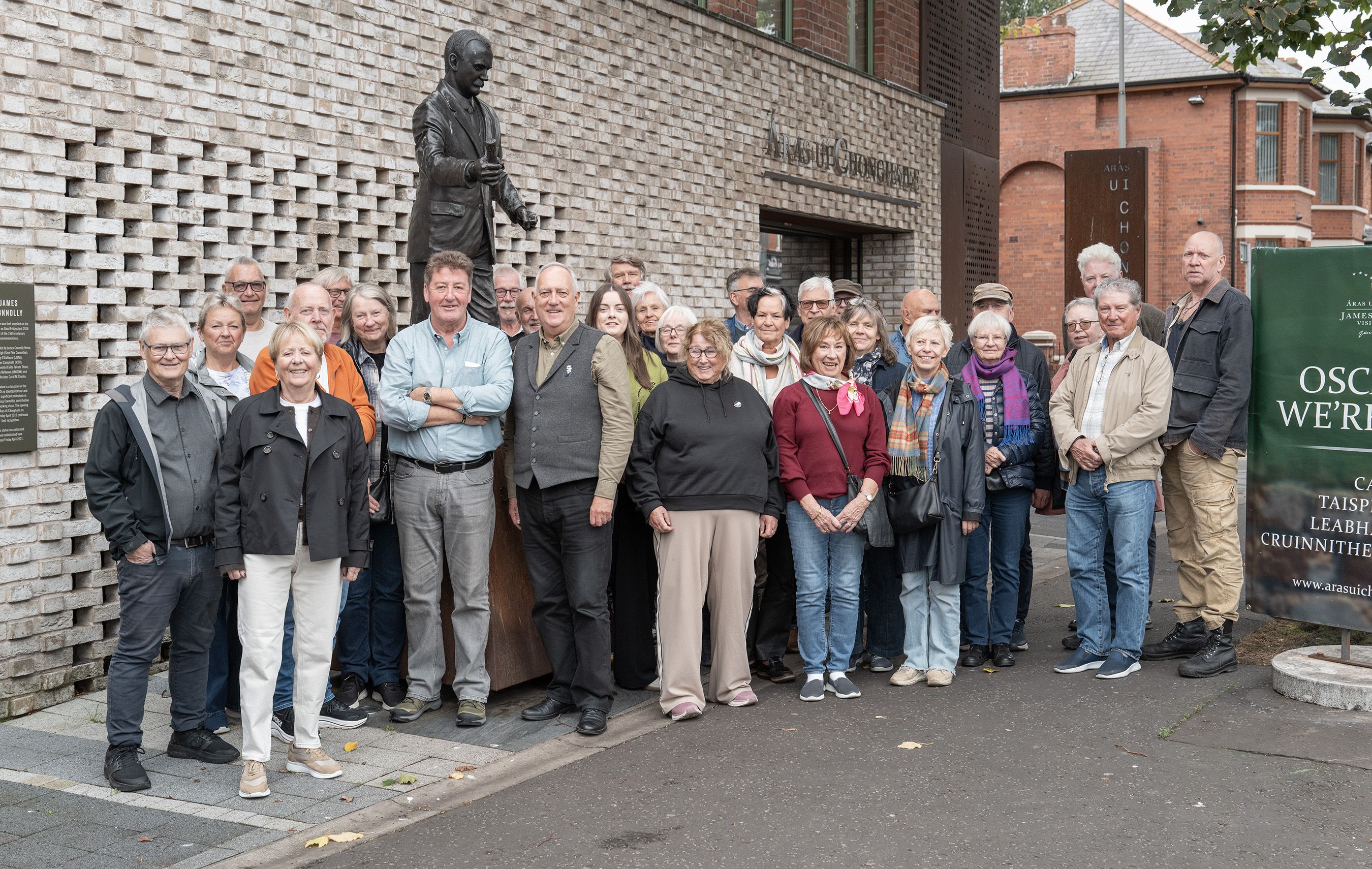
A GROUP of media professionals from Norway – all former employees of the national newspaper Dagbladet – have been spending time in Belfast as part of a week-long fact-finding visit to the North.
The trip was coordinated by Belfast man Eddie Whyte, who has lived in Norway for nearly 40 years.
"They want to learn something about the conflict, and about post-conflict resolution," Eddie said. "They want to learn about the effect the conflict has had on people who live here."
The group have had a packed schedule, including meetings with members of Ireland's Future, tours of Crumlin Road Gaol, the International Wall and the Titanic Museum, and a visit to the Bloody Sunday Museum in Derry, as well as the Giant's Causeway. The group rounded off their trip on Friday with a visit to Áras Uí Chonghaile on the Falls Road, where they received a welcome from Eimear Hargey and Séanna Walsh.

"We think it's important that they experience the real Belfast," said Eddie. "We've been talking to different community groups and individuals who can give them an insight into what really happened here."
Eddie said that Norwegian society is very Anglophile, with an Irish viewpoint being quite uncommon on news programmes. The group approached him to ask for his help in organising the trip, as they want to learn more about Ireland.
"Focus on the Troubles is on individual explosions or military action," he explained. "There is very little about the background as to why there was the conflict, the Civil Rights Movement and so on.
"There's a lot of cross-over between what works in Ireland and what works in Norway. We can learn from Norway that social democratic politics works. To create a system in which people are taken care of is the key to a good society."
Kirsten Karlsen is a former political journalist with Dagbladet. She said that she had often heard and read about the North in the news, but to come and see it in real life and realise how recently events occurred has been interesting.
"We can learn everything in a way from coming to places like this. You used to hear about the hunger-strikes in the news, or about the bombs.
"There are many historical events here that bring us right up to the present day that I wasn't aware of."
She continued: "Meeting the people that were there, that had been in prison. The people that lived here and were attacked, for example in Derry. It's so concrete, and that has stood out to me on the trip."
She said the solidarity with people in Palestine was noteworthy, and that even though Norway was very strong in its support of Palestine, communities in Ireland seemed to identify with the cause on a deeper level.
Rolf Fiske was a reporter in the North in the 1990s. He remembers his last time being on the Falls Road and interviewing the sister of Bobby Sands, Bernadette Sands McKevitt, in the Felons Club.
"I was told that I should turn up outside the Felons. I arrived and they searched me, I wasn't used to that! I came from little Norway. My photographer couldn't come with me, and I went inside and met Bernadette for the first time.
"It's a very different city now," he continued. "It wasn't nice here in the nineties, but it's been rebuilt to a good standard. The people are much calmer, everything was much more tense back then."
He said there was an interest amongst the public in Norway about Belfast and Ireland's history and society. He remembers being based in London and coming over to Belfast during the nineties, and being invited into people's homes for dinner, something that never happened in London.
"People were very friendly here. I interviewed both sides. It was easier to get interviews from the Catholic side. They were friendly with me. I was not English, I was Norwegian.
"It's a fantastic city."