THE family of leading republican Máire Drumm say their mother's legacy still lives on, ahead of her 50th anniversary.
Máire Drumm (57) was the vice-president of Sinn Féin when she was murdered on October 28 1976. She was assassinated by two members of the Red Hand Commando disguised as doctors while she was recovering from an eye operation in Belfast's Mater Hospital.
At the time of her murder she was a huge figure in republican politics and was often the public face and spokesperson for Sinn Féin. She was renowned for her rousing and inspiring speeches and as a consequence many thousands attended her funeral.
Máire was born on October 22, 1919 and grew up in the village of Killeen, County Armagh. Her mother Margaret McAteer (née Brown), had been active in the War of Independence and the Civil War.

The family moved to Dublin in 1940 and soon afterwards she joined Sinn Féin. The family moved again to Liverpool and it was there that Máire joined the Gaelic League. The family returned home in 1943 and she took up work as a grocer's assistant in Belfast.
Máire Drumm became an active participant in the Republican Movement, taking a particular interest in the welfare of republican prisoners and through this she met Jimmy Drumm who was imprisoned at the time and they married in 1947. Jimmy spent 13 years in prison for republican activity, with Máire raising their children in Andersonstown.
Máire assisted Catholic families who had been burnt out of the homes in August 1969 and in July 1970 led 3,000 women who broke the Falls Curfew by marching through British army lines with prams loaded up with supplies for the beleaguered residents. In July 1971 she was arrested for making a "seditious speech" at a rally in Belfast.
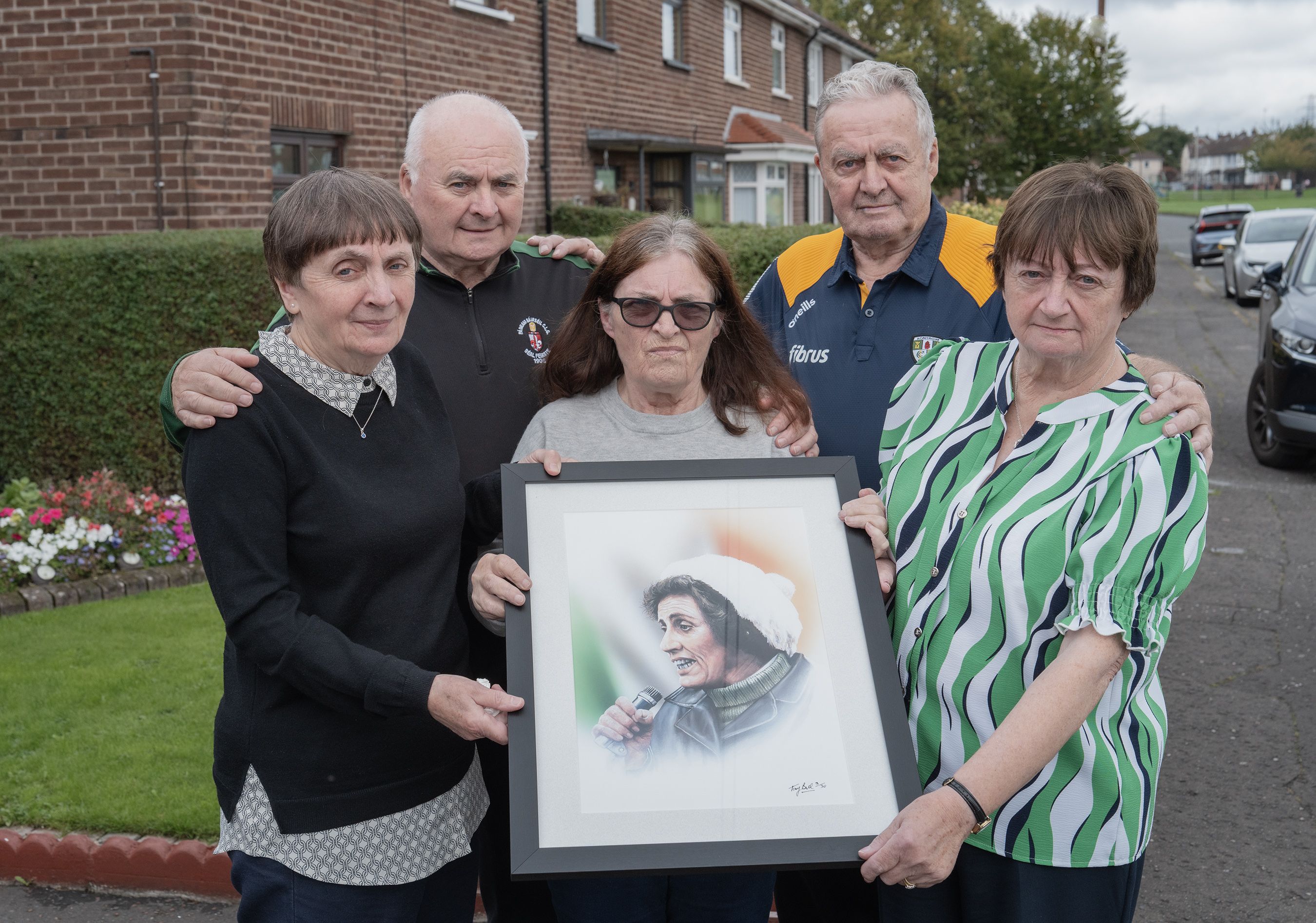
Ahead of her 50th anniversary, the Andersonstown News sat down with her five children – Séamus, Seán, Margaret, Catherine and Máire.
"We grew up in Glassmullin Gardens. Our mother got this house when they were first built in August 1955 and Máire still lives here," explained Seán.
"I think she had an interest in republicanism since she was born. She grew up in a republican family and living on the border was a factor too.
"She was never afraid to stand up for what she believed in.
"The first time she was arrested was for wearing an Easter Lily on the Crumlin Road in the 1940s. She was held for a few hours and released.
"In 1969, she was very involved in helping people who had been burnt out of their homes. There were caravans set up on the field outside the house. She would have cooked and we would have brought the food over.
"She used to give them each a night in our house to get a bath and watch TV.
"The house never stopped morning, noon or night. She was like the go-to person.
"When we think about it now, we had a very unusual childhood but we thought it was normal at the time.
"She was also big into camogie and served on the County Board. She sent us to everything like music, Irish dancing and sports but we were all useless at everything.
"The Falls Curfew was a huge thing for her. She was very proactive and helped organise the crowd of women. Máire’s attitude was something needed to be done so let’s do it."
Máire Drumm served as Vice-President of Sinn Féin from 1972–1976 and often acted as a spokeswoman for the party.
In August 1976, she was once again imprisoned following a speech at a rally in Dunville Park, where she suggested the city would be destroyed "stone by stone" by republicans unless republican prisoners were given Special Category Status.
Her 18 days in prison affected her health and she was admitted to the Mater Hospital for treatment.
How the Andersonstown News reported Máire Drumm's murder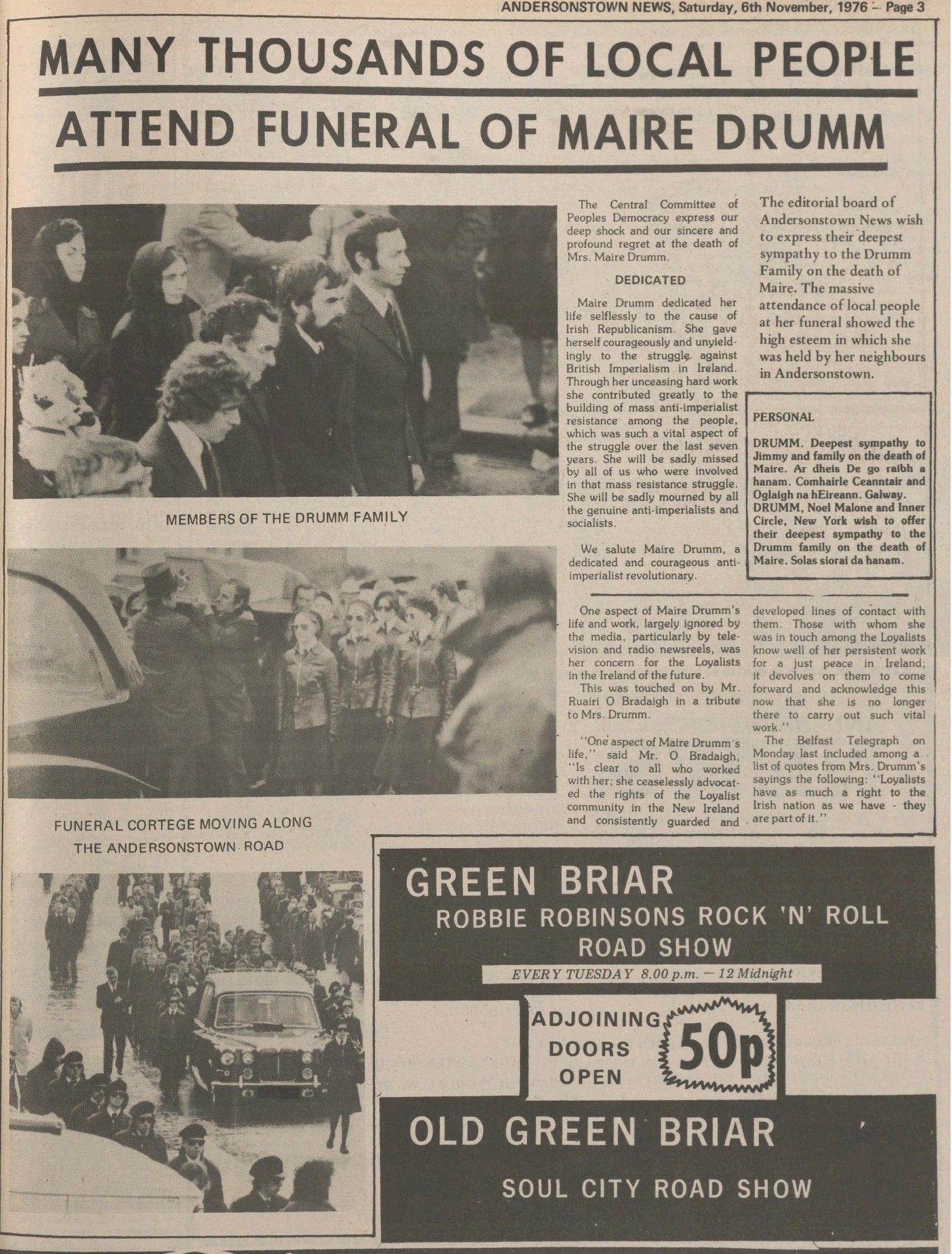

"She had to go into hospital for cataracts. It was her birthday on October 22, 1976," explained Margaret.
"On October 28, I was in the house and she said for no one to come and see her that day. She was due to go to Dublin the next day.
"I was getting her stuff ready in the house. The phone rang and they asked for my daddy. I explained I was her daughter and they told me I would need to get over to the Mater Hospital very quickly because she had taken unwell.
"I was also told to not go in the normal entrance. I knew straight away (that something was wrong). I asked, is she dead and there was no answer.
"We rang our uncle Sean who had a car and he brought us over. On the way over, there were patrols everywhere.
"I remember walking up the steps and the matron was standing waiting for us. I saw nurses covered in blood. The place was pandemonium.
"The matron told me she was dead. Máire was in jail at the time and heard the news there."
Looking back over the last 50 years, Catherine said: "People still remember her and talk about her. I think because she was a woman and a real leader.
"She was a good woman and way ahead of her time.
"It is hard to believe it is 50 years. You just think of all the things she missed out on."