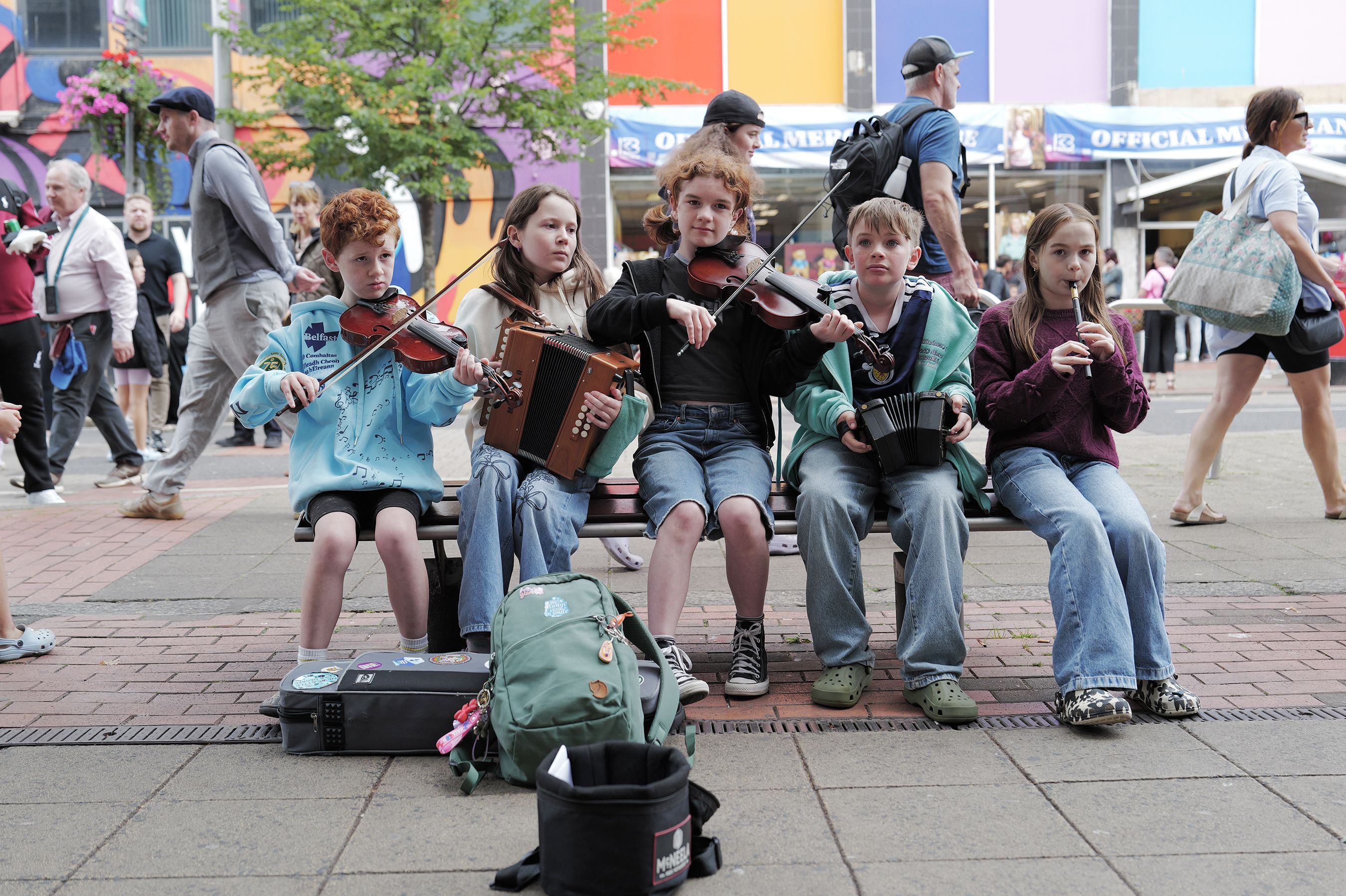
WELL, that was some week, eh? When it started with claims that the Fleadh would draw 800,000 people to Belfast, I thought it was maybe just a bit over-ambitious. Now they’re saying the number probably topped a million, and brought not £50 million to the city, but £60 million.
So how was it?
On Tuesday I made my way to the Gig Rig at City Hall. To call it a Gig Rig is deceptive – it was in fact a huge, solid, well-lit stage with superb sound. When I squeezed my way to the crush barriers, the big electronic screen told me I was now watching and listening to the Fintona branch of Comhaltas Ceoltóirí Éireann. At the 2021 census, Fintona was found to have 1271 people.
On stage, a line of primary school children were dancing, with behind them a mass of fiddles, harps, drums, concertinas – a total wall of sound to support them as they moved forward in a line, twirled, rocked, kicked their heels in the air so high that I found myself holding my breath. All this without the slightest sign of nerves or uncertainty. Total confidence.

Then two young women took the microphone and sang unaccompanied a song I’d never heard before: ‘The Road to Clady’. Their voices soared and dipped and wobbled in that characteristically Irish way of singing. I can’t remember ever hearing a song delivered quite so beautifully. It swirled and floated over the packed crowd, from the stern head of Queen Victoria’s statue in one direction to the spot where in 1984 a loyalist gang shot Gerry Adams in the arm and shoulder and neck.
The singing seemed to melt the grim past and all I could think of was the bit in the Bible where the transfiguration occurs, a heavenly light shining through a mortal body. In song and music, Belfast last week was drenched in beauty.
How did unionists take all this? Well, they were included. Loyalist bands played over the river at the Titanic Slipyard, and – wouldn’t you know – they made sure to have ‘The Sash’ high on their list. As Gerry Adams has pointed out, 'The Sash' is not a sectarian song, but it can be used in a sectarian way if someone chooses; for example, to pause outside a Catholic church and crank up the volume for the next three minutes.
But the Fleadh made a specific point of including the unionist musical tradition, and they appear to have accepted it. Whether their teeth were gritted as they did so, it’s hard to say. The Deputy First Minister said she welcomed it. And were other unionist politicians equally enthusiastic? Certainly not Ron McDowell of the TUV, who was very unhappy with a republican band playing on Royal Avenue (there’s a huge irony in there if you care to look for it). Chris Donnelly mused on Radio Ulster/Uladh about whether a loyalist event similar to the Fleadh would invite a republican band to play, and if they would be happy if the invited band started with something like ‘The Foggy Dew’. (Stop laughing, Virginia.)
But all in all, including for sensible unionists, the Fleadh was a transformative, ten-out-of-ten success. It showed the world that Belfast didn’t have to be a dour, grudge-bearing place. It reminded anyone open-minded enough to receive the message that Irish culture and song is so, so much more than an old guy with no teeth singing beside an open fire.
Maybe next year they’ll feature more song, including the many haunting rebel songs that form a part of the rich tapestry that is our culture. I mean, sticks and stones, etc.
Right, Ron?