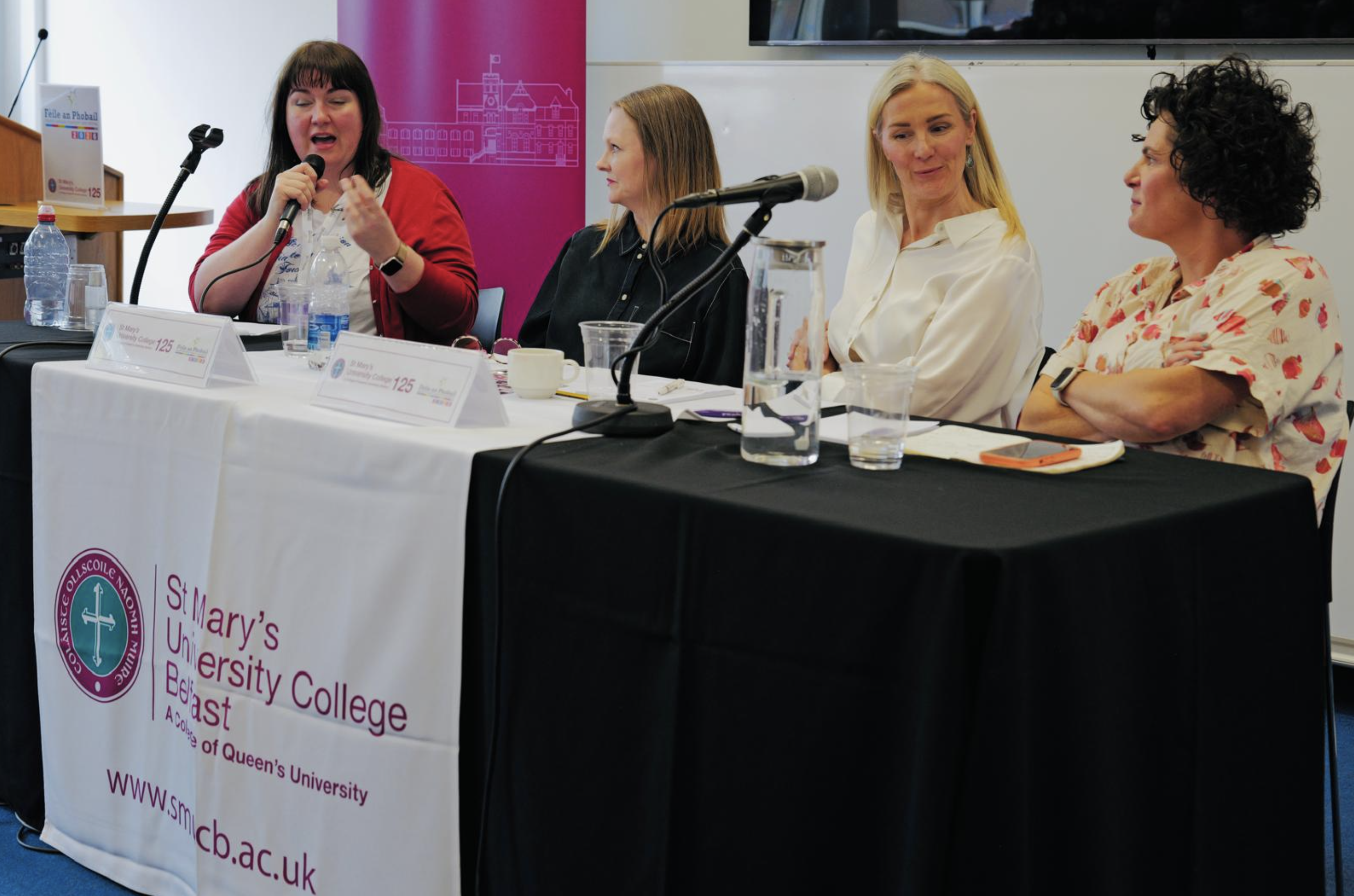
LAST Thursday I attended one of the many events organised by Féile an Phobail this year. It was a discussion involving four women: Journalist Amanda Ferguson as chair; Claire Mitchell; Linzi McLaren; and Claire Hanna.
At the meeting I learnt a new phrase: 'The Happy Lundys'. This is a term, I’m told, devised by former loyalist Davy Adams to describe people who had been part of the Protestant Unionist Loyalist (PUL) constituency but who had migrated to a new ground, where they are happily in favour of – or at least willing to explore the notion of – a reunited Ireland.
The two Happy Lundys on the panel were Claire Mitchell and Linzi McLaren.
Claire Mitchell, whom I’d not come across before, is short in stature but large in intellect – clear, articulate, witty. She looks about twenty-one but I believe she's more. She’s a senior lecturer in Sociology at Queen’s University where she's researched religion, identity, politics and our post-conflict society. She’s written several books, including 'Religion, Identity in Northern Ireland' and 'Evangelical Journeys'.
The second Happy Lundy was Linzi McLaren, a former UUP councillor in Ards and North Down Borough Council; a PSNI officer before entering politics; a woman who's outspoken on a number of issues, including Casement Park and moderate unionism. She has now left the UUP.
The thing that struck me about both women was the air of youthful optimism they gave off. Think Gregory Campbell or Nigel Dodds; then think the opposite in every way conceivable and you’ve got Claire Mitchell and Linzi McLaren.
They both concede that nothing is inevitable, but that everything short of inevitability points towards a reunited Ireland. They spoke of attending political meetings in Bangor and Banbridge and the considerable numbers of young Protestants filling the hall, interested in hearing about this idea of leaving the UK.
Next day I had lunch with a Protestant friend (actually he’s now nearer an atheist). He has learnt the Irish language, is (he tells me) no mean Irish set dancer, and he indicates that he has no desire to be tied to a Nigel Farage-led UK.
I actually didn’t get into the hall for the Feile debate – it was crammed and they led us to one of two spill-over rooms, with a large screen showing the panel in close-up. The woman beside me was taking notes at a great rate, and in conversation afterwards told me that she was a Protestant and a republican, and that her nephew was Jon Burrows, the leader of the UUP. Another Happy Lundy. (My new friend, not Jon Burrows.)
As I write, I’m planning to take in at least a few events of the Fleadh Cheoil na hEireann, being held in Belfast this week. The city is holding its breath as I write. On Friday Belfast Central Library was festooned with flowers, statements in Irish about the Fleadh, a display of Irish dancing costumes, advice about how many Fleadh events are scheduled and where to find them.
It’s interesting that the Feile and the Fleadh overlap. The Feile has for years now presented performance, debate, music, poetry, prose. The Fleadh will, we’re told, draw 800,000 visitors to Belfast.
Dear dirty Belfast; dour, not-an-inch Belfast; Belfast, the seat of unionist power complete with Queen Victoria in front of City Hall looking stern. What is happening to you? The city this week will be lan go doras – stuffed to the door – with harpists, fiddlers, bothráners, guitarists, all playing their hearts out, all joining in a vast coming-together celebrating all things Irish.
A few decades back, the front of City Hall and Royal Avenue were bunged with tens of thousands of people gathered to hear Ian Paisley’s famous ‘Never, never, never, never!’ speech. This week Belfast will articulate a silent ‘Yes!’ as Irish culture shows that it is alive and growing, intersecting with politics, discarding past dourness for a present and future joy.
Go raibh maith agaibh, Feile agus Fleadh Ceoil. Just don’t give Queen Victoria’s stern statue a coronary.