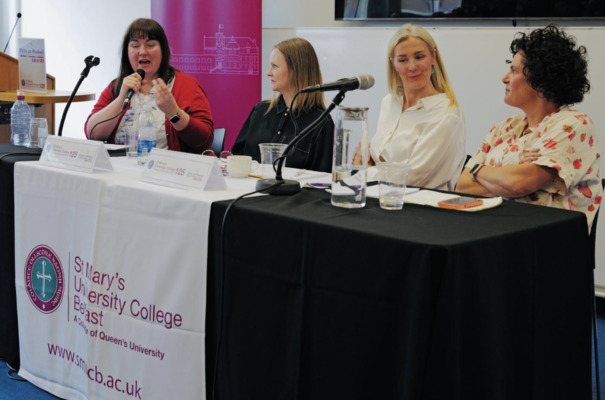
ON Friday last, I attended a meeting of Ireland’s Future in Derry City. The panel for the discussion (or conversation, as it’s now fashionable to call it) was Professor Colin Harvey, the Reverend Karen Sethuraman, and Niall Murphy, the well-known lawyer. It was an invigorating meeting, with questions raised and points articulated with conviction, and sometimes passion.
Ireland owes a lot to Ireland’s Future. From its initial meeting in the Waterfront Hall in Belfast in January 2019, it has held many meetings similar to last Friday’s. It has produced leaflets and booklets and books, all examining how best to approach present-day Ireland and how to move towards a border referendum.
For me it confirmed again the words of my old friend Dessie Donnelly, that if there is some political issue about which you feel strongly, you may be sure there are lots of people out there thinking similarly, waiting for you or someone similar to speak out and tell people they are not alone.

But here’s the thing. Ireland’s Future has provided the catalyst for thousands, probably tens of thousands, to join their voices in concern for the direction Ireland is pointed.
All three speakers on Friday spoke of the work being done, and the work still required, to increase pressure on the British government to call a border poll.
But a crucial factor is not being highlighted: The need to add to the poetry of passion the prosaic work of providing – or rather discovering – what a reunited Ireland might look like. Everyone at Friday’s meeting was agreed that we must not make the mistake Brexit voters made: Voting for something which hadn’t been clarified in advance.
Sinn Féin a few weeks ago attempted to begin the building of foundations. It called on the Dublin government to produce a green paper on Irish reunification and to establish a Citizens' Assembly examining the details of the entire exercise. The Dublin government promptly rolled up the Sinn Féin proposal and dropped it in the bin.
Hopes now appear to be pinned on Simon Harris and Fine Gael, who say they will produce a blueprint for the next steps towards Irish unity.
I can’t see Simon Harris leading Ireland towards a border poll. His predecessor as Fine Gael leader, Leo Varadkar, has spoken of national re-unification with an openness and energy that were rather more muted when he was in government.
Talk at Friday’s meeting was for us to wait out Micheál Martin, that he’d probably give way to Jim O’Callaghan at the end of this year or shortly afterwards.
I beg to differ on two fronts.
There’s plenty of work that could begin before that, and besides, Jim O’Callaghan may not be the Messiah some are expecting. The second point is that we should have a Plan B to follow the blank refusal of Michéal Martin, who says he goes "bananas" when he hears people talk of constitutional change.
We could do worse than pick up on Leo Varadkar’s comment that a Citizens' Assembly is fine for a single issue but not for a reunited Ireland.
In that case would it not be possible to establish a whole series of Citizens' Assemblies – 15, 30, located in different parts of Ireland, each to focus on one aspect of the model – health, education, infrastructure – calling on experts and finally coming up with what a new Ireland might look like in terms of health, education, infrastructure and so on.
This would require money and the services of experts to provide input. I am confident that if the Irish people were approached and asked to fund such a venture, they would respond.
Two things are vital. One is that we get down to the nuts and bolts of what a reunited country might look like. The other is that Citizens’ Assemblies provide the grass-roots involvement of the Irish people north and south. At present, Ireland’s Future is being splendidly led by people of standing in the community: Professors, lawyers, clergy. A series of Citizens' Assemblies would allow the grass-roots to join them in this central endeavour of our time.