OVER three thousand personal issue weapons issued to the UDR in 1974 were sold on to the private market by the British army in the late-80s and early-90s in a move described by a renowned arms expert as “really unusual”.
And it’s further claimed that the guns issued to the UDR could be “the only historical instance” of a military issuing an “assassin’s pistol” as a personal protection weapon to its soldiers.
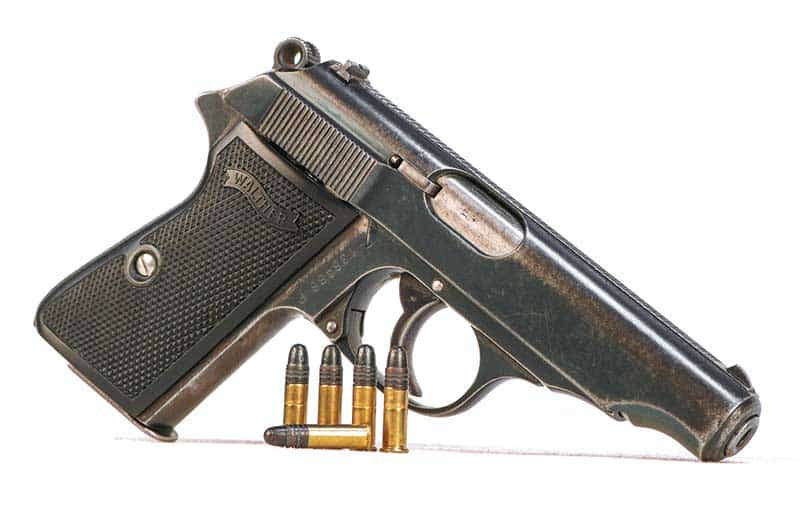
The 3,200 Walther PP .22LR pistols are now in the hands of civilians in Europe and the United States – even though British military weapons are seldom if ever allowed to enter the private market, according to Ian McCollum of the popular YouTube channel ‘Forgotten Weapons’.
The revelation came to light in a five-minute film that Mr McCollum made on the UDR’s personal-issue Walther titled ‘A Pistol for Northern Ireland’. A local gun enthusiast who stumbled across the 2022 film this week said the story of how the Walther came to be issued to the UDR is a fascinating piece of local history and an example of how the overwhelmingly Protestant regiment was always viewed as separate from the main body of the British army.

“British army weapons that are not needed or obsolete are either destroyed or placed in long-term storage for any future Dad’s Army-style civil requirement,” said our source, who’s been a member of a gun club for over 40 years. “Militaries are always reluctant for their weapons to leave their control, obviously because of the threat they pose in the hands of unknown users and the possibility of them being passed on to insurgent groups, But also because of the PR implications of military weapons being used by criminals. Selling on the UDR’s personal protection weapons to private interests just shows how standard procedure went out the window when it come to the regiment.”
Mr McCollum reveals that the Walthers bought by the British army for the UDR have caused confusion in the gun-collecting world because they are not marked with the commercial ‘Elk Antler’ stamp of the Walther factory in Ulm, Germany. Since they were bound for the British army they were instead proof-marked with the ‘Eagle’ stamp of the German army at its military facility in Koblenz. This means few or none of the new owners of the guns have any idea of their background as personal issue weapons for a sectarian loyalist militia.
The weapon displayed by Mr McCollum in his film was one of 1,500 of the former UDR pistols imported into the United States in the late-80s and early-90s by the International Armament Corporation of Alexandra, Virginia. The weapons were stamped ‘IAC Alex Va’ on arrival in the US.
Known commercially as the Walther PP .22LR (‘Long Rifle’), the weapon was designated the L66A1 (L for ‘Land Service’) by the British army.
In a further revelation, it has emerged that when the pistols were refurbished in the mid-80s the weapons were returned to UDR soldiers after being coated with the highly carcinogenic ‘Suncorite 259’ lacquer, which is now either banned or heavily restricted. Ian McCollum describes Suncorite 259 as “insanely toxic”. An article in Gun Magazine describes Suncorite 259 as “about as toxic as Plutonium”.
The ‘stove-black’ lacquer was widely used by the British army in the manufacturing and refurbishment of weapons from the 1940s to the late-80s. It was highly dangerous to factory workers applying it, and while the substance is considered, like asbestos, to be relatively stable when not mishandled, the health threat increases when the weapon is stripped and/or cleaned.
The Walther pistol is world-famous as the preferred weapon of the fictional spy James Bond. Author Ian Fleming first armed Bond with a Walther in his 1958 Bond adventure Dr No, and it has remained the glamorous spy’s weapon of choice via a number of iterations. Fleming chose the Walther because it was small and sleek enough to be hidden in Bond’s stylish and well-fitting suits, although the Walther Bond carried fired a more powerful round than the .22 in the UDR gun. In the United States and Europe the .22 round is used overwhelmingly for target shooting and pest control as its ‘stopping power’ – or ability to cause debilitating damage to the human frame – is considerably less than the standard personal issue 9mm and .45 calibres.
Adds Ian McCollum: “This is one of the very few if, perhaps, maybe even only historical instance of a military actually issuing a .22-calibre rim-fired firearm as something other than some sort of sneaky assassin’s pistol.”
It’s not known how much the Ministry of Defence received for the Walthers, but the money collected will have been a relative pittance, throwing the extraordinary decision to sell them privately into further confusion. In answer to a February 1982 House of Commons question from UUP East Derry MP William Ross, Under-Secretary of State for the Armed Forces Jerry Wiggins revealed the cost of the UDR pistols to the MoD in 1974 was £155 per unit. The used and refurbished guns will have been sold in large bulk years later for a fraction of that.
During discussions on open-source online military chat forums, former UDR members are scathing about the pistol, lamenting its unreliability, but mostly its notorious lack of power. Multiple contributors say UDR members often bought their own larger, heavier weapons at personal expense, such was their distrust of the Walther PP .22LR. That previously mentioned article in Guns Magazine said of the pistol: “For close-in defense against rampaging aluminum beverage cans, it’s the absolute perfect tool.”