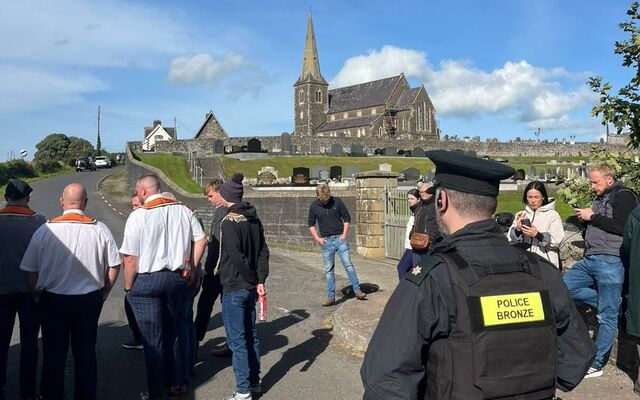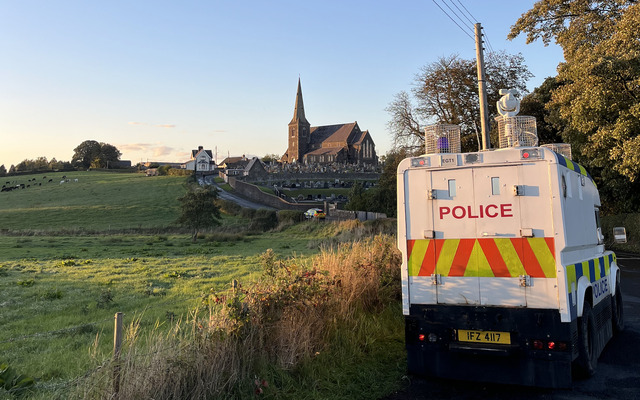
I THINK sufficient time has passed between Loyal Ulster trying and failing to get back up the Garvaghy Road for us to indulge ourselves in a little reflection.
Ex-DUP MP and Queen of Ulster Carla Lockhart was fairly vibrating with righteous indignation after she tried and failed to get 35 elderly Orangemen up the Garvaghy Road. (For the benefit of foreign readers, I should point out that ‘elderly’ is a more elastic word in Our Wee Country than it is in other Anglophone regions, encompassing a broad range of mature individuals from their mid-30s to their late-70s.)
“Here we stand we can do no other,” is the battle-cry of Portadown District, but after they proved they could do other by, ah, going home and doing something other, Carla left us in no doubt about her determination to overcome this 29th defeat in 29 years.

“Our country,” she thundered, “cannot be ruled by the mob and the lawbreakers and the threat of violence. After 28 years we have won the right to return home via our traditional route, and Portadown District intends to exercise that right on a date and time of our choosing.”
I’m interrupting my chain of thought here to point out that while Carla uses the third-person plural in reference to Portadown District, not only is she not a member, she’s not allowed to be a member because she’s a woman. And if there’s anything more pungently illustrative of where Loyal Ulster feminism finds itself in the Year of Our Lord 2026, it’s the laydeez of unionism pouring all their energy into securing the rights of a group that bans them from membership.
I don’t know about everybody else, but if I were to position myself as the champion of road-related law and order, I’d check beforehand to make sure my highway-linked record was a pristine one. I’d like to think I’d adopt a Caesar’s wife attitude to public order, and if anybody doubts my cred on this matter, let them ask themselves whether they’ve ever heard me lecture others on the twin menaces of beer and gambling.
In search of an indicator of Carla’s moral right to pontificate on matters tarmac, come with me back to June when the Upper Bann MP was to the fore in the attempt to stop anti-genocide protesters using the towpath on the other side of the Bann from Scarva.
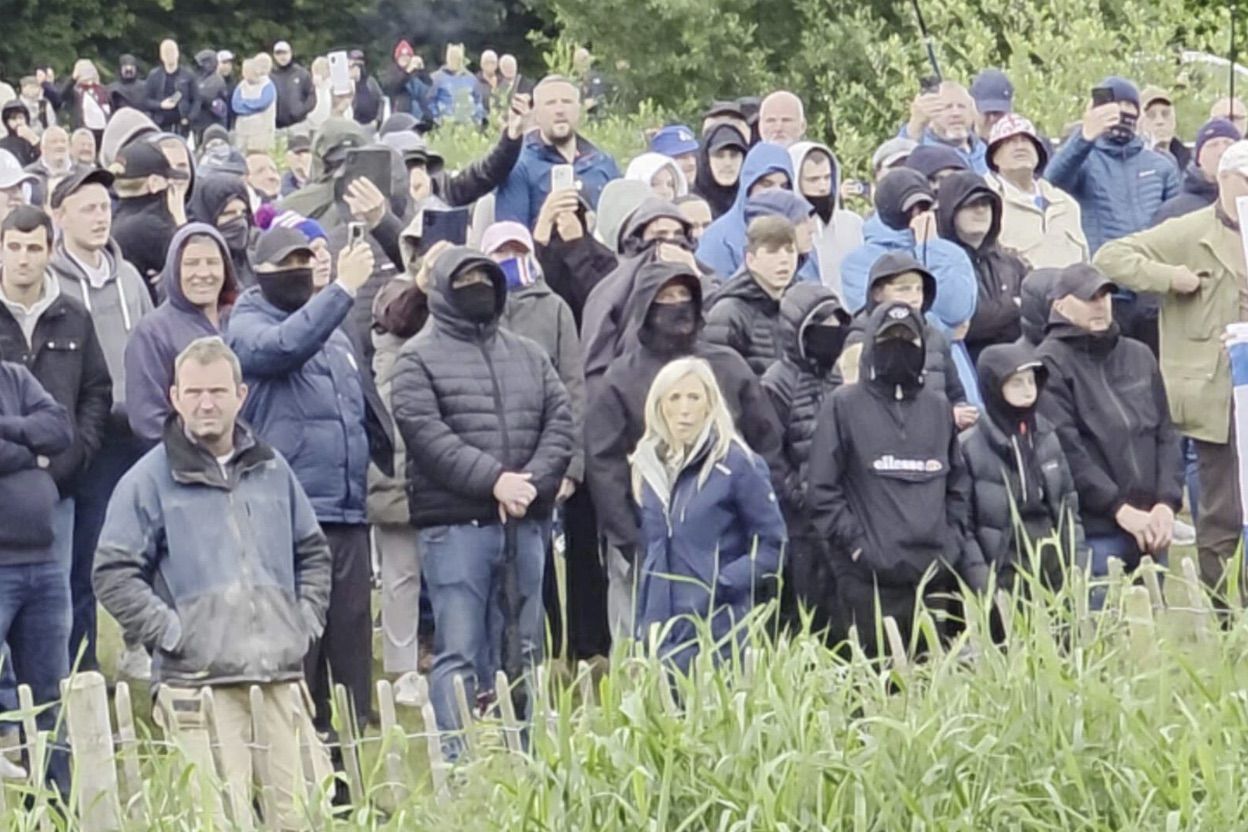
You will recall that gathered around Carla on that bad-tempered Saturday was a goodly number of stout Ulster yeomen with a strong aversion to Palestine and a stronger aversion to showing their faces. Carla and her Praetorian Guard suffered another defeat on the day, the protesters making their way along the riverside path with only the foul-mouthed ranting of masked loyalists and an inch or two of slurry hindering their progress.
Events have been well rehearsed and litigated in the months since Carla’s early-summer reversal, but what isn’t as well known, what hasn’t received as comprehensive an analysis, are the remarks of a High Court judge two weeks later. The remarks, post-Drumcree and printed only in the Irish News, are worth going over again in the light of Carla’s new-found expert status on protest protocol.
Mr Justice McAlinden, speaking tangentially during a hearing in the early stages of the loyalist challenge to the Parades Commission’s repeated banning of the Brethren from walking Garvaghy, made his thoughts on the Scarva events clear.
“One thing I think that caused, I think, some concern in relation to to the manifestation of, let’s say, challenge to the parade, or sorry, to the march, the pro-Palestinian march, at the Scarva event, was the presence of masked men in close proximity to Ms Lockhart and Ms Lockhart’s subsequent attempt to justify her presence there as standing with her people etcetera,” said Mr Justice McAlinden in relation to Carla’s submissions on the Garvaghy matter.
Given the popularity of trigger warnings in the modern media, I should probably warn admirers of Carla that the next few paragraphs may make for uncomfortable reading.
The judge continued: “Now, I have to be very careful in relation to what I say about that, but it does strike me that in terms of public representatives making submissions or making representations in respect to issues such as this parade [Garvaghy], it’s a bit concerning when when those same public representatives do not see that there is an issue lining up with people who are masked men, counter-protesting against a march in Scarva, just strikes me as, let’s say, a movement back towards the bad old days rather than a movement forward.”
Oooft!
In footballing terms that’s what’s known as a two-footed jump tackle. But even as Carla lay clutching her leg, Mr Justice McAlinden followed through with a scything scissor challenge that would have had Roy Keane wincing.
“And I think any correspondence from such an individual (ouch!) has to be weighed, taking account of that individual’s actions in other circumstances, especially when those other circumstances are specifically addressed in the correspondence.”
There’s a Latin legal word for that: Hawkward. But as Carla and the Brethren pulled at their collars and hoped that was that, Mr Justice McAlinden was about to move on to the Upper Bann MP’s reluctance to distance herself from the blokes in black clothing and masks.
“Well, she’s saying there’s a difference of approach, and she’s saying that there should be, you know, well, there should be a re-evaluation of the stance taken by the Parades Commission in this particular instance, but there doesn’t appear to be any willingness to in any sense, distance herself from masked men who are exhibiting hostile opposition to a pro-Palestinian march.
“And it’s that type of, let’s say, willingness to get involved with those that appear to be, let’s say, well…
“Wearing masks in public is a criminal offence. We know that it’s a specific offence. You know, it’s the, let’s say, lack of recognition of the public perception of that that does, in a sense, devalue her intervention in this particular instance.”
The judge added: “There was a potential to distance oneself afterwards, and that potential was not, in any sense, taken. There was a doubling-down. So that does, I think, indicate a state of mind that would be somewhat inimicable to, let’s say, the universal application of rule of law etcetera, etcetera. It just flavours things, you know, and it does, in a sense, cause me some, let’s say, concern in terms of placing too much weight in respect of the correspondence from this MP, having regard to this MP’s recent behaviour in another contentious, let’s say, parade-type or march-type situation.”
As Carla was carried off the pitch on a spinal board sucking furiously from an oxygen tube, the judge finished with a magnificently Belfast flourish: “That’s all I’m sayin’.”
(Yes, I know, a judge is unlikely to say “sayin’ ”, but after that shellackin’ – sorry, shellacking – a little literary licence is surely allowable.)
Astute observers will note that not a word of the judge’s fascinating and forensically germane thoughts on Carla and her credibility in relation to street protest managed to see the light of day four months later, as she bloviated daily and at length on what she was pleased to describe as a “mob” on the Garvaghy Road. The masked men shouting “Stick your Palestine up your hole” beside Carla in Scarva, were, of course, not a “mob” in the Lockhart lexicon.
We could, I imagine, put it down to an extraordinary bit of luck that Carla’s High Court humbling was forgotten about in the vast acreage of coverage – broadcast and print – of Drumcree ’26. Whatever the reason, Carla has a lot to be thankful for. Had she been confronted with the uncompromising words of Mr Justice McAlinden as she stood like a latter-day Boadicea on the hill at Drumcree, then much of the righteousness in her righteous indignation would have disappeared as quickly as Buckie on a band night.
It’s still not too late, of course. Carla has taken a well-deserved break from the airwaves and the news and op-ed pages, but when she comes back it would do no harm either to posterity or perspective for her to be reminded of her day out in Scarva.