SEVERAL weeks ago British PM Andy Burnham sparked a furious debate over future constitutional change and Irish Unity with his crass comment that it was “off the table”.
The unionist parties were delighted.
Fast forward two weeks and an endorsement of a united Ireland by US President Donald Trump has ignited another energetic conversation around the issue. Speaking during his visit, President Trump, sitting beside An Taoise. “It would be a ‘fantastic thing.” He repeated this several times over the following two days.
The unionist parties were not delighted.
President Trump’s remarks are welcome, even though this column profoundly differs with him on many other matters, especially US foreign policy, including the genocide against the Palestinian people.

President Trump’s comments reflect broad north American sentiment and particularly that of Irish America towards Irish reunification. Since the days of President Clinton, who played an important role in the peace process and the Good Friday Agreement, there has been a bi-partisan approach on Capitol Hill. Successive American administrations have reflected a more positive and progressive position on Ireland. This bodes well for the future.
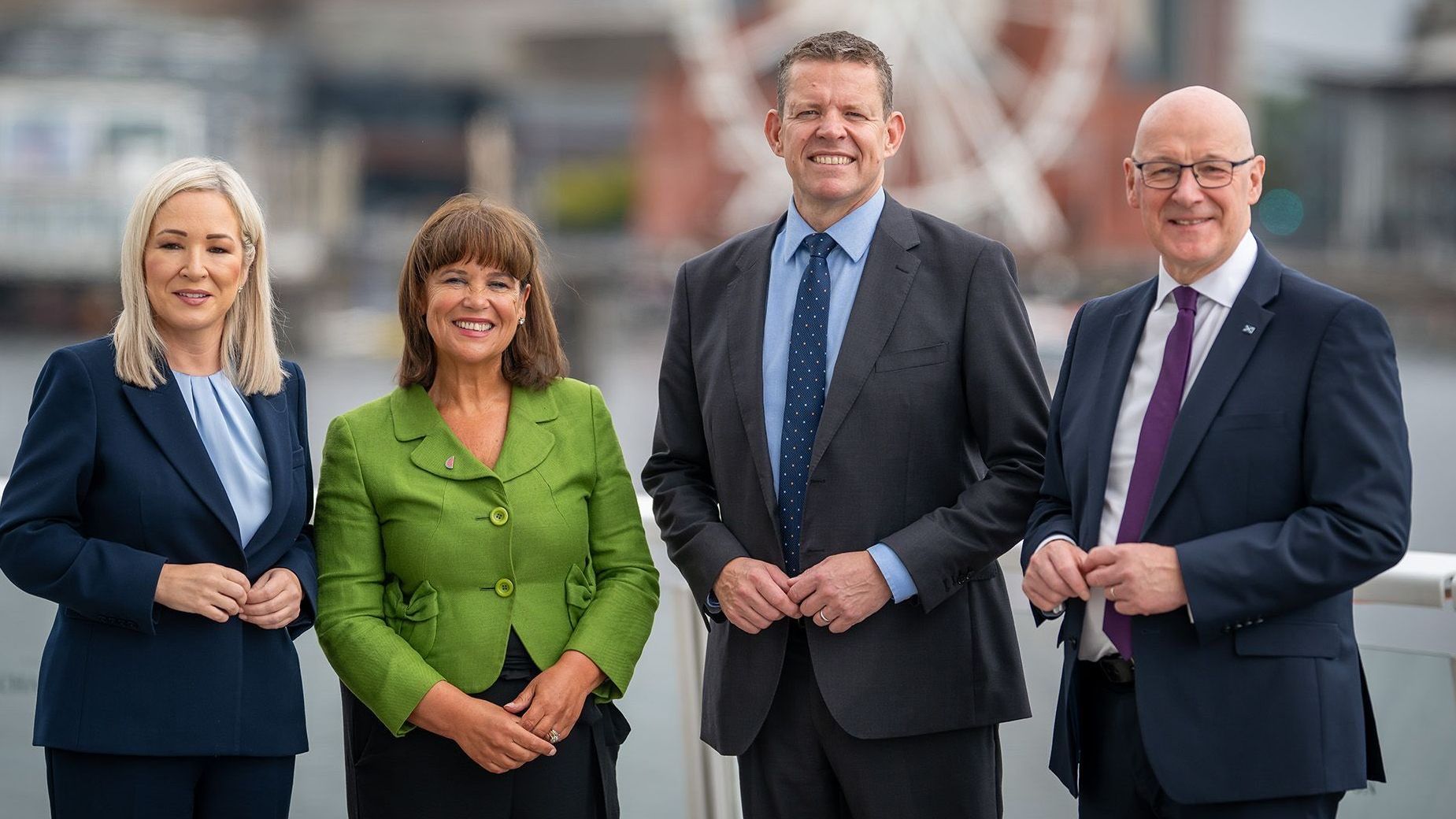
The demand for the unity referendums and for the conversation on a united Ireland received a further substantial boost on Monday when Uachtarán Shinn Féin Mary Lou McDonald and Leas Uachtarán Michelle O’Neill travelled to Cardiff for a meeting with Scotland’s First Minister and SNP leader John Swinney and Plaid Cymru leader Rhun ap Iorwerth.
This is a historic step by the leaders of the three nationalist and pro-independence parties in government in the North, in Scotland and in Wales. They came together in a shared desire to shape our future, free from British rule. As Mary Lou put it on Monday: “The future of Scotland is a matter for the people of Scotland. The future of Wales is a matter for the people of Wales. And the future of Ireland must be decided by the people of Ireland. For Ireland, that principle is not merely an aspiration. It is embedded in an international agreement endorsed overwhelmingly by the Irish people, North and South.”
However hard the British government seeks to downplay the demand for the unity referendums the fact remains that they have no veto over this. No British Prime Minister can take the desire for Irish unity off the table. The British have no discretion in respect of the unity referendums. Nor does anyone with a titter of wit believe that that decision is for the British Secretary of State for the North. It is above his pay grade. The decision on preparing for and facilitating the unity referendums is a matter for both governments.
Which brings us to the nub of the matter. Why should a British government facilitate unity referendums when An Taoiseach Micheál Martin has set his face against this? He has consistently refused to even consider planning for unity, a position that is at odds with his partner in government Fine Gael and all other parties in the Oireachtas, as well as many in his own party. As Fianna Fáil celebrates its centenary Mr Martin has turned his back on its founding aim of ending partition and reuniting the island of Ireland. He needs to correct this and play a leading part in this process.
The Good Friday Agreement will celebrate its thirtieth birthday in April 2028 – less than two years from now. Whatever challenges still exist around the power-sharing institutions, as unionists continue to fight a rearguard action against its potential, the future political direction of Ireland and our relationship with Britain is rooted in the implementation of the Good Friday Agreement.
This is the next phase in our political journey. It is about preparation and the Irish government has to play a leadership role in this. It must organise citizens’ assemblies or forums to bring together the expertise that will allow for citizens and communities, especially those within the northern unionist and protestant section of our people, to hold an informed debate on future change. They especially have to know what unity means for them, that their rights and sense of Britishness and identity will be protected and guaranteed in the new Ireland.
A fitting tribute to Kieran’s outstanding heroism
SEVERAL hundred former political prisoners gathered in Ionad Eileen Howell/St Comgall’s on Saturday for the launch of a new book – ‘Kieran Nugent – The First Blanketman’ – edited by Danny Morrison. It was an emotional event with former comrades recalling Kieran’s courage and heroism in the face of a brutal prison regime.
Kieran’s daughters Rae and Eileen and grandchildren Michael, John and Michael were present.
50 years ago, on September 14, 1976, Kieran was the first republican political prisoner to be sent to the H-Blocks. Britain’s criminalisation strategy was determined that republican prisoners would no longer be classified as political. That meant political prisoners wearing a criminal uniform and acquiescing to the prison regime.
When Kieran arrived at the prison he was handed a prison uniform to wear. He refused. He was alone, surrounded by a hostile and aggressive group of prison officers who demanded he strip. He refused. They attacked him. He was punched, kicked, forcibly stripped. As the screws were leaving the cell one of them threw a blanket at Kieran. So, as Kieran recalled later, that’s how the blanket protest started.
HONOURED: With Kieran's grandson Michael John; daughter Rae; daughter Eileen; Aleyna, Michael's girlfriend; and Michael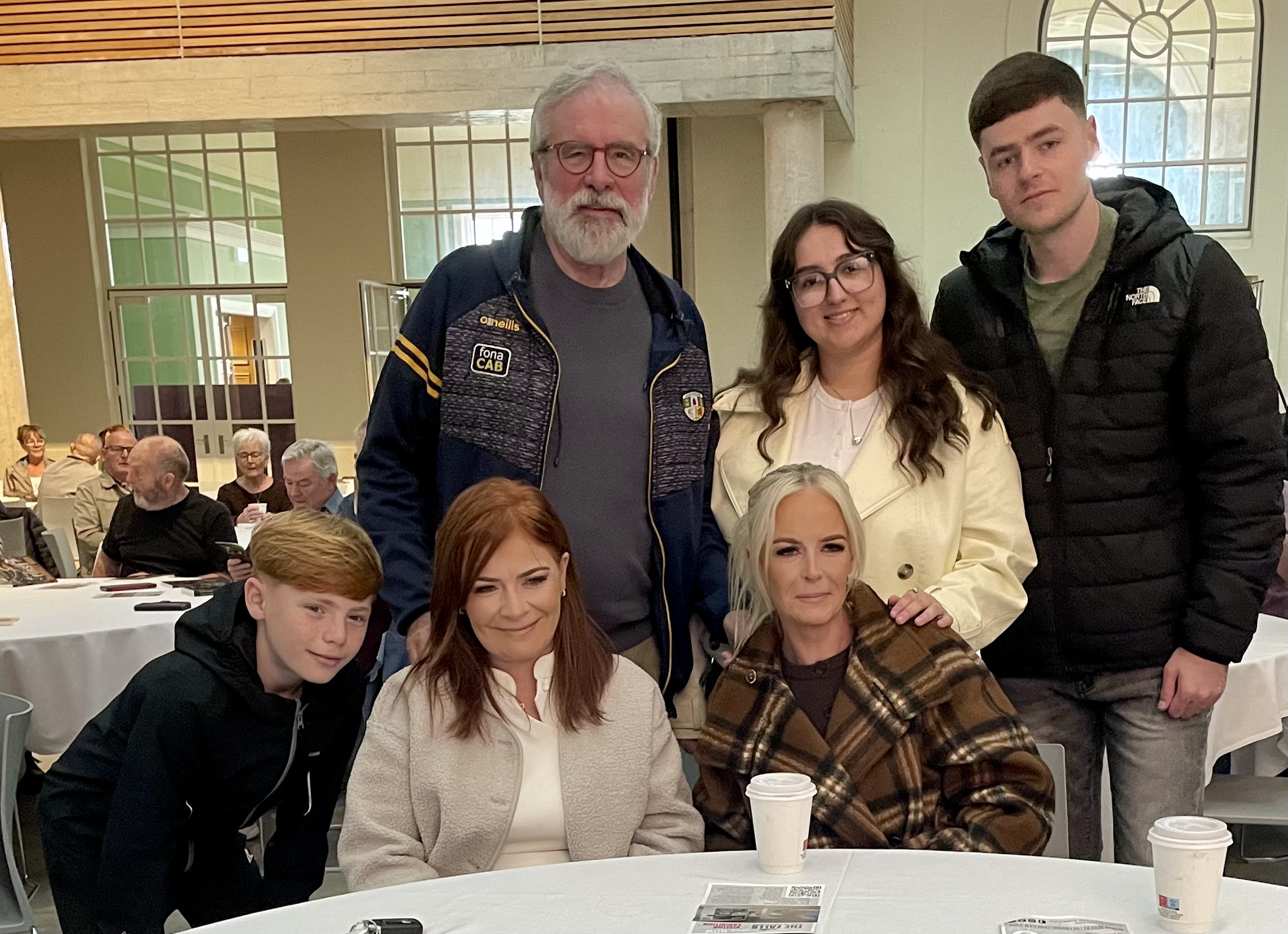

Several weeks later Tom Hartley, who was in charge of the party’s POW Department and office in Belfast, remembers Kieran’s parents, Margaret and Frank, arriving at the office. Kieran had gone missing. The family didn’t know where he was and neither did the POW office. The Brits were desperately trying to break him before his presence in the blocks would get out. They failed. The family took them to court and they had to reveal where Kieran was.
Kieran was the constant victim of abuse and violence by prison officers. Like his 387 comrades who were on the protest as he left in early 1979, Kieran had been denied reading material, a radio and all access to recreation time, and for most of his three years, to any fresh air or exercise. The prisoners were forcibly washed with deck scrubbers, hair sheared, and there were brutal mirror searches as the prison officers searched their anal passages.
‘Kieran Nugent - The First Blanketman’ recounts Kieran’s life, his incarceration, his activism as an IRA volunteer, and his hard work as a republican activist after his release, travelling across Ireland and the world telling people about the H-Block protest and then the hunger strikes. He was a remarkable, courageous and heroic activist. Kieran died on May 4, 2000, aged 41. A weekend of events was a fitting celebration of his life. Well done to the Falls Commemoration Committee and everyone involved, especially Kieran’s clann.
Kieran Nugent – The First Blanket Man is available at An Fhuiseog, 55 Bóthar na BFhál, online at anfhuiseog.ie/ and the Sinn Féin bookshop, 58 Parnell Square, Dublin.
It’s good to talk
LAST week I wrote in advance about participating in the Desmond Greaves Summer School. A packed Unite Trade Union Hall in Dublin on Sunday was the venue. The clár dealt with a number of important issues including a talk by Ray Bassett and me about the importance of the Good Friday Agreement.
I want to thank Anthony Coughlan, Kevin McCorry, Daltún Ó Ceallaigh and all of those who organised the 36th summer school for the invitation to take part.
The Agreement is, in my opinion, the most important political agreement of our time. The twists and turns from April 1998 have been many. However, despite these difficulties the Agreement has demonstrated how deep rooted conflicts can be resolved. It also provides a way forward to democratically and peacefully ending partition and achieving a united Ireland. Desmond Greaves would approve.
As I told the meeting: “The Good Friday Agreement needs to be part of a perpetual process of change. There will be many challenges ahead but there will also be many opportunities. I look forward to the future with hope and optimism.