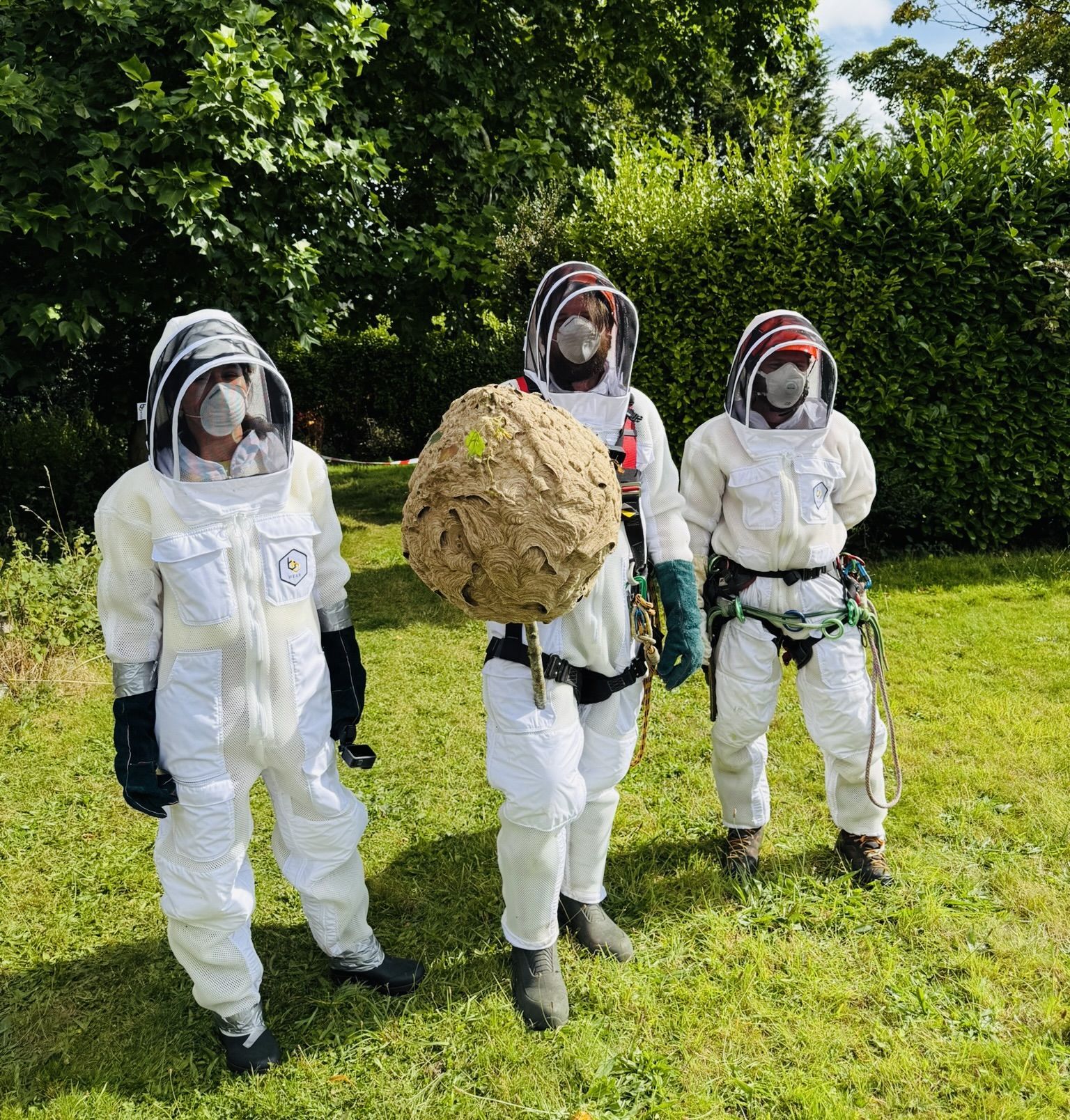
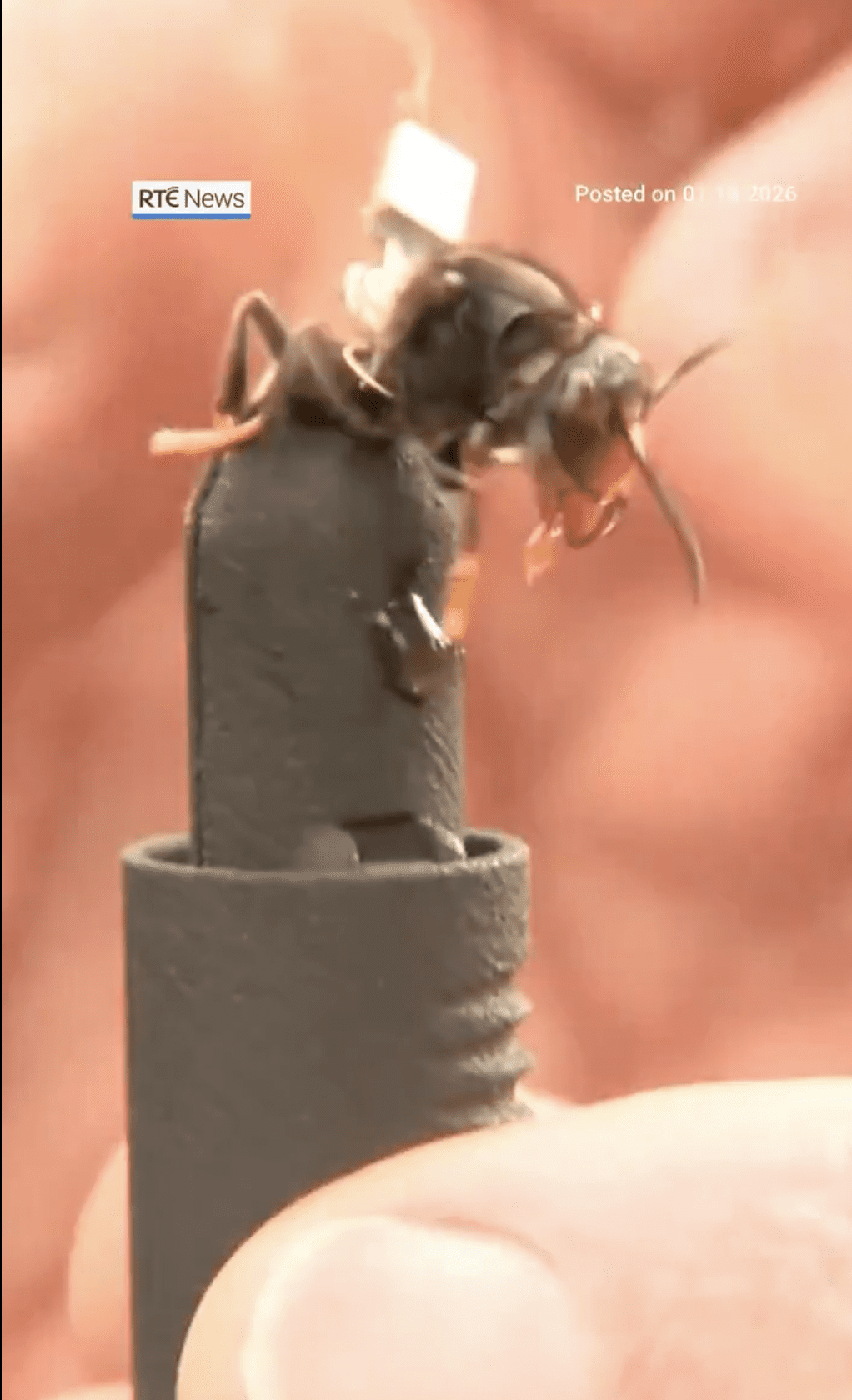
IT'S a scary image – terrifying even. These three experts are holding the massive nest of the deadly Asian hornet, which was discovered in Cork last week after a tiny tracker was placed on a single hornet that was spotted there.
The Asian hornet is deadly – but not to us, at least not directly. Its sting will hurt, and unless you’ve an allergy, you’ll recover.
But Asian hornets are deadly to bees. It’s like a predator from another dimension with superpowers that have no countermeasures. For native Irish bees, their whole race is facing imminent annihilation. As the terrifying Borg said on Star Trek, resistance is futile.
Nature is replete with power struggles, of course. Creatures kill and are killed themselves. Only the strongest or the wiliest or the best camouflaged survive. Isn’t the arrival of the Asian hornet just part of the natural process?

Not this time. The Asian hornet – the cornfhoiche Áiseach, which is like a big wasp with yellow legs – has escaped its native land and has discovered a paradise: a part of the world where it is supreme. It can kill at will because none of its prey saw it coming. They are totally defenceless and simply surrender their lives without a fight, defeated by a creature from what must seem like another planet.
Back in its native Asia, the bees were almost beaten, but then they discovered one ingenious countermeasure. And it takes massive effort. They surround a hornet and flap their wings so fast that raises the temperature so much that the hornet fries. It must have taken millennia of trial and effort to discover that one tactic. Irish bees have no such time.
Just like the Borg, Asian hornets are merciless. When they find a beehive, they’ll hover a foot from the entrance and snatch a returning bee. They don’t bother stinging it – that would be a waste of resources. Instead, they use their massive jaws to bite the bee’s head off, slice off its legs and turn the most succulent part into a moist meatball to carry back to their larvae.
And as soon as they get a kill, they are immediately replaced by another hovering killer. They can decapitate 40 bees a minute and destroy a whole hive in a few hours.

Ireland’s 100 species of bees (isn’t that a beautifully neat number?) – including our single honeybee species – would be toast. As would we, most likely. Experts say the human race would survive the extinction of bees, but not without taking huge losses from worldwide malnutrition, vitamin deficiencies and a domino extinction of countless wildflowers and the birds that feed on them.
So finding an Asian hornet’s nest like this one is a national emergency.
It’s the fourth one found so far – last year two were found in Cork and another in east Belfast. This latest one was by far the largest nest – and the worry is that with it being so late in the year, queen hornets may have matured. One nest can produce 300 queens, which leave, overwinter and set up their own hives.
Cork is thought to be a hotspot because the insects arrive at the port on ferries from the continent, having hitchhiked in containers or even luggage.
The hornet was accidentally brought to France in 2004 and since then tens of millions of euro have been spent trying to contain it.
This Irish nest has been handed over to scientists in the National Museum of Ireland, where it will be placed in a freezer for three weeks to ensure it’s harmless and then DNA tests will be carried out to show where the hornets came from. The report into the two in Cork last year said that, thankfully, neither had reached the reproductive phase.
One thing is certain – this will not be the last Asian hornet’s nest found in Ireland. Last week a single insect was confirmed in Dublin.
Now when Dúlra sees a wasp in the garden, he prays they don’t have yellow legs. This is a battle we can’t afford to lose.
* If you’ve seen or photographed anything interesting or have any nature questions, you can text Dúlra on 07801 414804.
Reader Ivan Cullen reports spotting a badger in Poleglass – and Dúlra’s not surprised, seeing it’s so close to Colin Glen and there are so many mature trees bordering the roads there. Poleglass is a wildlife haven and it’s always thrilling to see such big animals in an urban setting.