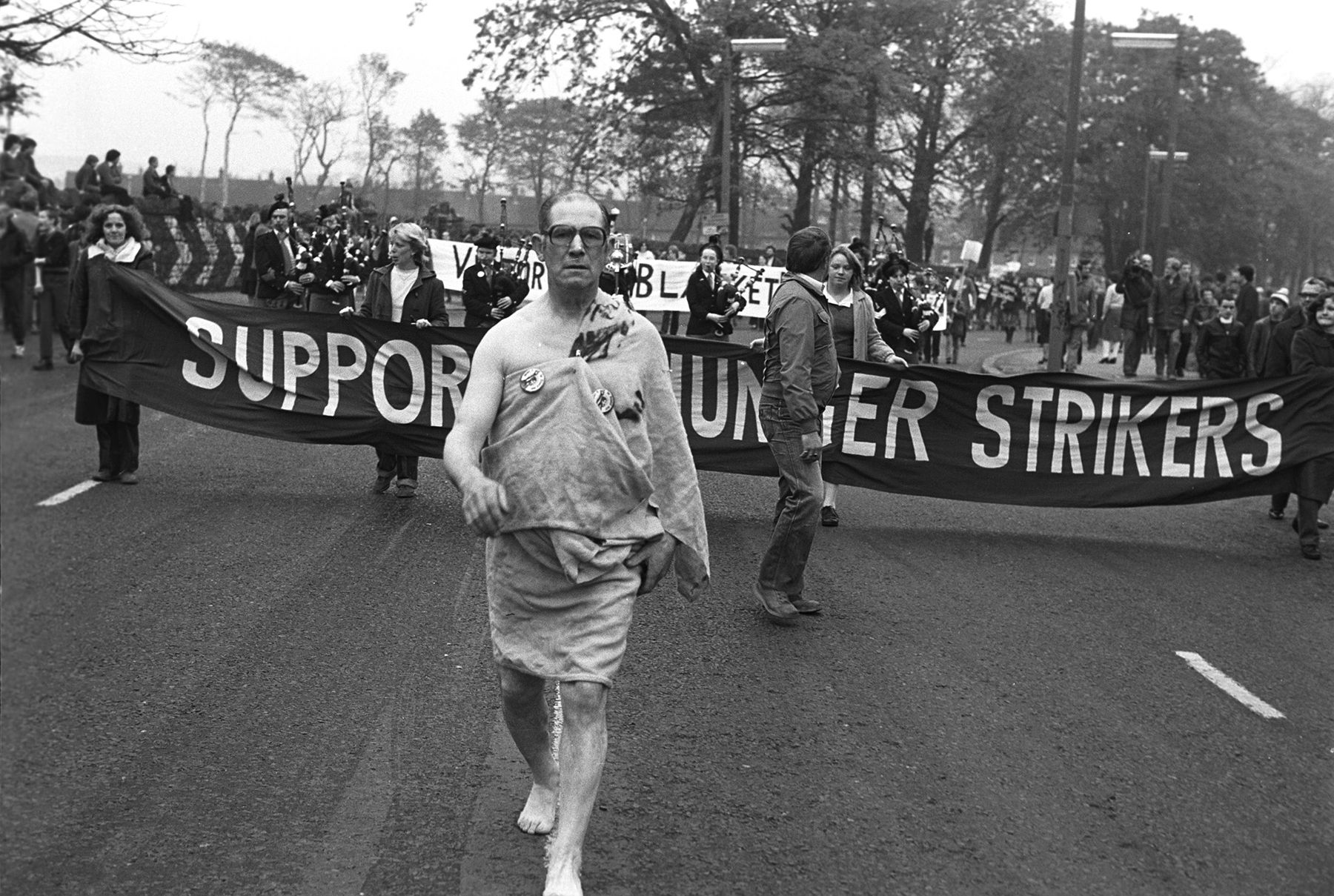
THIS Sunday the National Hunger Strike Commemoration will commence at 2.30pm in Ballina, County Mayo. The event will mark 45 years since the 1981 hunger strike in which ten men died. It will also remember all of those Irish republicans who died on hunger strike and especially the resolve and courage of three Mayo hunger strikers. Michael Gaughan (1974); Frank Stagg (1976); and Jack McNeela (1940).
Looking back five decades after the commencement of the blanket protest in September 1976 and the two hunger strikes that took place in 1980 and 1981, I remain awed by the tenacity and determination of those who endured five years of brutality, violence, deprivation and abuse in the H-Blocks and Armagh Women’s prison before embarking on that most challenging of all personal undertakings – the hunger strike.

I remember the lengthy discussions, via smuggled comms, about the pros and cons of embarking on hunger strike. The men and women in the H-Blocks and in Armagh Women’s Prison, were determined to proceed, believing that they had no other option.
They were under no illusions about its probable consequences both inside and outside of the prison. It was a high risk strategy.
In his contribution to ‘Hunger Strike’, a remarkable book of reflections on the hunger strike edited by Danny Morrison, writer Timothy O’Grady describes to the reader the mindset, the internal debate that someone contemplating hunger strike goes through as they come to a very difficult decision.
O’Grady writes: “A hunger striker fights, but not to kill or cause physical damage to others. Instead, he uses the slow ruin of his own body. A hunger striker exposes and clarifies. It is the ultimate act in a long process that takes in the politics of parliamentary democracy, street demonstrations, civil disobedience, boycotts, cultural nationalism and war itself. It declares that the combatant's own tortuous death is worth it in the making of a point.
“It is carried out in public – on the doorstep of the transgressor in the ancient world; in the media of the modern world. Everyone is invited to watch and to feel the hunger striker's painful disintegration. It can be worth it only if the point being made is about the violation of a principle. The principle of a hunger strike is always a principle of justice. It can have the power of revelation if the principle is perceived to be sufficiently fundamental.”
The 1981 hunger strike was about a principle of justice. And in that it succeeded. The demands of the hunger strikers were met and the criminalisation policy around which it was constructed failed. The hunger strike was a tipping point in modern Irish history which continues to resonate today.
It isn’t just about the strength of Sinn Féin North and South – it is also evidenced in the growing demand around Irish unity.
The self-sacrifice of the men and women who undertook the hunger strikes and those who died continue to inspire us. The writings they left and the words of those who survived also enthuse and encourage us as we advance toward the goal of Irish unity.
Laurence McKeown – Big Laurny – is one such former political prisoner, hunger striker and gifted writer. His second memoir ‘And Flowers Grew Up Through the Concrete’ is an account of his journey through imprisonment, hunger strike, brutality and growing self-awareness. It is beautifully written and unashamedly honest in its emotion. He concludes by remarking on the well- known quote by Bobby Sands: “Let our revenge be the laughter of our children.”
It is, he writes, “an amazing quote, written as it was while he was naked, malnourished, barefoot in a cell whose walls were covered in his own excrement. They are not harsh words. There is no bitterness in them. No call for vengeance. Quite the opposite. There is hope for laughter. The laughter of children of a new generation who thankfully would know nothing about internment, criminalisation, hunger strikes and armed conflict.”
Laurny is right and so too is Bobby.
And Flowers Grew Up Through the Concrete – A Prison Memoir, by Laurence McKeown
Available from Beyond the Pale, info@beyond thepalebooks.com
At An Fhuiseog 55 Falls Road.
Online at anfhuiseog.ie/
Traveller culture demands respect and recognition
THE Traveller community has contributed hugely to the preservation of Ireland’s native culture, particularly our music and song tradition. Christy Moore, among others, has always acknowledged and recognised this. In particular, the songs of John Reilly. The late Tom Munnelly did mighty work collecting and recording this aspect of our heritage. Now the Heritage Council has published Ireland’s first Traveller Heritage Strategy, setting out a national framework to support Traveller cultural heritage.
Developed over three years through a Traveller-led working group, and informed by national consultation with members of the Traveller community and other organisations, the Strategy responds to the need for long-term support for Traveller culture and heritage in Ireland.
The Strategy has six strategic commitments:
• Directing supported, dedicated funding to heritage projects within the Traveller community.
• Establishing a Traveller-led, high-level working group to address the urgent need to safe-guard Traveller language.
• Undertaking a scoping study to understand possible operational models for a National Centre for Traveller Heritage.
• A live web directory that facilitates ongoing access to the many extant and emerging Traveller heritage online repositories, projects and resources.
• A certification scheme to ensure heritage organisations, across all aspects of their operations, represent and respect Traveller heritage and the Traveller community.
• Establishing a Traveller-led oversight group that will oversee the delivery of the Strategy.
The publication of the Strategy follows the formal recognition of Irish Travellers as an ethnic minority by the Irish government in 2017 and marks an important step in acknowledging Traveller heritage as an intrinsic part of Ireland’s national identity and shared cultural landscape.
The vision set out in the Strategy is for an Ireland in which Traveller culture is fully respected, valued and supported as part of the nation’s diverse cultural fabric.
The launch of the Strategy, just ahead of National Heritage Week 2026, is timely. This year’s theme, Heritage at Risk, is encouraging communities to identify and explore heritage assets, traditions and practices that are vulnerable or under threat, from built, cultural and natural heritage, to folklore, language, traditional skills and local knowledge.
One cause close to this column – the Moore Street Preservation Trust – is participating in this year’s events.
National Heritage Week was August 15 to 23 and is Ireland’s largest community-led celebration of heritage. Now in its 26th year, the festival attracts almost 500,000 attendees each year and featured more than 2,500 events nationwide last year, providing a national platform for communities, volunteers, local organisations and heritage champions to share and protect Ireland’s heritage for future generations.
Virginia Teehan, Chief Executive of the Heritage Council, said: “The ambition of this Strategy reflects how seriously we take this responsibility. It is not simply an expression of intent, but a practical plan backed by a workplan and resources. On behalf of the Heritage Council, I welcome its publication and look forward to working with Traveller communities and organisations to strengthen support in the years ahead.”
Travellers are often subjected to discrimination. Most of this is based on ignorance. The fact is Traveller story tellers and musicians have long been custodians of our folklore and traditional music. Traveller tinsmiths and craftspeople developed skills in making, mending and recycling that were vital to past generations.
This column says good luck and thanks to all involved in this important work to preserve and promote Traveller culture.
See the Strategy at paveepoint.ie/first-traveller-heritage-strategy/
Eithne Vallely
A FEW weeks ago I wrote a piece for this column – The Little Lost Bird and the Blue Butterfly – about an art exhibition in Féile an Phobail by John B. Vallely, a renowned artist from Armagh City. His exhibition focused on the children killed at Wounded Knee by the US army in 1890 and the Israeli genocide in Gaza in which over 20,000 Palestinian children have been murdered.
Sadly, Brian’s wife Eithne was killed last Friday morning in a road accident. Eithne was a well-known and popular traditional musician and teacher. Along with her husband she founded the Armagh Pipers Club in 1966. She was an outstanding Irishwoman.
I want to extend my deepest condolences to Brian, to their children, grandchildren and the wider Vallely clan. Ar dheis Dé go raibh a hanam.
The Chieftain’s Walk
On Sunday, September 13 the Chieftain’s Walk in Derry in memory of Martin McGuinness will take place. All money raised goes to charitable causes. Sign up and take part. I will return to this in next week’s column with more details.