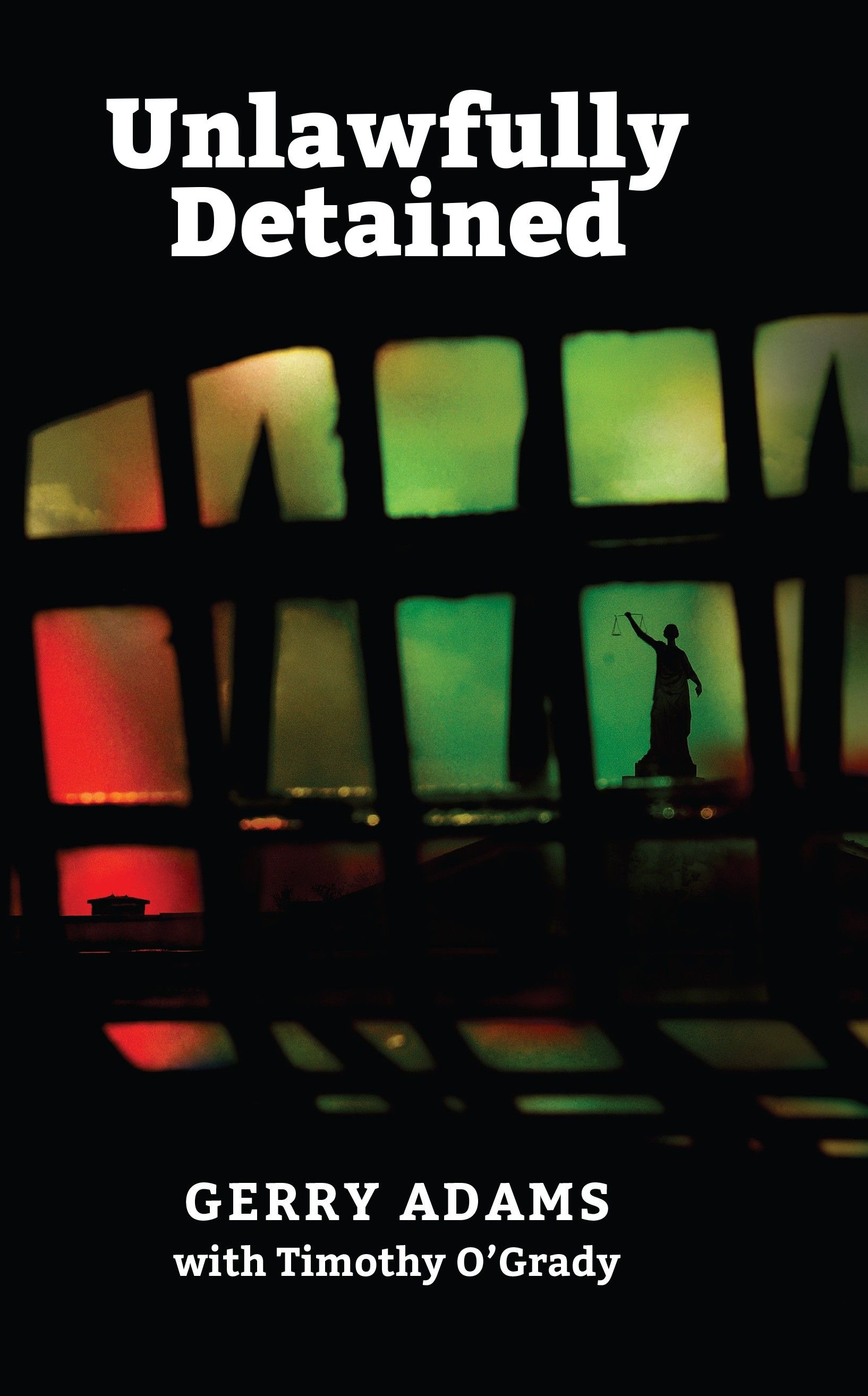
MY new book – Unlawfully Detained – written with Timothy O’Grady, will be launched by Ronan Bennett on Saturday, November 28, in Ionad Eileen Howell/St Comgall’s at 12.45pm. Published by Greenisland Press it deals in part with my successful legal challenge in the British Supreme Court in 2020, against convictions I received for attempting to escape from internment in the 1970s.
But the book also looks at the role of the law – of British law – in Ireland over the centuries which was integral to its colonisation process and the subjugation of the Irish people.
British General Frank Kitson put it well when he wrote: “The law should be used as just another weapon in the government’s arsenal, in which case it becomes little more than a propaganda cover for the disposal of unwanted members of the public.”

Jack Warshaw’s song ‘No Time For Love’ puts it better:
You call it the law, we call it apartheid, internment, conscription, partition and silence.
It’s the law that they make to keep you and me where they think we belong.
This is what underpinned British military incursions across the world, in India, in Kenya, Ireland, the Middle East, Malaya, Aden, Cyprus, and a host of others and more recently in Iraq and Afghanistan. The law of conquest and terror.
Unlawfully Detained will go on sale from November 28. More details later.
Narrow Water project is a bridge to a bright future
JUST outside Warrenpoint on the northern side of Carlingford Lough the Newry River narrows substantially and it is at this point – aptly named Narrow Water – that the work on building a bridge has been well under way for the last two years. Recently, decking and pylons for the bridge arrived from Belgium. When completed the bridge will be 195 metres long and will allow for vehicles, cycle and pedestrian traffic. It will provide a vital link between the Cooley Peninsula and County Louth in the South and the Mourne Mountains and South Down in the North.
TÚS MAITH: Then Taoiseach Simon Harris at the beginning of work on the Narrow Water bridge across Carlingford Lough in 2024

When I was elected as TD for County Louth in February 2011, I met many of the community activists and local Sinn Féin members, like Arthur Morgan, who had been involved in promoting the construction of a Narrow Water Bridge from at least the mid-1970s.Some people in Down and Louth have campaigned for even longer than this.
Sinn Féin passed motions at the Ard Fheis in 2009 pledging support for the Narrow Water bridge and in 2011 we set up a cross border working group, met with Ministers North and South and with the East Border Region Group.
Along with the Narrow Water Bridge Community Network and the various Chambers of Commerce from this region, we embarked on a renewed effort to have the bridge built. There was and remains, widespread public support for the project. The lobbying involved extensive conversations with the European Union, its institutions, the Irish government, and the Executive in the North. I raised the project many times in the Dáil with successive Taoisigh and government Ministers, and discussed the project with Louth County Council and representatives of Newry and Mourne Council.
In October 2012 the bridge received planning permission for the northern section of the construction, and An Bord Pleanála gave planning permission for the southern leg. Louth County Council applied for funding under the INTERREG IV A programme and Sinn Féin and others supported this. Later the Narrow Water bridge was included in the Irish government’s 2016-2021 Capital Investment Plan and on one occasion an Oireachtas Jobs, Enterprise and Innovation committee concluded that it was essential to the economic development of the region. However, without a firm commitment by the Irish government to funding the bridge remained an aspiration.
Nonetheless, Sinn Féin, local councillors and other representatives from all of the main parties and the Narrow Water Bridge Community Network refused to give up. The lobbying continued and in 2021 it was finally announced that the Shared Island Unit would fund the bridge.
Those local stalwarts, community and business and political representatives on both sides of the border deserve our comhghairdeas for their unswerving determination and commitment over many years. The Narrow Water Bridge makes economic as well as community sense for the people who live on both sides of the Newry River and Carlingford Bay. It will enhance community and business connections and provide a vital piece of tourism infrastructure.
So well done to all involved. Le cuidiú Dé, I look forward to walking across the Narrow Water Bridge on its completion in 2028.
Gaza exposé
ALMOST two million Palestinians in the Gaza Strip continue to fight a daily battle for shelter, for heat, for safety and for food. The United Nations Relief and Works Agency for Palestine Refugees in the Near East (UNRWA) has reported that 94 per cent of the population need shelter assistance and essential non-food items. A Water, Sanitation and Hygiene (WASH) Cluster survey completed in September found that 84 per cent of Gaza’s population experienced frequent, unpredictable disruptions in access to safe, clean and reliable water for drinking, cooking and hygiene.
To add to this crisis, on Saturday the first storm of the winter wrought devastation on thousands of Palestinian families surviving amidst the rubble of Gaza. Thousands of tents sheltering displaced families were flooded and many were forced to abandon their meagre shelters. Families were reduced to using pots and pans to try and clear water from inside their flooded tents.
Other families living in buildings, already extensively damaged by Israeli bombs, are at risk as these buildings face collapse as a result of the heavy rain. Families, especially children, are soaked to the skin from the rain and have no means of drying clothes. And all the time Israel continues its attacks on the civilian population and is refusing to allow desperately needed humanitarian supplies into Gaza.
UNRWA’s ‘winterisation response’ is under way. It has teams of activists working hard to clean manholes, gullies and drainage networks, identify high-risk locations, inspect available equipment and put preventive measures in place, including sandbags in flood-prone areas.
However, as the weekend demonstrated, these efforts are seriously curtailed because many pumps needed to combat flooding are not functioning due to Israel’s blockade on items like engine oil and spare parts, and it refuses to allow heavy machinery into Gaza.
The United Nations Office for the Coordination of Humanitarian Affairs (OCHA), published a damning report on the situation in the West Bank and Gaza last week. It is a frightening exposé of the inhumanity of the Israeli apartheid regime and of the failure of many within the international community to demand action against Israel. I urge you to read it.
Humanitarian Situation Report | 5 November 2026 | United Nations Office for the Coordination of Humanitarian Affairs - Occupied Palestinian Territory
In recent days the Norwegian Refugee Council warned restrictions by Israel on the entry into Gaza of shelter materials as well as funding shortfalls were “likely to leave 1.65 million people facing a fourth winter in worn-out tents and war-damaged buildings.”
The Gaza Strip for many years was described as the biggest open-air prison in the world, but today it is the biggest-ever concentration camp in which families live in abject poverty, hungry and cold. Frustration and anger at this appalling situation, and the failure of the European Union and others to take a firm stand against Israel, cannot be allowed to distract from the essential work of supporting the Palestinian people and their right to self-determination.
Saffron lore
MY thanks to all those who organized a great night in St Mary’s University College last Friday to remember and celebrate Antrim’s great football teams from the 1920s to the 1940s. In particular, the 1946 senior football team. The presence of many family members of players of that era and their recollections was a very special element of the event.
Dónal Mac Anallen’s talk and power-point presentation was outstanding. Dónal is a human library. Full of facts and figures. And amusing observations. I learned a lot about the early days of Gaeldom in our county. So too with the great work of Hugh McGettigan. Hugh has produced a souvenir programme to accompany Dónal’s talk.
If your club doesn’t have copies, get some and distribute them. I whole heartedly recommend it.
Angela Feeney gave us a few songs. Paul McErlean was an outstanding fear an tí and there was a great input from the audience. Well done to all involved, including Seamus McMullen and the County Board. A great initiative. Now for a similar project about the hurlers and the camógs. And our handballers.
Over to you, Hugh, agus do chairde.
Míle buíochas.