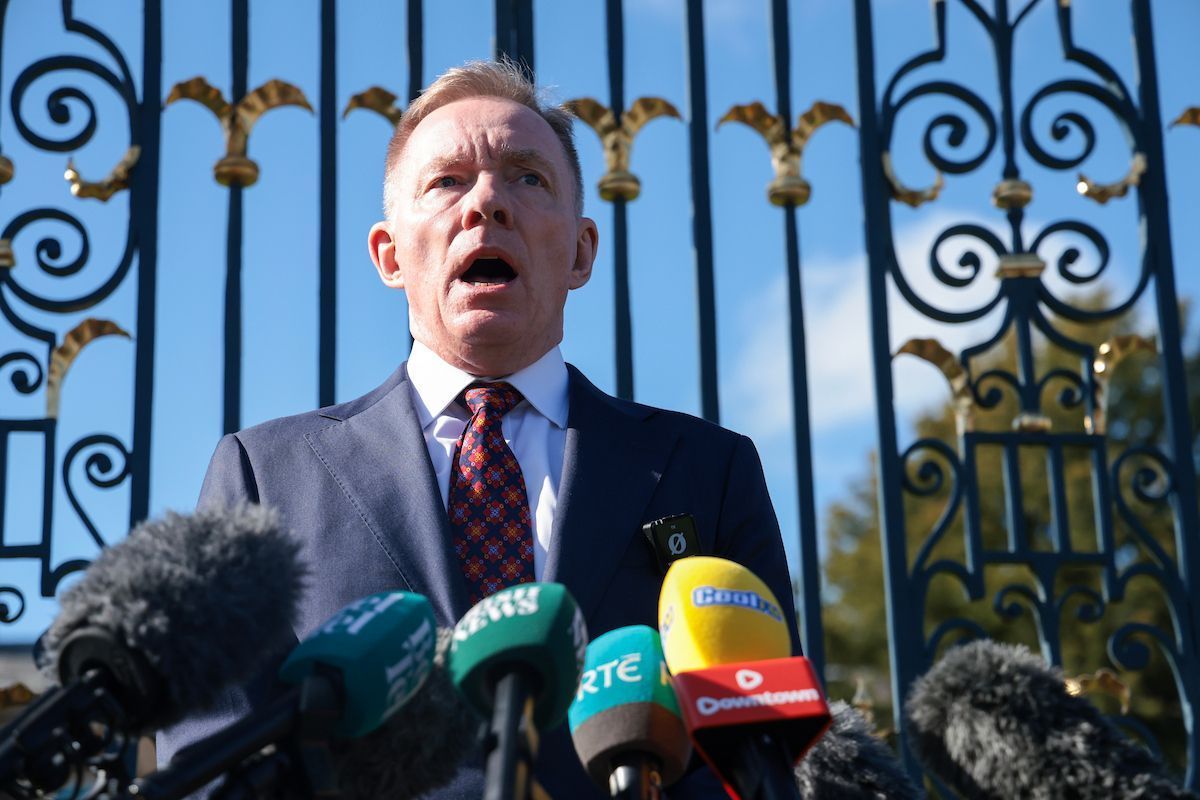
THE first British Secretary of State to be appointed to the North was William Whitelaw, who took office on March 24, 1972. He’s been followed by 25 more, many of whom I met as a result of the peace process. The current holder is Chris Bryant. Most of the 26 had no idea about the North. Some had no real interest in the place other than as a stepping stone to somewhere else. All were reliant for advice and guidance on the Northern Ireland Office – Britain’s colonial administration for the North and notoriously pro-military and unionist. Their priority was and is to promote British national interest and they were and are at all-times subservient to the whims of whoever lives in 10 Downing St.
Chris Bryant spent a lot of time last week refusing to spell out what are the factors that will persuade him to call the unity referendum promised in the Good Friday Agreement.
His refusal rests on the clause in the Agreement that a ‘border poll’ will only be called by the British Secretary of State “if at any time it appears likely to him that a majority of those voting would express a wish that Northern Ireland should cease to be part of the United Kingdom and form part of a united Ireland.” Pressed by one interviewer on the issue of the criteria, Bryant repeatedly said: “When it appears likely.” And he claimed that the call is at “my discretion.”

At the same time, he told RTÉ’s Morning Ireland programme that “it is for the people of Northern Ireland to decide their future.”
How can they do that when he blocks the referendum? Mr. Bryant also quite arrogantly rejects the Irish government having a say in this process, despite the fact that two referendums, North and South, are required and that the Agreement constantly references the role of the Irish government in facilitating and legislating for this process.
The reality is that contrary to Mr Bryant’s assertions he and whoever follows him is merely an enabler in this process. The decision to hold the referendum is above his pay grade.
It will be a decision for both governments to make and will be a whole-of-government decision in both jurisdictions.
So chasing the British government to spell out the criteria is a distraction. It may be useful to make the general point that London is failing in its responsibility to fully implement the Good Friday Agreement. But the decision to call the referendums will be a political decision. And it will be taken in Downing Street and Government Buildings in Dublin, not in Hillsborough Castle.
It is also a fact that the Irish and British governments are co-guarantors of the Agreement. They have an obligation to implement its provisions – including the unity referendum provisions. However, neither government wants the unity referendums at this time. An Taoiseach, Micheál Martin, has set out his position on this. For its part, the British government is not neutral in the discussion on Irish unity. It is a unionist government. Consequently, it will not decide to hold the referendums unless it is pressed to do so by the Irish government. And the current Irish government is unlikely to do this unless persuaded by an overwhelming demand from within the island of Ireland, from the Irish diaspora, and from the international community. Recent initiatives by the two main parties of government are welcome but they have much more to do to fulfil their obligations.
So, we have to increase the campaign for unity. That is the next phase in our political journey. It’s about encouraging the dialogue needed to address all of the issues involved. The recent shifts in the Fine Gael and Fianna Fáil positions on preparing for unity are evidence of the success already of this strategy. We now have to find more allies in Ireland, in Britain, in Europe, in North America and internationally who will support this endeavour. It is also about united Irelanders consciously and deliberately engaging at every opportunity with our unionist and Protestant neighbours to persuade them that their self-interests lie in Irish unity.
The unity referendums are not a concession to be gifted to the people of Ireland by Chris Bryant or by any English politician. They are a legal entitlement enshrined in the Good Friday Agreement.
Dublin coalition defying the people on the triple lock
ON Saturday thousands of people marched through Dublin city centre in defence of Irish neutrality and in protest at the effort by the Irish government to end the ‘triple lock’ protection. Under this provision the triple lock states that no more than 12 Irish soldiers can be sent into a battle zone. Sending more requires the permission of the government, of the Dáil and must be part of a mandate from the Security Council of the United Nations – the triple lock.
In the bitter debate that has raged on this issue in recent weeks it has been pointed out that in 2013 Micheál Martin told the Dáil that the triple lock was “at the core of our neutrality”. He said the push to weaken it was part of a wider effort by a wing of Fine Gael to erode neutrality. He stated unequivocally: “My party and I completely reject this.” In 2002, ahead of the second Nice referendum, a previous Fianna Fáil leader and Taoiseach, Brian Cowen, assured the Dáil that there would be no change to the triple lock unless the people first gave their assent in a referendum.
DEMO: Thousands marched in Dublin to keep the triple lock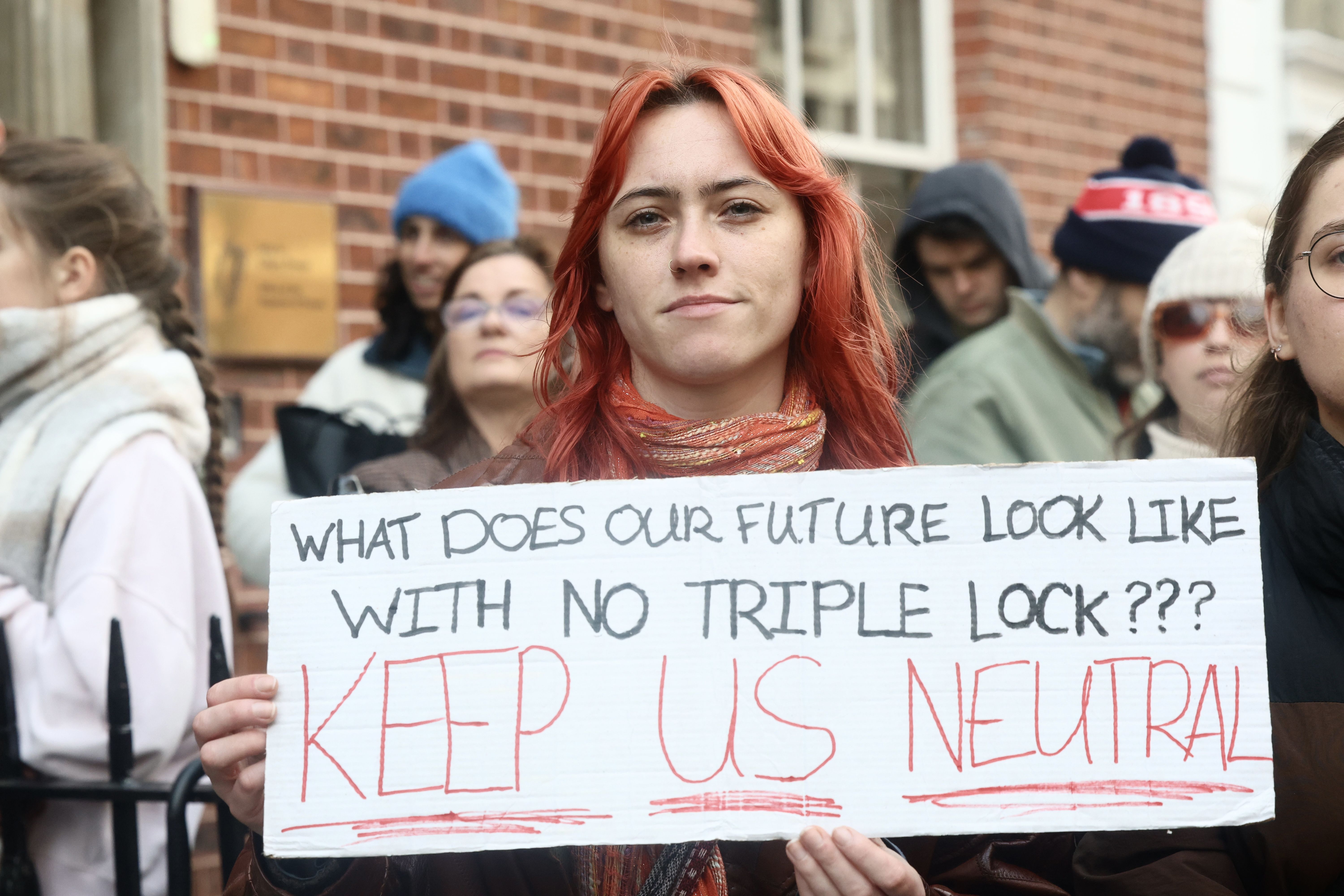

Micheál Martin has upended this and now seeks to drive a coach and horses through neutrality.
Last month the Irish government proposed an amendment that would remove the United Nations element of the triple lock, meaning that a government with a majority could deploy Irish troops into any conflict situation, anywhere in the world.
All of the opposition parties in the Oireachtas are opposed to this proposal. Last week a Sinn Féin motion in defence of the triple lock was narrowly defeated by the government – 84 votes to 77.
The anger at the government’s stance saw every opposition party participate in last Sunday’s march, organised by the Irish Neutrality League. At least 10 Fianna Fáil TDs are proposing amendments to the Bill and 224 amendments in total have been proposed for discussion in the committee stage, which begins this week.
All of this is taking place in an increasingly violent and toxic world with wars and political instability evident in many places. In addition, many states, as well as the European Union, are allocating billions to the buying of new and more deadly weapons.
To allow an Irish government alone to take the decision on where Irish troops might be deployed is dangerous and threatens the decades-long neutrality position. Any decision on the triple lock has to be for the people to decide. Last year a poll by Ireland Thinks revealed that 75 per cent of people favoured neutrality. There was no public appetite to change this.
The future of Irish neutrality is too important for the decision to be left to the government parties. It is also too important to be rushed through by Christmas, which is the government’s intention. There must be a referendum. The people must decide.
Solidarity Day
NEXT Sunday, November 29, is International Day of Solidarity with the Palestinian People. It is observed annually and was first observed in 1978. The day provides an opportunity for international attention on the rights of the people of Palestine, as well as on the ongoing genocide in the Gaza Strip and the daily violent oppression of the people of the West Bank.
As we give expression to our solidarity, it is important that we understand the human cost of Israeli aggression. On Saturday Israel killed four Palestinians and wounded 17, including three in a vehicle distributing meals to displaced families. These are the latest victims of genocide.
• 74,702 Palestinians have been killed and 176,105 wounded.
• Israeli occupation forces have committed 6,233 ceasefire violations in Gaza since the ceasefire agreement in October 2025.
• 1,650 Palestinians have been killed during the so-called ceasefire, while 5,975 have been wounded.
• Israel has only allowed a third of the aid trucks to enter Gaza.
• Palestinians, many of them children, are starving, and cold and are living in flooded tents.
Oppose the genocide. Support the people of Palestine.