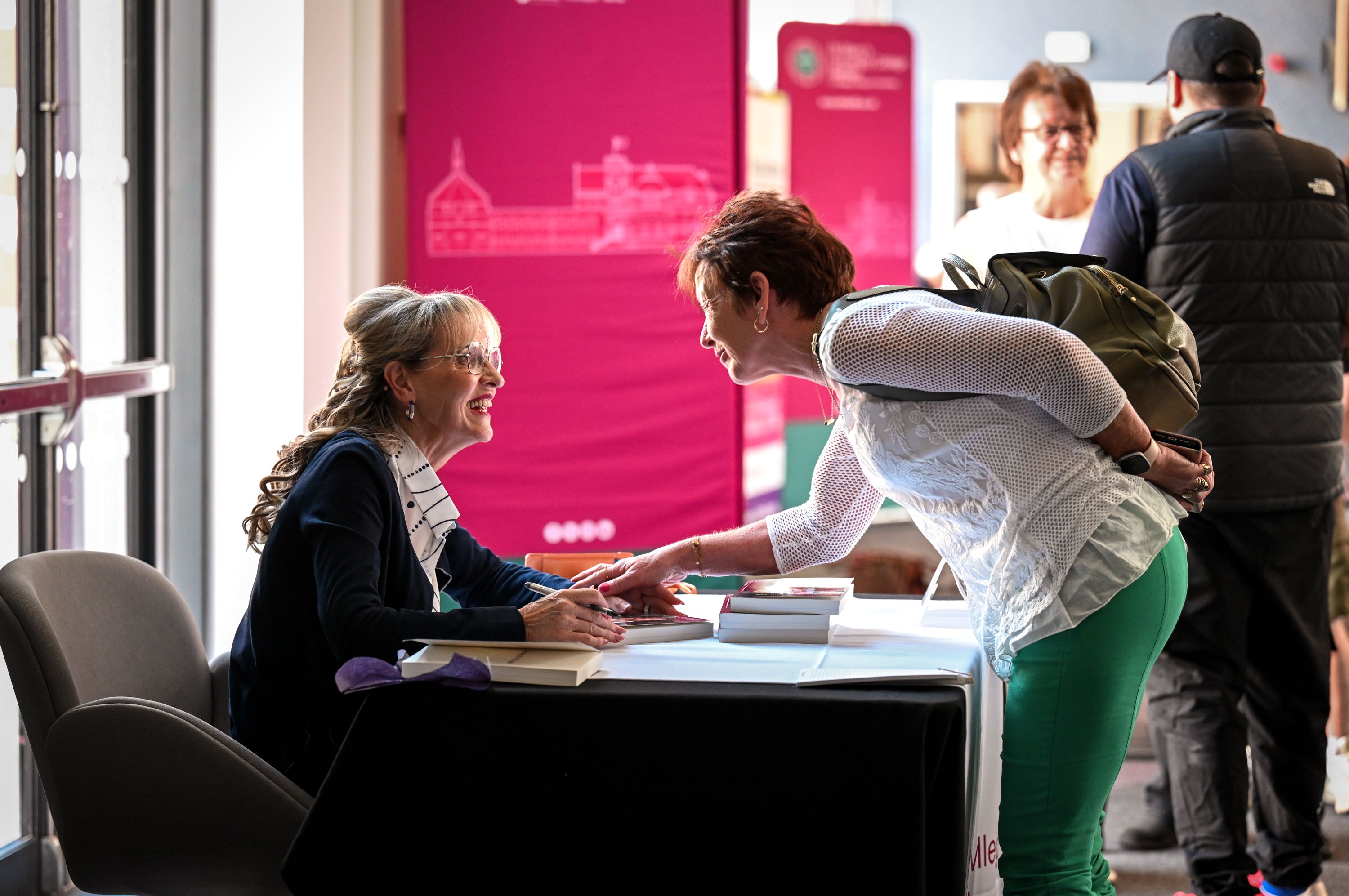
ON Saturday a packed St Mary’s gave a huge welcome to Martina Anderson, who was launching her personal and hugely important autobiography – ‘Choosing the Struggle’.
This is an honest and heartfelt account of Martina growing up in Derry, her experience of poverty, witnessing the excesses of the British army and RUC, the injustice of the northern state and deciding to take a stand against these by joining the Irish Republican Army.
It is wonderfully well-written with her description of her arrest and imprisonment in England, and of the conditions in which she and her friend and comrade Ella O’Dwyer were held – a reminder of the terrible conditions that Irish POWs endured.
Martina’s account of her decision to seek a termination of a pregnancy and of the years of brutal strip searches are deeply personal and moving. Her experiences with Ella in Durham Prison are especially shocking.

Martina sees herself as an activist – in whatever area of struggle she is engaged. She is an Irish republican who believes that the future of the island of Ireland lies in securing our right to self-determination and unity.
As an MEP she played a leadership role in the campaign to defend the Good Friday Agreement and force the then Irish government of Enda Kenny to challenge the British government following the disastrous Brexit referendum vote. And she led the diplomatic offensive to secure a special drsignated status for the North.
As her friend Eibhlín Glenholmes writes in the foreword: “This book is also threaded in her love stories. A love for her husband Paul, of the indefatigable Anderson family, of her people, of her comrades, of the future New Irelanders who will reap what she and other women have sown – the seeds of a just and equitable society where every voice is heard.”
Well said, Eibhlín.
And well done, Martina.
Choosing the Struggle is published by Beyond the Pale Books. It is available through An Fhuiseog, 55 Falls Road and online at sinnfeinbookshop.com/
Spooks are thriving – and moving with the times
EFFORTS by the PSNI and MI5 to monitor the calls of journalists have been in the news lately. Both were ordered to pay compensation to BBC journalist Vincent Kearney while on Spotlight former BBC reporter Brian Rowan revealed that his calls were part of a surveillance operation by the PSNI. Both cases have drawn attention again to the use and abuse of surveillance by British state agencies in the North.
Republicans were often the target of this kind of behaviour. For example, as the Sinn Féin delegation walked into crucial talks at Leeds Castle in England in September 2004, several of us carried a five-foot-long listening device that had been uncovered in Connolly House in West Belfast. A week earlier another device had been found in a flat belonging to a member of my constituency staff.
Irish republicans have long been targeted by the British state as part of their counter-insurgency strategies. Homes have been bugged, phones tapped, and movements monitored and noted. One of the most infamous examples of this was in December 1999 when the British bugged a vehicle Martin McGuinness and I were using during crucial meetings with the IRA.
That such actions were being undertaken during critical moments in the peace process was a serious act of bad faith by the British government.
Under the repressive laws still available to them, British state forces had widespread powers to stop, question, and search vehicles and passengers at hundreds of permanent and temporary checkpoints.
Millions of vehicles were stopped and most of these were in nationalist areas. In addition, the British army would regularly carry out what they called census raids on homes. They would record the names of those in the household, as well as apparently innocuous information such as the type of furniture, number of rooms and design of wallpaper.
Today, advances in technology have created a surveillance system that goes well beyond anything the spooks had available to them during the decades of conflict in the North. The use of drones and artificial intelligence-powered facial recognition technology is now widespread.
In Gaza and the West Bank they are an integral part of the Israeli state’s genocidal campaign against the Palestinian people.
In May 2019 the United Nation’s Human Rights Council published a report by its Special Rapporteur on the ‘Promotion and Protection of the Right to Freedom of Opinion and Expression’. Its concern was that the “surveillance of individuals – often journalists, activists, opposition figures, critics and others exercising their right to freedom of expression – has been shown to lead to arbitrary detention, sometimes to torture and possibly to extrajudicial killings.
Such surveillance has thrived amid weak controls on exports and transfers of technology to governments with well-known policies of repression.”
However, in the seven years since then the effort to protect human rights and to prevent these new technologies from being abused has been largely unsuccessful. This means that the British security system and those of most other industrialised states, have at their disposal information on every single person. No-one is immune from this surveillance network. Global companies and criminal gangs are increasingly using AI, social media and the internet – the latter to con citizens out of their savings.
In 1949 George Orwell published his dystopian masterpiece, ‘Nineteen Eighty-Four’, which describes a world dominated by mass surveillance, manipulation of public opinion and totalitarianism. The threat to the future from today’s exploitation of new technologies is not that far removed from Orwell’s vision and should not be underestimated.
Vital voices
ÁRAS Uí Chonghaile was packed to capacity on Tuesday for the launch of ‘Women's Voices, Hopes for the Future’, a new book published by Sinn Féin's Commission on the Future of Ireland, edited by Grace McDermott and Aoife Ferguson.
Uachtarán Shinn Féin Mary Lou McDonald praised the 62 women who contributed to the book, which was, she said, an “important opportunity to bring women's voices from the margins to the centre of the conversation about Ireland's future.”
The focus of Women's Voices, Hopes for the Future is the new Ireland. What kind of future Ireland do women envisage? The book is a contribution to this conversation and seeks to amplify the diverse voices of women and girls across Ireland and the diaspora.
Women have been in the leadership of the struggle for Irish freedom and self-determination. They have been champions for change. Women like Mary Ann McCracken and Winnie Carnie, Constance Markievicz and Máire Drumm, Mairead Farrell and too many others to name. This book challenges all of us to imagine a future that is more equal, more inclusive and more representative of all who share this island.
I want to thank all of the women who contributed to the book and when a book signing takes place in your area I would encourage you to get this remarkable book which is full of new ideas, great ideas, for the new Ireland.
Women’s Voices is available through An Fhuiseog, 55 Falls Road, and online at sinnfeinbookshop.com/
The book will also be launched at the Derry Féile by Leas Uachtarán Shinn Féin Michelle O’Neill in Cultúrlann Uí Chanáin, Derry, on August 12 at 2.30pm.
More details and other launches will be announced soon
RIP Mary
LAST Friday I travelled to Carraig Airt in North Donegal to join my friend and comrade Pat Doherty as he buried his wife Mary. I knew Mary well. She was originally from Mayo and met Pat in the early 1960s in the Gorbals in Glasgow. They married in 1967 and would have celebrated 59 years together next week.
Pat and Mary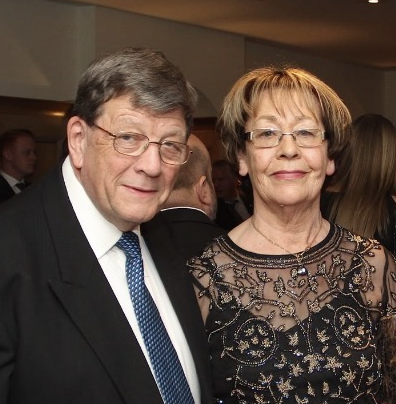

As Uachtarán Shinn Féin Mary Lou McDonald said in her oration, Mary was “unique, brave, irreplaceable. She was fierce. She stood her ground. Stood by her beliefs. By her friends. And she loved her family ferociously.”
Mary and Pat arrived back in Ireland as the Civil Rights campaign grew into mass street protests across the North and just a year before British soldiers were sent on to those same streets. Together they took a stand against the prejudice, discrimination and oppression they witnessed in the North. Thus began a lifetime of activism in the republican struggle.
Pat contested his first general election in 1989 and then three European elections for Sinn Féin. He became an MLA in 1998. In 2001 Pat became Sinn Féin MP for West Tyrone. Mary was at the heart of each of those campaigns.
I want to extend my deep condolences to Mary’s children: Maria, Rosaleen, Kathleen Anne, Danny and Michael. And to her grandchildren: Aoife, Ultán, Daithí, Ruairí, Aoise, Dearbhla, Laoise, Pádraig, Óonagh, Daniel, Mikey and little Gracie.