“I would like to make my mind clear as to the exact relationship between ourselves and the Northern Government. I understand the Belfast station, like all our other stations, is ultimately responsible to the British Government for its actions and that it has no actual responsibilities towards the Northern Irish Government. Nevertheless I am sure that our position here will be strengthened immensely if we can persuade the Northern Government to look upon us as their mouthpiece.”
So spoke George Beadle, the first bigot to head up the BBC after its Northern outpost was founded in 1924.
No surprise then that the British Broadcasting Corporation in the North decided to ban the Irish language from the airwaves - not so much as a Dia Duit or an Oíche Mhaith was to pass the mouth of a Beeb broadcaster from 1924 right up to 1981.

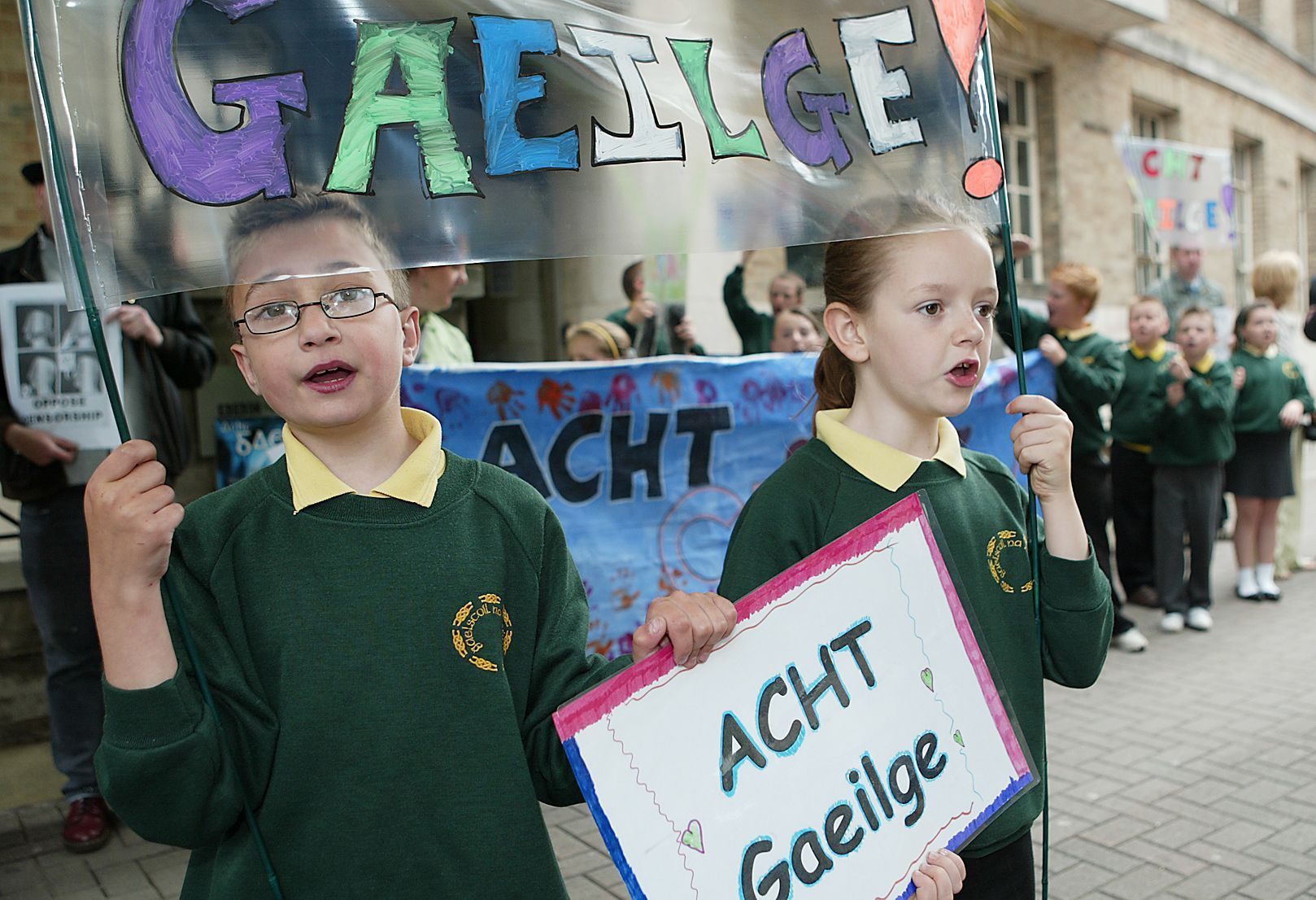
Faced with the allegation from Irish language campaigners, mobilised predominately in West Belfast, that Auntie Beeb was Anti-Irish, in that hunger strike year BBCNI conceded the absolute minimum imaginable - 15 minutes of radio broadcasting a day.
From that time on, and faced in particular with the Good Friday Agreement pledge for "robust action" to promote the Irish language, BBCNI resiled slightly and ever-so-slowly from its absolutist position of hostility to An Ghaeilge (and, indeed, to Gaelic games), allowing the development of an Irish language unit at Ormeau Avenue.
This was progress, but it was no linguistic paradise for Irish speakers. In fact, when viewed against the rapid gains of Welsh and Gaelic speakers in BBC Wales and BBC Scotland, it was clear that begrudging baby steps was to be the policy of BBCNI.
In fact, the ban on Irish remained over large swathes of the local BBC — including in news, weather and sport coverage — even when all three of those areas are now covered comprehensively in Welsh and Gaelic. In fact, in Scotland, which boasts around 70,000 speakers of Gaelic — roughly half the number of Irish speakers in this benighted jurisdiction — there is not only a best-in-class news website but also an entire Gaelic TV channel.
The BBC brass in both London and Belfast insist that the decision to make redundant three of the most talented Irish language broadcasters of their generation from the Ormeau Avenue Gaeilge unit is no more than housekeeping at a time of budgetary belt-tightening.
Some might liken it more to a George Beadle-style blitz.
When the BBC higher-ups are finished, the Irish language unit will have just two members of staff. Even the Andersonstown News, produced on a shoestring, has one full-time Irish language journalist. Are we really to believe this is the best the BBC locally can do in 2026 to act, per its much-vaunted mission, in the interests of the local Irish language audience?
George Beadle would probably say yes but Beeb bosses should be aware that those who value the Irish language will not be forced back to 1924. As our beloved community has affirmed of late, there will be no going back; not for the community of the Garvaghy Road, not for the Gaeilge community.
Let's spell it out for George Beadle's successors, in English and in that language which once again is being driven from the BBC:
Níl Dul Siar Ann - No Going Back