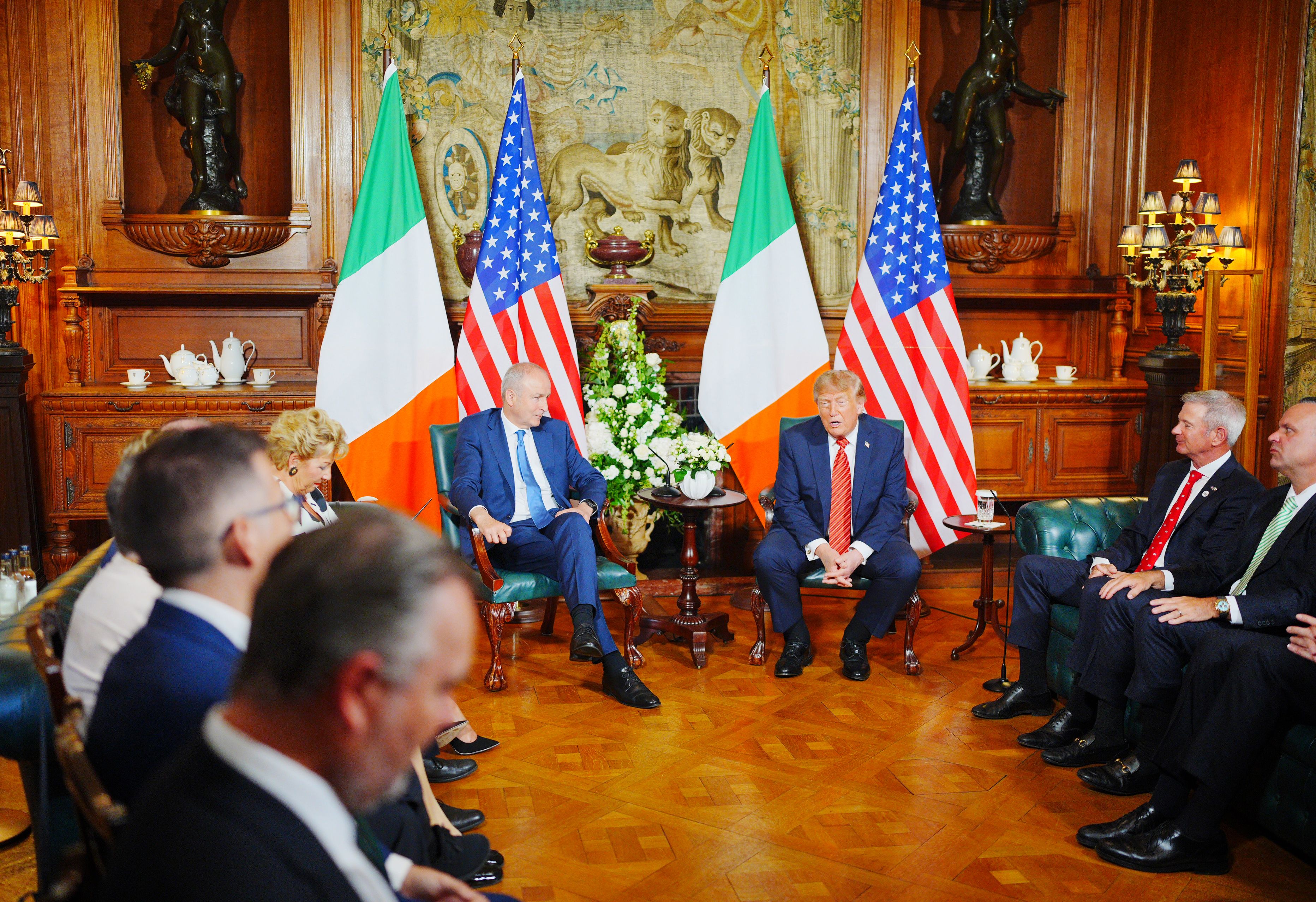
TAOISEACH Micheál Martin must have thought he had succeeded once again in negotiating a tricky meeting with the mercurial President Trump when a British journalist lobbed a hand grenade.
What did the world's most powerful man think of Irish unification?
The answer, thoughtful and firm, blew out of the water DUP bleatings that President Trump's previous musings on this issue were "a joke", as the Donald gave the idea the full MAGA treatment.
"Fantastic", "nice", "cool", "a great thing", "good for everyone" were just some of the superlatives the President threw as he opined: "The way I look at it, it's going to happen eventually. It may as well happen now."
Irish unification hadn't received this enthusiastic an endorsement since the last Sinn Féin ard fheis.

Sitting beside his American guest, the famously unity-averse Taoiseach looked like a boy who had swallowed a gobstopper.
So what motivated President Trump to raise the Irish "merger", unprompted, with both President Connolly and Mr Martin? Some suggest he is merely reflecting the mainstream Irish American view that Irish unity is a prize worth pursuing; others that his Irish American cabinet members (the famously Scots-Irish JD Vance or Transport Secretary Sean Duffy?) may have been whispering in his ear.
Or maybe he was just giving the Brits a dig in the ribs.
Others have warned us that President Trump is not sincere in his utterances and doesn't care about Irish unification, as if being sincere ever had any bearing on the utterances of politicians. Does anyone really believe PM Burnham will keep Irish unity "off the table" when push comes to shove?
So where does Mr Trump's comments leave the unity debate — the one that unionists say doesn't exist and which drives Mr Martin "bananas"— and the ongoing efforts to speed up preparations for the referendum on Irish unity promised in the Good Friday Agreement?
Boosted, undoubtedly, but more so in America than at home.
For what is clear is that President Trump has let the unity genie out of the bottle, much to the chagrin of the only constituency in Ireland which supports his nativist policies – the unionists.
He has opened the floodgates, allowing senior politicians in the US to now parrot his position. That's a massive break with the incredibly disciplined American bipartisan approach to Irish affairs since the Good Friday Agreement. No previous American President, US Special Envoy, or even senior Friend of Ireland on Capitol Hill has ever given their full-throated endorsement to a United Ireland. Not one. Not ever. Not even 'Irish' Joe Biden — as culpable for the Gaza genocide as his successor — could bring himself to speak up for Irish unity.
So kudos to Trump for upsetting the establishment apple cart, and if he's motivated more by annoying the Brits than his love for Ireland, so be it. Either way, this genie isn't going back.
With 50 days to the mid-terms in the US, expect the leading Democrats to race to catch up ground in the eyes of 40 million Irish American voters. Post-Doonbeg, no self-respecting Irish American pol can fail to talk up Irish reunification.
For its part, the Irish government, instead of trying to get the President to row back his comments, should be asking the American administration what concrete financial support it can give to the process of unification.
It's long been understood that with the advent of reunification, the European Union, Dublin and London would step up with a transition dividend, but surely now there's an opportunity to ask the American government to write its own big beautiful cheque.