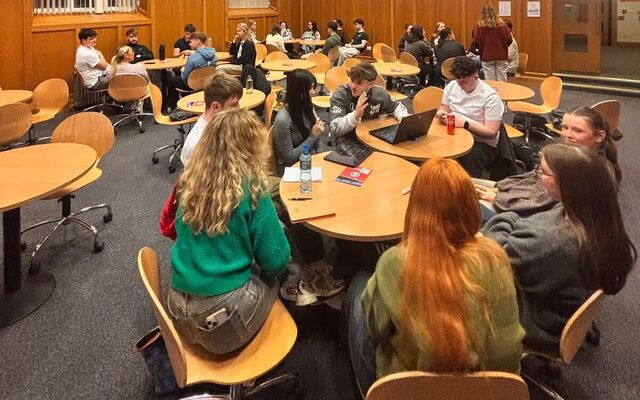
A BELFAST teacher has spoken about the increased workload teachers now face compared with when he began his career three decades ago.
The Belfast teacher was speaking as the five main teaching unions voted to strike if the Department of Education does not address grievances over workload. The members of the five teaching unions – NASUWT, Irish National Teachers' Organisation (INTO), Ulster Teachers' Union (UTU), National Education Union (NEU) and the National Association of Head Teachers (NAHT) – were balloted last month, with the vote closing on 1 September.
An Independent Workload Review was published by the Education Minister Paul Givan in April of this year which aimed to address challenges around teacher and school leader workload including such issues as flexible working, working hours, unnecessary administration and teacher training.

A potential strike date has not yet been set and unions have said that action could be avoided if concerns around workload are addressed.
Brian Banks has been a teacher for thirty-three years. He says that the amount of additional work now, compared to when he started his career is astonishing, with evenings and weekends often taken up marking coursework and assessments.
"Being a teacher at the minute is like having homework every single day and weekend and holidays until you die, and most of that work is unpaid," he said. "So we have contracted hours that we're paid for, and if we work over those hours we don't get any additional pay."
Brian said the extra pressure on teachers is having a knock-on effect on the level of education they can provide for pupils.
"Within the last ten years I won a national teaching award for being one of the most effective teachers in the country, and now I feel like I'm failing every lesson, and it's because I feel like I'm set up to fail.
Regarding those who criticise teachers for striking, on the basis that they get longer holidays than other professions, he said that those who criticise do not understand the complexities of modern-day teaching, including that fact that teachers who are not on full-time contracts do not get any pay over the summer break.
"I like to think of the job of teaching like stand-up comedy in front of a difficult crowd, six times a day, with minimal preparation. You're doing performance all the time when you're teaching. You've got twenty-five different lessons in a week, and you've got eight minutes to prepare for each of those, and you've got twenty to twenty-five kids, all of them have different needs, and you're being assessed at every single thing you do during that lesson and all the decisions you make.
"It is a very, very, very high-stress job, and the reason we get shorter hours, is because that's been acknowledged, been acknowledged for 40 years that it is emotionally and intellectually very tiring.
He continued: "I think what we really, really want to do is – like other jobs – to be able to come into our job, do our job feeling prepared and supported to do it, do it well, to really high standard, and then go home at the end of the day and live the rest of our life."
Matt Wrack, NASUWT General Secretary, said that members have delivered a resounding message to the Minister.
“They are adamant that they are not prepared to tolerate a situation where workload is unaddressed and are fully prepared to take either strike action or action short of strike in furtherance of this campaign.
“The Minister and employers must move decisively to ensure that workload is fully addressed. Failure to properly address workload will inevitably lead to robust industrial action."
Turnout of NASUWT members was 54.89 per cent, with 92.04 per cent voting in favour of strike action.
Education Minister Paul Givan expressed his hope that industrial action could be avoided, and said he would continue to work with the Northern Ireland Teaching Council (NITC) to come to a resolution.
"Negotiations over recent months have been very constructive with agreement reached across a range of issues in dispute. This ballot was initiated before the negotiations had commenced and the outcome does not reflect the genuine efforts that have been made by all parties to find a resolution.
"My Department and Management Side have engaged in good faith, demonstrating a willingness to listen and respond and we will continue to do so. We will also need to consider how further engagement can be structured in a way that is meaningful and has a realistic prospect of reaching agreement. I believe that further progress is possible through continued engagement and I will continue to work with the NITC and employers to find a way forward."