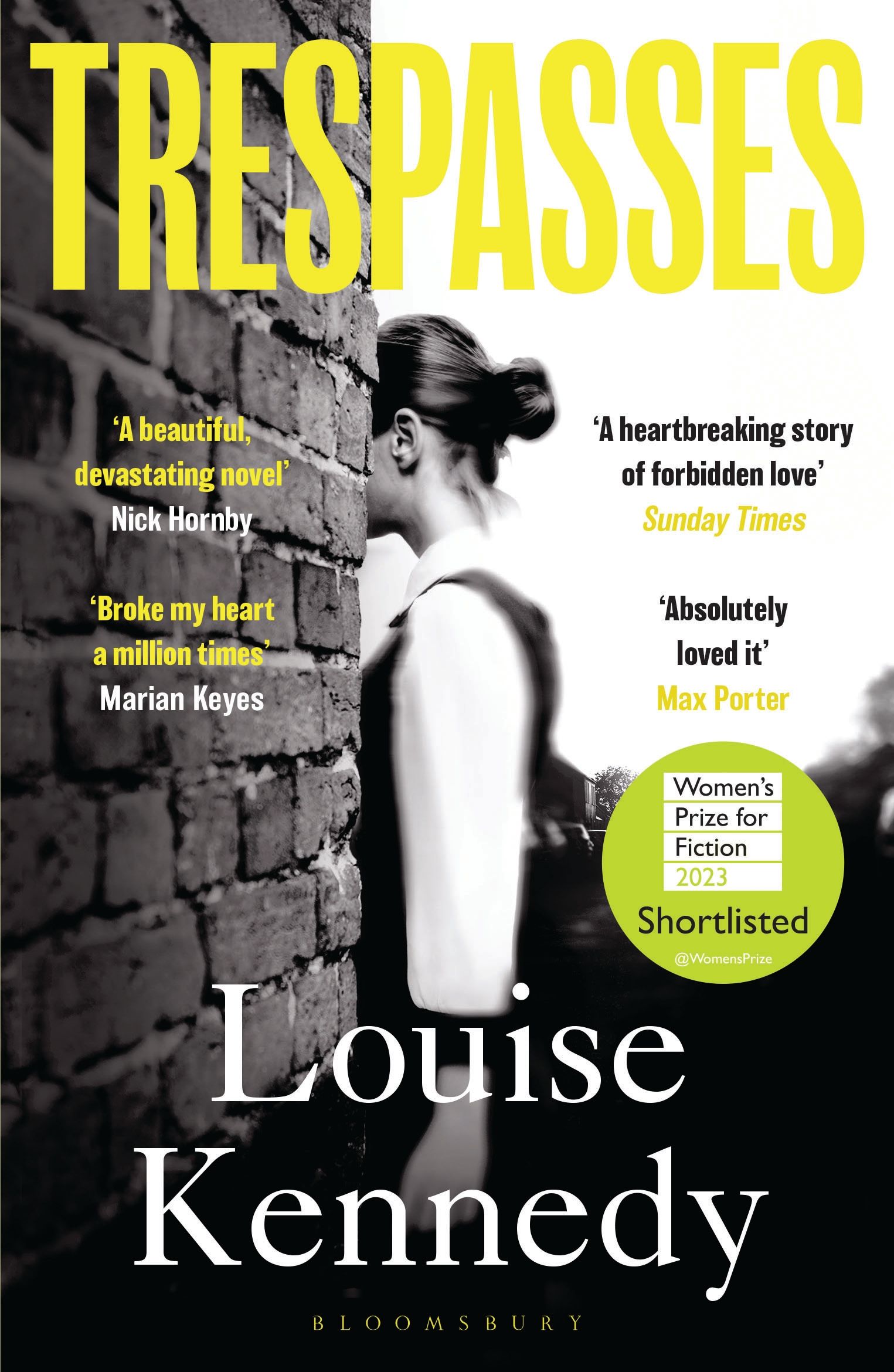
DÚIL. Leafing through an Irish-English foclóir/dictionary, you will eventually land on this word’s meaning: desire. In 1975, during the Troubles, how does one in an illicit cross-community affair express such a feeling? How does one face the awful repercussions of treading on thin ice?
Louise Kennedy’s debut novel, shortlisted for the 2023 Women’s Prize for Fiction, and winner of the 2022 An Post Irish Book Awards novel of the year, aptly titled 'Trespasses', depicts a precarious entanglement between a working-class Catholic primary school teacher and a respected, married Protestant barrister.
Amidst rampant bigotry and brutality, Cushla Lavery and Michael Agnew’s relationship represents not just a taboo, but an act of trespass. The further they venture into each other’s territory, the further their forbidden love blossoms; the further they perilously traipse along the gulf of widespread sectarian division. The two occupy distinct socioeconomic worlds, and so, there is no evading judgment, nor can the escalation of conflict be halted.
Strongly opposed to the Diplock non-jury legal system (that had been introduced to Northern Ireland in 1973), the target on Michael’s back is ever-growing. He ardently defends the civil rights of young men from nationalist backgrounds; stating that they are “subjected to constant harassment” by the army and the police, resulting in a “recruitment drive for the IRA”.
The developments of this romantic liaison, “each event, each decision, each choice”, fall like dominoes; one after the other, posing terrible ramifications for the couple and those that surround them. At one point in the novel, whenever Michael is concerned about the state of their relationship, Cushla reassures him as best she can – albeit with searing honesty: “We’re doomed. Apart from that we’re grand.”.
Sligo-based writer Kennedy grew up in Holywood, Co Down. Following bomb attacks on her family-owned pub, as the violence escalated, she and her family moved to the Republic. These personal experiences closely inform Kennedy’s novel, allowing her to delineate a fragmented Northern Ireland, fraught with conflict and prejudice.
Louise Kennedy

In a “garrison town” outside Belfast, 24-year-old Cushla and middle-aged Michael meet at Cushla’s family-owned bar. This lived-in establishment attracts an array of clientele; from British troops, to characters like Minty, the Carlsberg-loving school caretaker, or Fidel, khaki-cap-wearing local UDA branch brigadier, who by day works in a sweet shop. However, it is the worldly barrister that catches her eye.
Prior to becoming a writer, for approximately 30 years Kennedy worked as a chef. As such, her writing exhibits a chef’s eye for detail. Attuned to sensorial stimulation and acutely aware of the general scepticism of the era, with her razor-sharp prose, Kennedy deftly loads the novel’s observations and interactions with engrossing intimacy and realism.
The oxytocin-fuelled insatiable yearning for a life with Michael, beyond her socioeconomic circumstances, that cannot truly be realised, is coupled with Cushla’s fear that she will not be Michael’s final lover. Moreover, her tense rendezvouses with Michael and his fellow upper-middle-class friends as their Irish teacher, lead her to wonder if she is no more than the “token Taig”. On one occasion, she is asked to teach the words Imtheorannú/“Internment”, and Sceimhlitheoir/“Terrorist”.
As Michael states: “It’s not about what you do here […]. It’s about what you are.”. This perceptive statement is asserted by Kennedy in the depiction of sectarian persecution; particularly the maiming of Seamie McGeown, husband in a mixed-religion marriage, and father of Cushla’s favourite student Davy.
Caught in the conflict’s crossfire, the disruption to ordinary life is constant. There is only so much Cushla can do as a primary school teacher to protect her young students from the slew of atrocities; shootings, beatings, and bombings reported daily. She can only hope to meet this brutal reality with acts of compassion, e.g. providing Davy with free school meals, and aiding his impoverished family following Seamie’s assault.
The Troubles was an era defined by the unspeakable, a time when it was “so much easier to say nothing than to forget”. Concerning the romantic and the societal, Kennedy’s Trespasses voices an undeterred collective desire for peace.
'Trespasses' by Louise Kennedy is published by Bloomsbury Publishing (RRP £8.99)