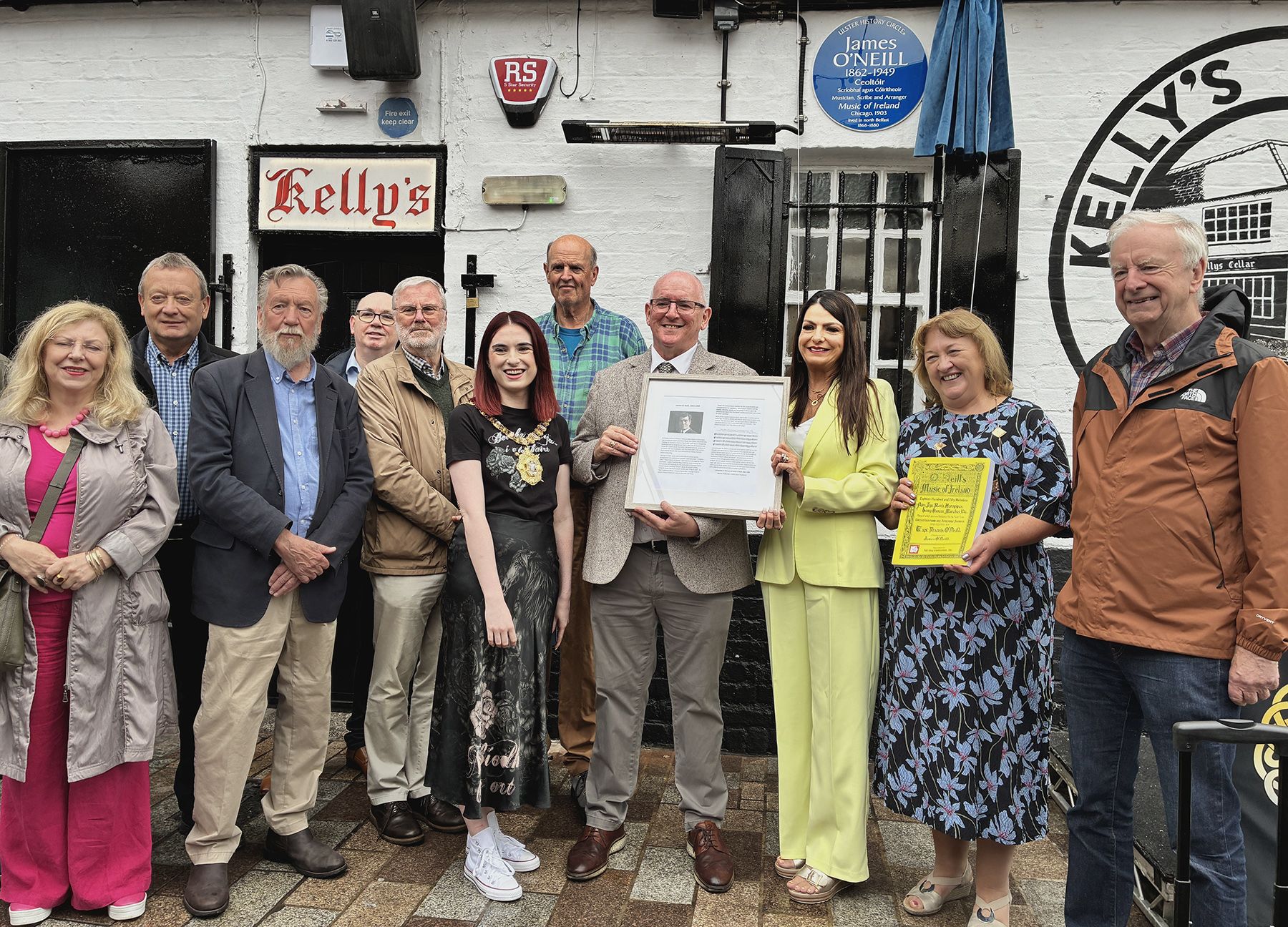
JAMES O’Neill (1862-1949), who collected tunes from people just like him, who were thousands of miles from their birthplace, has been commemorated with an Ulster History Circle Blue Plaque during Fleadh Cheoil na hEireann in Belfast.
The plaque to James O’Neill was unveiled on Tuesday at Kelly's Cellars in Bank Square.
In his adopted city of Chicago, O’Neill used his skills as a transcriber to preserve music that would otherwise have been lost forever. Working with his more famous namesake Francis O’Neill (no relation), James helped put together some of the greatest collections of traditional music in the world.
Both men joined the Chicago police force, in which Irish immigrants were dominant. James O’Neill’s home in Chicago became a mecca for immigrant musicians who were heroes in their native Ireland.

The surviving manuscript of O’Neill’s collection is a direct link with the community of supremely talented Irish musicians who settled in Chicago.
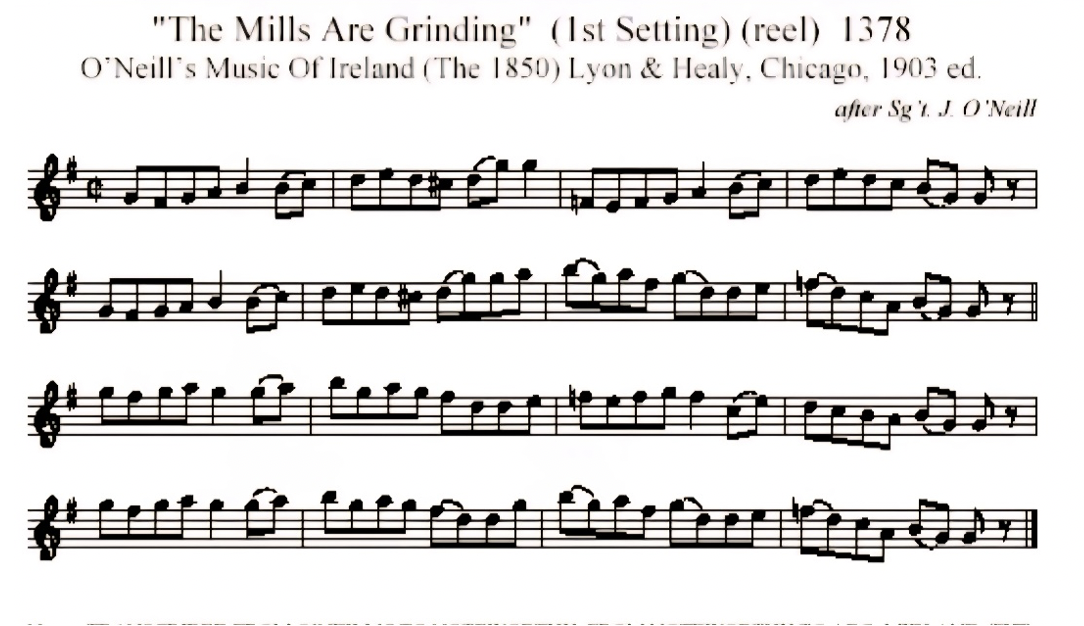
Police officer O’Neill was on duty in the winter of 1901 when he took shelter in a barber’s shop to keep warm. A baby was crying and the father came from the kitchen to comfort the child. He whistled a tune, bouncing the baby on his knee. James took out his police notebook and began transcribing the tune. Every time the barber got near the ending he was called back to the kitchen. Frustrated, O’Neill knocked on the door to ask the barber to please come out and finish the tune. Naturally it was called 'The Whistling Barber'. It was later identified as 'The Mills Are Grinding', the title by which it’s known when it’s played today.
O’Neill’s biographer Caoimhín Mac Aoidh visited the site of the disused barber’s shop in Chicago. He writes: “ Somewhere in Ireland a man left in search of a greater life in America. It brought him to this very spot. By quirk of fate and James O’Neill’s astounding musical diligence, his simple act of whistling a reel from his community’s repertoire thousands of miles away resulted in a small but important piece of Irish cultural history which lives on."
James O'Neill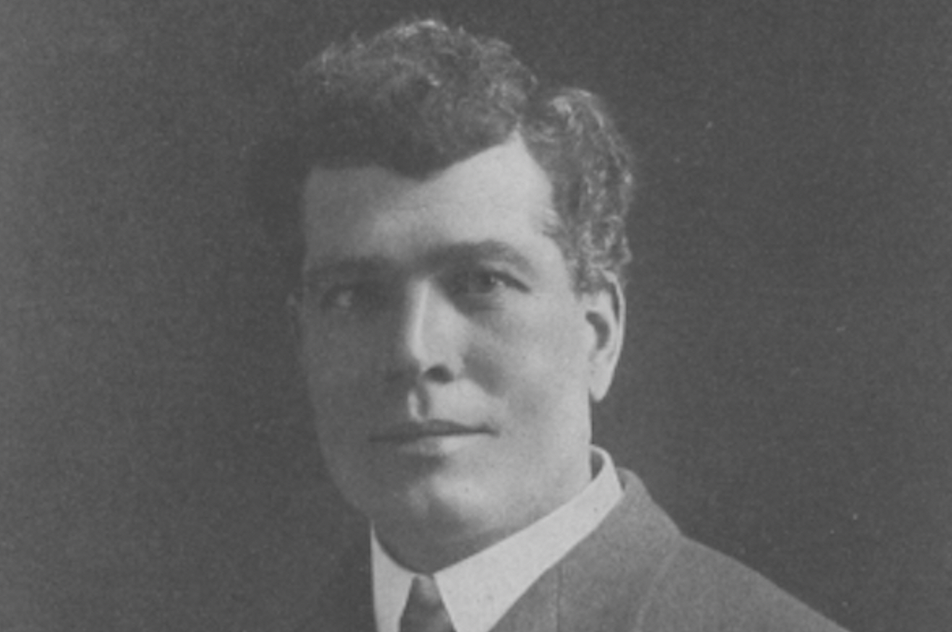

O’Neill was an accomplished fiddle-player, like his father, John. The title 'The Mills are Grinding' recalls James’ childhood. He was born in Seapatrick, Banbridge, County Down, but in 1868 John moved his wife and children to Belfast and found work in Flax Street Mill. The first family home was in Brookfield Street in the north of the city.
There were further moves in the same area – to Glenpark Street and Ardilea Street – but by 1880 the O’Neills had left Ireland. John, his wife Mary and five of their six children went to Scotland. James, the eldest, headed for America at the age of eighteen.
He was introduced to his namesake, the celebrated collector Francis O’Neill from West Cork, in 1884. The two became colleagues in the Chicago Police Department. With James as his skilled transcriber, Chief of Police Francis completed the greatest collection of tunes of its time, including "O’Neill’s Music of Ireland' (1903) and the unofficial 'bible' of Irish music, 'Dance Music of Ireland' (1907).
Francis described his friend as “Quiet and unassuming in manner, his fine musical talent was unsuspected by his neighbours… (his) musical notation (of) the playing, whistling, singing and humming of others was truly phenomenal. None from the North Country possessed such a store of Ulster melodies.”
James contributed tunes named after locations such as Banbridge, Portaferry, Belfast and Antrim. He was particularly fond of jigs: Drink and Be Merry and McArdle’s Fancy among them. Many tunes in the collections were wrongly credited to Francis but were actually collected by James. He transcribed as many as three variations of a particular favourite, The Blackbird. His work is the basis for sessions and Fleadhanna Ceoil, traditional music festivals, the world over.
His achievement was huge at a time when traditional music was thought by some to be close to extinction. He and Francis would take a fragment of music they heard or remembered and from that they would form the whole tune. When James left Belfast, he brought his father’s music collection and transcription manuscripts with him. Sadly, this material as well as over two thousand of James’ own transcriptions were lost when his family home was flooded in the Brighton Park neighbourhood in Chicago. The sole surviving James O’Neill manuscript is now regarded as the Holy Grail of Irish music.
CaoimhÍn Mac Aoidh writes that James lived in Brighton Park “during most of the collection years. Francis O’Neill regularly called to this house. He would sit on the porch drinking tea and whistling tunes waiting for James to arrive back from the Brighton Park police station. When the two settled down, the jigs and reels would flow and the furious transcription of the music began in earnest.”
Former Irish radio producer Peter Woods writes of James O’Neill: “It was a life of labour. That of a man who was, by all accounts, quiet and decent and who sacrificed areas of his personal life…In its way this life is also heroic… It was James’ facility as a musician and more importantly his ability to transcribe music that lifted him beyond all of this. It’s for this reason that he is remembered – his collaboration with the other O’Neill.”
James O’Neill died in Saint Anthony de Padua Hospital Chicago on November 28th 1949. He is buried in Mount Olivet Cemetery.
CaoimhÍn Mac Aoidh, O’Neill’s biographer, says: “His (James O’Neill’s) extraordinary musicality meant he could transcribe a previously unheard tune simply upon hearing it played. Their joint work was published by Francis O’Neill noting James as musical editor. The remarkable musical skills of James O’Neill contributed to the capturing of a huge and critical store of tunes which enrich the lives of traditional musicians around the world and will continue to do so for generations to come.”
The Lord Mayor of Belfast, Councillor Róis-Máire Donnelly, said: “Mar Ard-Mheara Bhéal Feirste, ta luchair orm duine cosuil le James O’Neill a cheiliuradh – ceoltoir, scriobhai agus coiritheoir ceoil. Cluintear a chuid cheoil istigh sna seisiuin sa chathair seo agus thart fan domhain chuig an lá atá inniu ann.
"We are proud that Belfast is hosting this great event, at which James O’Neill’s name is being resurrected, remembered and commemorated by the Ulster History Circle.”
Rev. Gary Hastings, Church of Ireland Rector and Ard Ollamh, Chief Bard of the Fleadh Ceoil, said: “It’s a very important thing to mark the part James O’Neill played in preserving the musical and historical tradition belonging to us all.”
Ulster History Circle Vice Chair Eibhlin Mac Aoidh added: “James O’Neill learnt and played traditional tunes in Belfast. He carried them across the sea to Chicago and as ‘The Scribe’ he was key in transcribing and preserving the tunes of the Irish diaspora and preserving them for generations. The Ulster History Circle is delighted to commemorate James O’Neill’s contribution to the music being played in Belfast this week at the Fleadh. The Circle thanks Belfast City Council for funding the plaque and Michelle Downey and the Downey Group for their kind assistance.”