On 2nd September last, the day before Ronnie McCartney’s 72nd birthday, he was given the news in the City Hospital that he had Stage 4 cancer, that chemo would not help, and that he had between six and nine months to live.
He had been in no pain, apart from his arthritis which rendered him weak on his feet. He did have COPD but had no warning of this devastating news that would shatter the composure and morale of any of us.
But Ronnie was fortunate—though that is not the right word—in that he had the pillar of Anne Marie by his side, his best friend of more than two decades. He was also of the view that “if it is God’s will to take me, then so be it,” though of course he wanted to be around his beloved and wide family circle for many, many more of his twilight years.
As it was, he died after three months, two days after having been rushed into the hospital.

TRIBUTE: Ronnie McCartney who died at the age of 72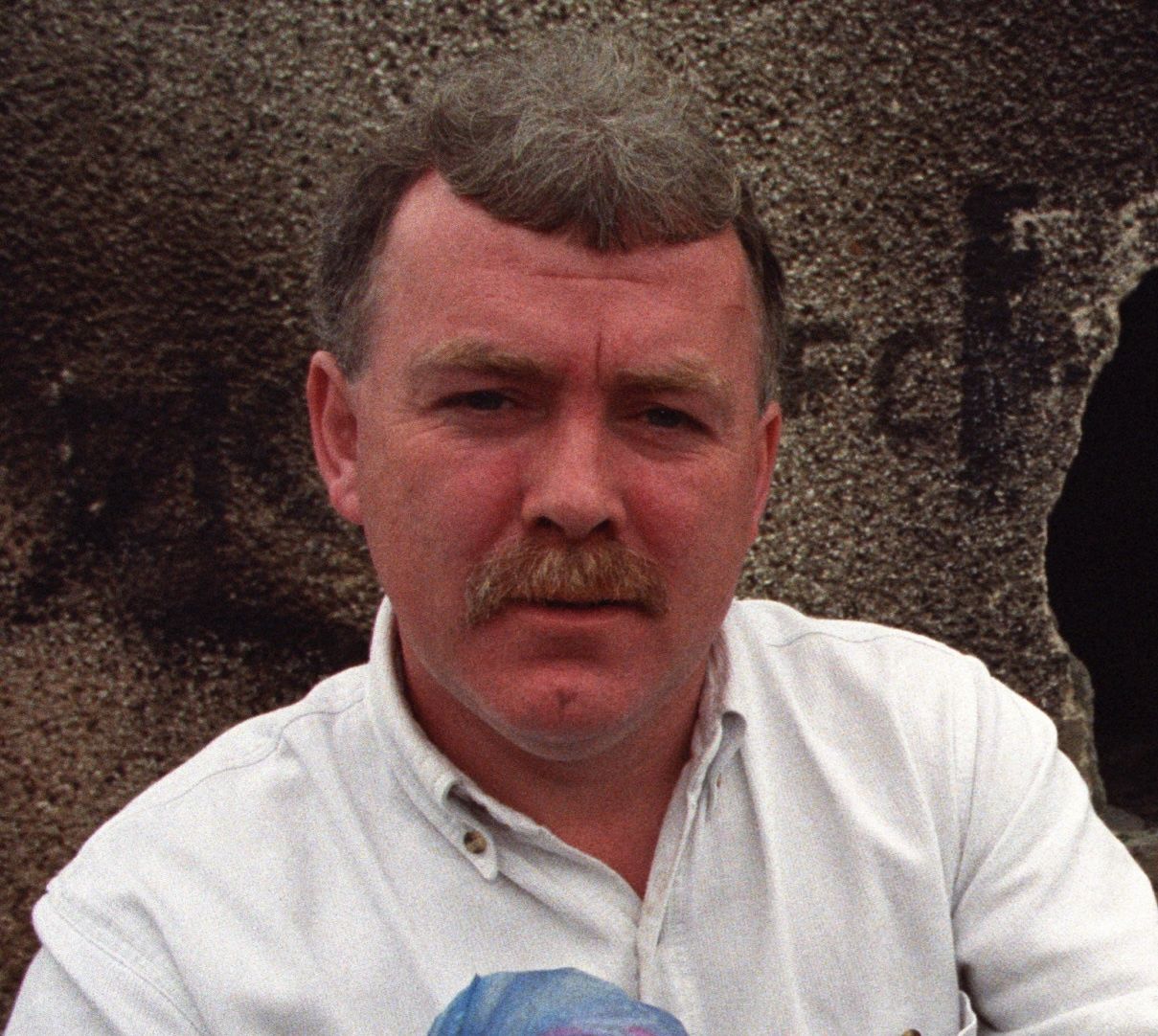

Ronnie’s life can be divided into almost three parts: the first, 21 years of life in West Belfast under Orange rule and British Army occupation; the second, of over 21 years in English prisons suffering incredible deprivation; and then the last 21 years, which he and others who knew him described as the happiest years of his life, again due to Anne Marie and her family, which became his family.
He was that rare example of a husband who got on brilliantly with his mother-in-law Bernie, who in turn adored and loved him.
“I was very lucky,” said Anne Marie, “that the man I fell in love with fell in love with my family and they with him.” Her siblings, Liza and Sean, were to Ronnie a sister and a brother.
Ronnie was born in Cape Street in 1953, the second youngest, one of eight children. He was called Ronnie after his Uncle Ronnie (Ronald) McDonald. When Ronnie was nineteen his Uncle Ronnie, his uncle’s brother Sean, and sixteen-year-old Tony McGrady were killed in a UVF sectarian gun and bomb attack on their car repair shop on the Cliftonville Road, the price that a thousand members of our community paid for seeking their rights.
Also born in Cape Street the same year was Jim Girvan who was a lifelong friend. Jim and his wife Teresa were at Ronnie’s bed with Anne Marie, Bernie, Liza and Sean, Ronnie’s nieces Nicola and Grace and Anne Marie’s other nieces and nephews when he passed shortly after 3.30pm on Monday, 1st December.
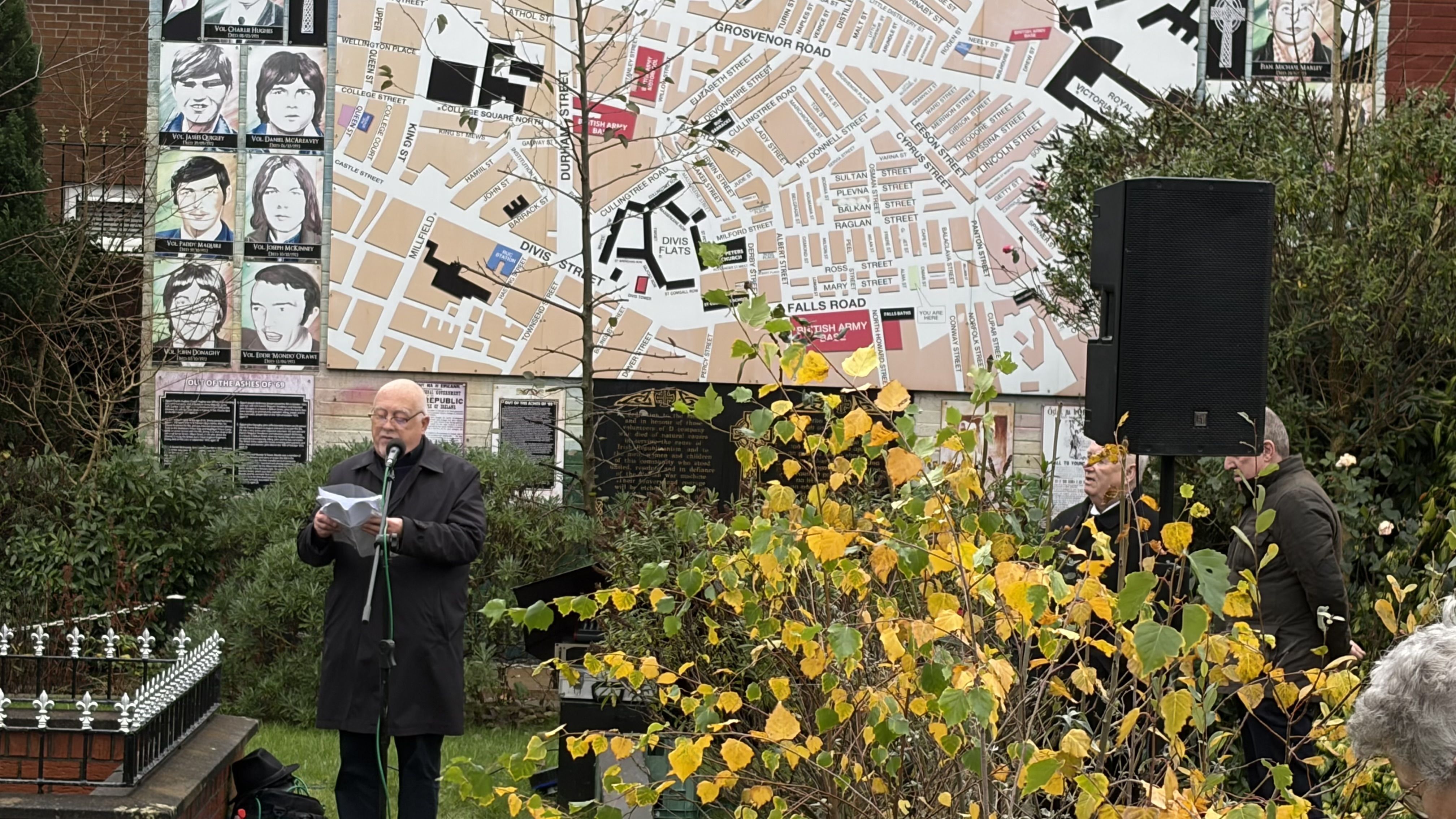
Danny Morrison delivers oration for Ronnie McCartney, an IRA volunteer who spent almost 20 years in English prisons, at the Republican Memorial Garden on the Falls Rd today. Ronnie McCartney passed away on 1 Dec, funeral mass was celebrated at St Peter's Cathedral. @molloy1916 pic.twitter.com/mHflNuszy2
— Andersonstown News (@ATownNews) December 9, 2025
Both Ronnie’s parents died within a short space of each other when he was in his mid-teens. He attended St Peter’s School in Brittons Parade, as did many who later joined the ranks of the IRA, including my best friend Jimmy Quigley, who was killed on active service; Fra McCann, and Gerry Kelly who later served time in England and with three comrades experienced force-feeding over the 200 days of their hunger strike.
Ronnie witnessed the pogroms of August 1969 and the Falls Curfew several months later. Caught up in the anger and passions of those times he was involved initially with ‘the Officials’ – the Sticks – before, as we later joked, he realised the error of his ways and joined the mainstream Republican Movement, the organisation that would raise the nationalist community out of its misery and despair… the Movement that would confront the repressive Six-County state, its institutions, its military forces and its political masters in London, and which would eventually take the war to England—operations in which Ronnie himself would participate.
I first got to know Ronnie after I came out of internment and when he was billeting in the Beechmount area.
In December 1974 in Southampton, British police surrounded a house to capture two IRA Volunteers. The Volunteers, one of whom was Ronnie, broke through the cordon and as Ronnie was being pursued by a number of policemen he opened fire and wounded PC Malcolm Craig, made good his escape, and was able to get back to Ireland.
(Incidentally, 25 years later, after the ceasefire and as a gesture towards reconciliation, Ronnie appeared on television with Malcolm Craig and spoke about the reasons why there had been an armed struggle.)
In 1975 Ronnie was arrested in County Tyrone and transferred to England where he was charged and later sentenced to life imprisonment for wounding Craig, 20 years for conspiring to cause explosions and 14 years for possessing a weapon.
In Long Lartin he joined with other IRA Volunteers serving long sentences in the ‘Dispersal System’. In 1977 he was moved from Wandsworth Prison to Wormwood Scrubs and there, along with Eddie Byrne, Eddie O’Neill and Paul Norney, attempted to escape. However, they were captured and overpowered near the prison wall, with Alsatian dogs being set on them. He spent 28 days in solitary confinement before being moved to Brixton Prison, one of almost 50 prison moves—‘ghosting’ as it was called—and usually on the eve of a family visit.
Family members were cruelly treated. His older brother Martin was banned from entering Britain for a visit and it would be another 16 years before they were reunited in Maghaberry. Martin, who was also in prison at this time in the 1990s was serving a lengthy sentence in the H-Blocks.
Friends of Ronnie, the McCaughey family from Birmingham, Sister Sarah Clarke and others from support organisations were all banned from visiting him.
All Category A prisoners were treated harshly and with lesser entitlements than the rest of the prison population, in an attempt to break them, but in Ronnie’s case it was normal for his visits to be restricted to fifteen minutes.
It is widely recognised that there is a special bond between the republican prisoners who served time in England. Here, we were imprisoned in our hundreds, in our thousands over time on Irish soil, which was an injustice in itself, yet because of proximity to home was of some comfort to us and our relatives.
But on English soil you were in enemy territory, in the lion’s den, among a hostile prison population (though there were times when they expressed their admiration and looked up to the Volunteers). You were subject to isolation, brutality, racist abuse from prison staff, cut off from Ireland, transferred at the whim of a governor for any infraction of rules.
Yet, even in isolation, or in the periods when they were together, the cause of Irish republicanism burned brightly with unbelievable commitment from comrades to each other. Think of the solidarity between Michael Gaughan and Frank Stagg, two friends who died on hunger strike 18 months apart. Think of the comfort and support that the late Ella O’Dwyer and Martina Anderson gave each other as they were isolated, year after year in Durham. Think of the ingenuity of the escapes and the escape attempts. And think of the resistance and determination of one of the greatest prisoners, Paddy Hackett from Tipperary who had been severely injured in a premature explosion, losing a leg and the lower part of his right arm, who spent his sentence on the blanket, defying prison authority.
Taken together, all these experiences of shared penal servitude forged an unbreakable bond between these men and women, who are, indeed, our heroes.
The blanket protest, begun by Kieran Nugent, and the no-work protest by the women in Armagh was into its third year and was now gaining momentum. In Gartree Prison, as recorded in Ruan O’Donnell’s book, ten republican POWs, including Paul Holmes and Martin Brady, broke out of the yard and climbed up on the rooftop. Ronnie said: “We thought about the boys on the blanket and the women in Armagh, so we said, ‘Right! Lets hit the roof!’”
They raised a makeshift Tricolour and unfurled banners which read, ‘H-Block Torture’, and ‘POW Status’ and ‘Solidarity’, and sang rebel songs and shouted comments to the general public for the next two days.
They paid for this protest with 42 days each in solitary confinement.
Ronnie’s ongoing defiance later resulted in him being locked up over Christmas, denied the right to send cards to his loved ones, and denied the right to go to Mass. He was held in what was called the ‘strong box’—a white-walled, soundproofed cell with a reinforced door to maximise sensory deprivation, and a concrete bed.
The governor in Wormwood Scrubs took great delight in sentencing him to fourteen days’ loss of remission every fourteen days for refusing to do work.
When Tommy Quigley was imprisoned in 1983 one of the first prisoners he encountered in Gartree was Ronnie whom he described as being as ‘game as a badger’.
Another POW from England, Joe O’Connell, who visited Ronnie just weeks before he died, says that Ronnie role in the prison struggle cannot be overstated. He had the respect of the POWs and the rest of the prison population, would ensure that no republican prisoner was left on his own or faced intimidation. He helped those who were wrongly convicted and will be remembered for his sense of humour and his sheer determination to overcome challenges.
Ronnie was very close to all his English comrades but had a special bond with the late Roy Walsh at whose funeral here, at this very spot, Ronnie spoke just 14 months ago.
In jail Ronnie followed closely political developments back home and was an early supporter of the evolving peace process. As Sinn Féin’s campaign for the repatriation of prisoners gained traction, Ronnie and Liam Baker were among the first to be transferred back to Maghaberry from where they were eventually released.
After his release he would be a regular visitor to his brother Martin’s house in St Catherine’s Row.
His kindness could also be seen in his loyalty to friends. He and Anne Marie regularly visited Kevin Rafferty who in 1978 was shot several times, suffered a brain injury, was in a wheelchair and spent his last years in Kilwee Care Home. They took him out for meals several times a year, especially on his birthday, an event he looked forward to with great joy.
Ronnie worked for a time at the Belfast Unemployed Resource Centre and devised a programme to help those with addiction issues caught up in court cases. His programme was funded by Comic Relief and many young people were to express their gratitude to him for helping them turn their lives around. He also worked for a time as a development officer at the Blackie River Community Group.
It was while working at the Unemployed Centre that fate was to bring him across the path of one Anne Marie McCluskey from Dermothill who worked professionally as an accountant. Anne Marie came from an apolitical family but had worked for her Uncle Joe on a conflict resolution programme in Moldova. She had also been approached by Dominic McGlinchey’s sister, Ann Gallagher, who had been a nurse in the RVH and had established an organisation dedicated to peace-building, ‘Seeds of Hope’.
The following month Anne Marie drove Ronnie up to Stormont for a meeting with ministers about ‘Seeds of Hope’. She says she felt very comfortable in his company. He told her about his IRA background and having been in prison. She became curious, was interested in the person behind the former IRA prisoner.
Ronnie must have been the slowest Romeo in the world and she the slowest Juliet because they remained just good friends for the next four or five years. She asked him that question—which we have all asked ourselves: what do you think your life would have been like had the Troubles not happened. Ronnie said he would have liked to have been a journalist because he loved writing. Something inside her changed when he said that. He told her that he had kept a prison journal and that he would love her to read it. She was initially afraid to read it, but when she did she was captivated by his words, his description of prison life, by his analyses of politics and international politics, by how the prisoners were broken-hearted by the death of the ten hunger strikers in 1981. Her respect and admiration for him only increased.
Anne Marie says that she fell in love with Ronnie McCartney on the 14th February in 2003 at 7.30pm in the Duke of York. Ronnie was later to admit that he had fallen for her long before that.
On his fiftieth birthday, later that year, he summoned up the courage to ask her to marry him. She was quite frank and said: “I’m not sure, Ronnie. I love you but I’m not sure I could live with you.” But three days later she said, Yes.
They were married in 2004 in Clonard Monastery, the church to which Ronnie often returned when he turned to prayer.
They were married twenty-one years and it was twenty-one years of bliss, of happy family gatherings and holidays together. Ronnie was the househusband who looked after their home in Cavendish Court, shopped for the groceries, did the cooking and cleaning.
In recent years the arthritis he suffered, and which was no doubt exacerbated by all those times sleeping on a cold concrete bed, crippled him, and he felt bad that more and more responsibilities fell on the shoulders of Anne Marie.
He was a proper, proper family man who lived for Anne Marie and for his and her families. She has wonderful memories of love, companionship and friendship to draw upon in the days ahead.
Ronnie said he wants no tears. No one is to pine or to mourn—just celebrate his life, which despite all its tortuous twists and turns he considered wonderful.
A life of three stages: the first, the rebel teenager; second, the unvanquished life prisoner; and third, the man who found love, happiness and contentment at last – and forever.
Across the evening sky,
all the birds are leaving,
But how can they know,
it's time for them to go?
Before the winter fire,
I will still be dreaming,
I have no thought of time.
For who knows,
where the time goes?
Who knows,
where the time goes?
And I am not alone,
while my love is near me,
I know it will be so,
until it’s time to go,
So come the storms of winter,
and then the birds in spring again,
I have no fear of time.
For who knows,
how my love grows?
And who knows,
where the time goes?