I CAN’T say for sure if the Irish language has been hijacked by violent republicanism. Personally don’t think it has, but I can’t – even as someone with as fine a Planter name as mine – put myself in the shoes of a Protestant or unionist who thinks it has. I’m going to accept that’s how they feel about it if people who I know to act in good faith tell me so. Although of course I retain the right to exercise extreme scepticism in the case of bucketmouths, louts and microphone-chasers.
Who am I to tell a person that they’re wrong to feel uncomfortable when they see Mná and Fir on a pub toilet door alongside – or instead of – Women and Men? How can I possibly tell a unionist in East Belfast that they need to take a chill pill when they learn that their street is to get an Irish accompaniment? I’m happy to accept their discomfiture as real and not only that, I’m firmly of the opinion that the job of convincing people that increased exposure for Irish is not a threat will be a lot harder if we start from the assumption they’re misguided Gaelgeoirí.

Why don’t I personally think it’s been hijacked? Well, when the main – some say only – argument is a line whose derivation is clouded in at best uncertainty and at worst mystery then I ask myself why that should be. Who said “Every word spoken in Irish is a bullet fired in the freedom struggle”? I’ve seen it attributed to three or perhaps four people. I’ve seen it attributed to a number of different events and venues. I’ve heard the phrase expressed in a number of different ways. I’m not saying it wasn’t said, because there may come a time when a recording or transcript may emerge. I’m just saying that when the argument against the increased use of Irish in public is built on foundations of sponge cake and Angel Delight, I have a duty to myself to ask why something so flimsy is relied on so heavily.
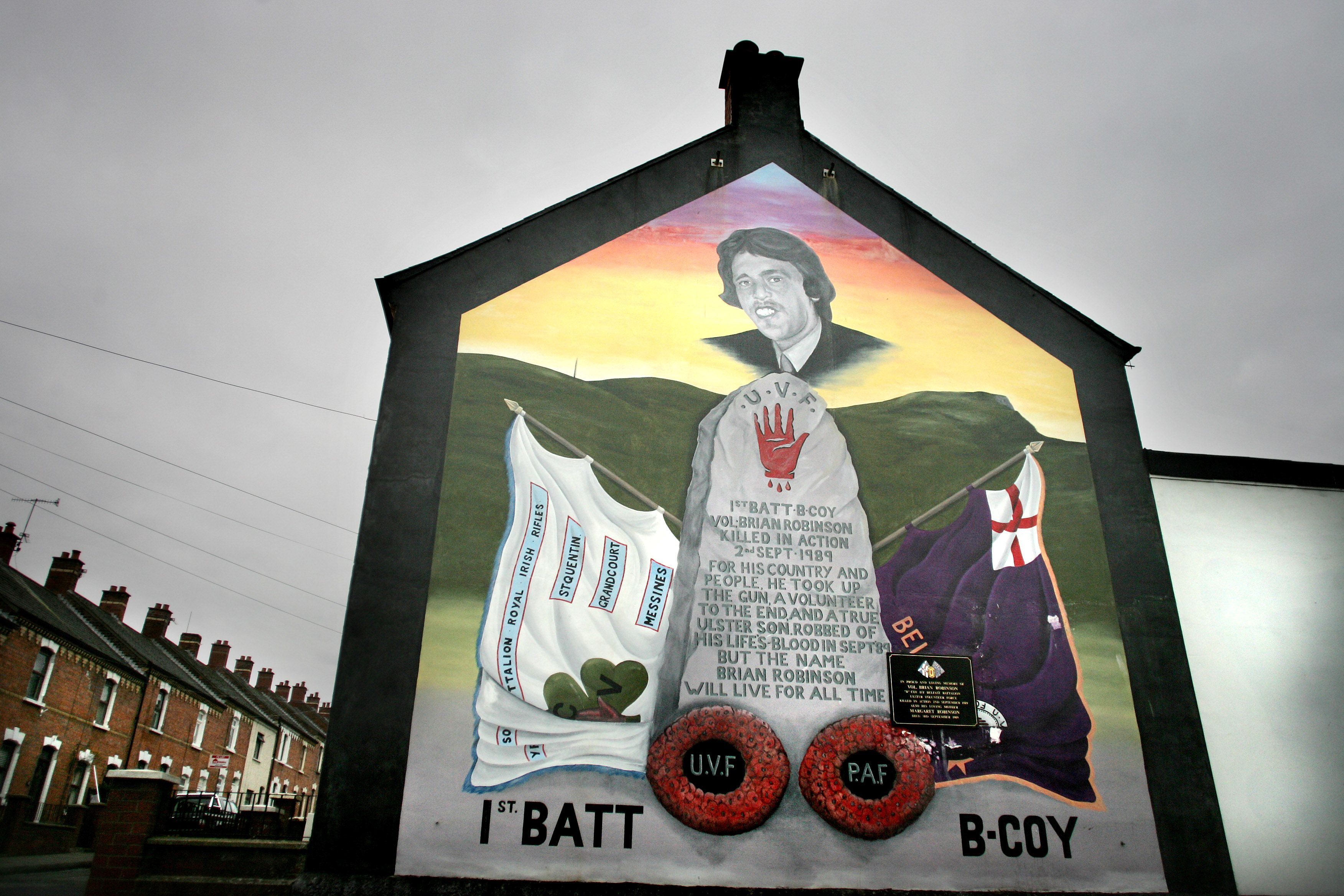
I’ll tell you what I know has been hijacked, though, because this town is riddled with examples of it: the poppy. Or Remembrance Day.
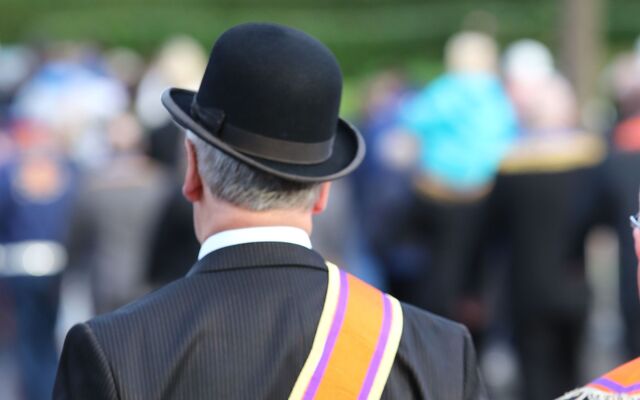
That Laurence Binyon quote about the going down of the sun is more likely to be found on a loyalist mural than carved on a plinth. And beside it on the wall is not a Tommy in puttees and tunic, but a masked head inside a circle of poppies.
Every redbrick memorial garden paying sombre tribute to UDA drive-by killers and UVF pub-sprayers has a carpet of poppy wreaths placed there on Remembrance Sunday, the ink on the maudlin messages running and faded from the rain and the sun. Tubby loyalist foot soldiers are as familiar with the strains of The Last Post as British army generals; they know the choreography of remembrance better than splendidly attired marines and we see it every year at their gable wall cenotaphs. The forward and backward steps; the static march; the chin bow; the snap to attention; the long-way-up-short-way-down salute. And of course while there’s an overwhelming absence of poppies on shoppers’ breasts in a busy Belfast city centre on a November Saturday, there’s not a Bacardi brigadier or a cocaine commander who doesn’t strut the streets with a poppy proudly pinned on his North Face puffer jacket. And, believe me, that’s a massive commitment, since everyone knows you don’t puncture the fabric in a £200 anorak because as soon as you do you its waterproof integrity is over. Gotta be a moral there somewhere.
And so the questions arise but never find an answer: What’s more weaponised – the Irish language or Remembrance Sunday? What’s more directly and immediately redolent of paramilitarism – an Irish word on an East Belfast street sign or a poppy on a Shankill mural? The truth is that it’s an urge to avoid awkward and unpleasant realities that leads senior unionists to avoid the truth about Remembrance Sunday while they prattle on incessantly about that mysterious Irish language bullet. And a further truth is that those awkward and unpleasant questions don’t need to be answered because controlling and regulating acts of remembrance is as impossible as controlling the clouds: they loom in the distance; we talk about their colour, their nature and their possibilities; they arrive; they pass; we watch them come and go; we play no role.
Which is why I don’t think unionists or BBC news-readers should be embarrassed about wearing the same poppy that is used to pay tribute to Catholic-killers. Which is why I do think a modicum of self-awareness would be useful and welcome when it comes to bemoaning the weaponisation of Irish.
Sinn Féin and the SDLP think the same way. That’s why they show up at the cenotaphs these days when there’s an easy out for them, an easy out provided by exactly the same people who want them to do the Cenotaph Sunday chin-bow. And that easy out is drawing attention to the loudly trumpeting elephant dumping a hundredweight of steaming manure in the corner every November; that easy out is to say that Remembrance Sunday has been hijacked by the UDA, that it’s been weaponised by the UVF and so, sorry, we can’t go near it.
But that’s all it would be: an easy out. To acknowledge what Tommy Atkins would call the bleedin’ obvious is not to say that it represents an insuperable obstacle; it is simply to say that the obstacle provides us with a choice: stand still and scream at it, or dander around it.
The same choice presents itself to those who have recourse every five minutes to that Danny Morrison/ Gerry Adams/Pat Rice/ Stephen King/Bob Dylan freedom bullets quote (at which point I need to remind you, without suggesting for a second that my pal Danny Morrison would set m’learned friends on me, that Jim Allister recently retracted a claim that it was Danny who spoke the words). That choice is: continue to insist that the Irish language is in the Ra, or acknowledge that the language is as natural and wild and uncontrollable as gorse on the mountain.
For now, unionist political leaders have made their choice. The choice is that the Irish language is the final line in the sand before the next final line in the sand. The choice is to pretend for grimly cynical political reasons that dual-language signs are the contemporary equivalent of ‘Sniper at Work’. I don’t think any unionist believes that, but I’m willing to accept that for a smörgåsbord (Swedish; n) of reasons political, historical, social and personal many unionists do pull up short at the sight of Irish signage. Is it a majority? I strongly doubt it, but, again, I don’t know.
What I do know is that if indeed it is an obstacle – and I believe it is – it’s as easily walked around as that obstacle Sinn Féin and the SDLP walk around on their way into the cenotaph.