Sometime ago, on the eve of a study trip to Amsterdam to visit projects by Uytenhak, Claus en Kaan and West 8, an architect-friend and I prepared a list of what we might want from good housing in the city. A terrace; a good room; private space; storage; dual aspect, and a long view, if possible. Since then, I have thought of that conversation (and the list I kept in my back pocket) as a rubric, of sorts, on which to consider the many housing projects I have visited and studied.
Ross Street, off Albert Street, opposite St Peter’s Cathedral, fifty metres from the Falls Road, around the corner from St Comgall’s (imaginatively restored by Hall Black Douglas), is a twenty-minute walk from Belfast city centre. Unfortunately, the trauma of the conflict and severe levels of multiple deprivation and poverty affected levels of crime and disorder and spiralling levels of anti-social behaviour in the Ross Street flats, to the extent that they were almost impossible to let, notwithstanding high levels of homelessness and housing crisis.
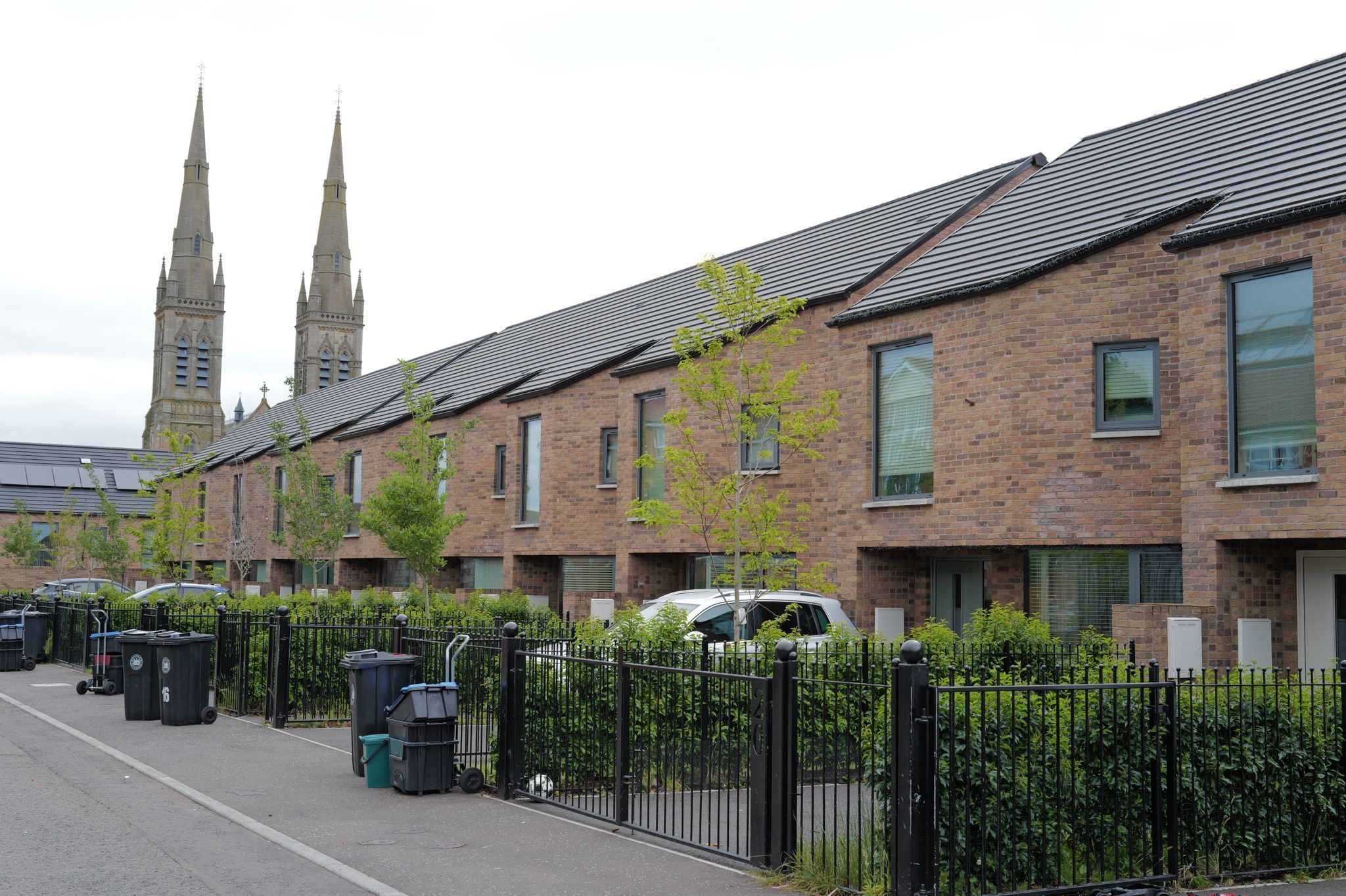
Ross Street Mews by Studio Rogers, is a fine terrace that replaces the former flats, built just after Divis Flats which also suffered many decades of neglect. The new terrace changes the character of that legacy and will mature in its contribution to the increasing sense of positivity in the neighbourhood. It deservedly gained the 2026 RSUA award for ‘best social housing project’.
Almost fifty years ago, the 1979 general election brought in a Conservative government led by Margaret Thatcher that spelled the end of the bipartisan programme of local authority construction in England that had prevailed throughout the post-war years. That led to our ‘right-to-buy’ programmes and demolition of the Victorian-era housing stock in our red-brick pocket city. Essentially suburban housing typologies changed the morphology and fabric of the inner-city, diminished experience of neighbourhood, and reduced the inner-city population by forty per cent.
The housing developments in the mid-conflict period have left a mixed legacy, much of which is now in the process of being replaced. The Woonerf and Essex Design Guide now gone, we remain uncertain how we assess quality. However, given reports by the Joseph Rowntree Foundation assessing built examples of developments in Britain, of different scales and typologies, it seems clear that our housing crisis is a failure not just of supply but of quality.
That informs our socio-economic context, and there is merit considering the work and words of others to inspire and enthuse us. Peter Barber has advised how to de-commodify housing and end the housing crisis, by introducing private-sector rent controls, halting the selling of social houses, and by building tens of thousands of social houses every year funded by direct taxation.
He, among others, declared that to design urban housing is to design the city. The agency of the architect, in managing diverse requirements, the legislative codes and politics of daily work in the process of assembling a building, is in the way our work connects with people and everyday life. Empathy is the architect’s essential quality.
Studio Rogers’ declare, "Ross Street Mews asserts a strong architectural presence rooted in Belfast’s historic urban grain. The … typology reinstates a legible street structure that restores enclosure, frontage … to a site previously defined by fragmentation and concealment." The architect’s instinctive sense of the strength of a simple terrace with a bold street presence, with south-facing private gardens, with the same floor level and ridge line, makes a bold statement to claim ground in a neighbourhood previously fraught with despair.
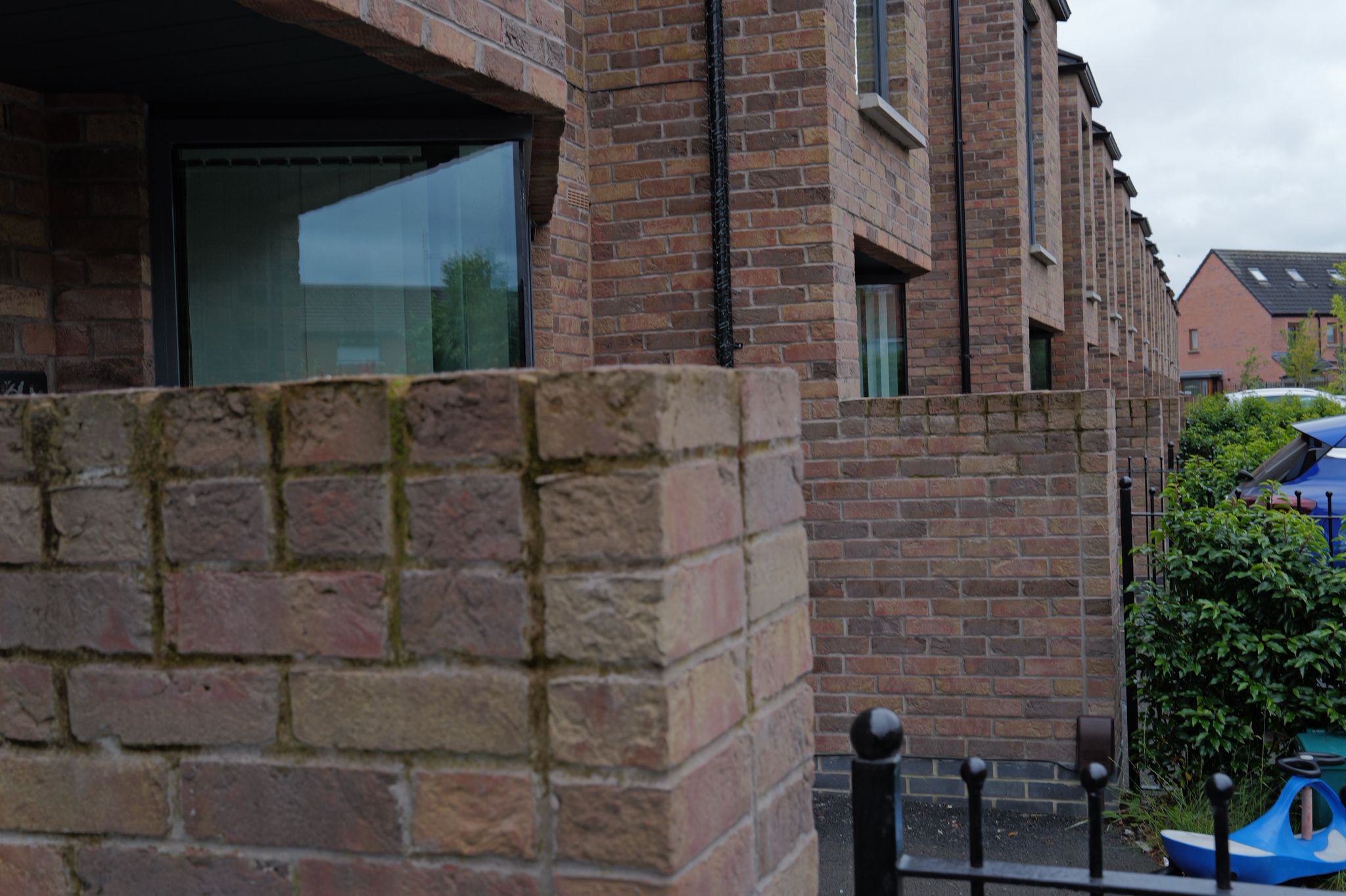
Studio Rogers won a Radius Housing Association design competition for Ross Street and cleverly developed a house type that had been simmering for a while in their studio, designing a physical and visual connection between a recessed front door and a splayed recessing bay that provides a welcoming sense of entrance.
One can imagine that little space as a warm and inviting place to sit in the evening sun. The repetition of that generous gesture creates a vertical rhythm that adds a measure to the ‘walking pastness’ of how we read housing in its place-setting helping make the urban continuation. The planting of a rowan tree in each front garden and a hedge along the front party boundaries resonates strongly on the Falls Road /Bóthar na bhFál - the road of the hedges.
This project delivered, below budget, twenty-four well-proportioned, "spacious social homes which restore a sense of ownership and dignity to residents’" Through a clarity of architectural intent and a considered approach to placemaking and design, the scheme has fundamentally reshaped the area.

"Ross Street Mews is more than just housing provision; it is tangible, sustainable regeneration." As may be expected, at pre-planning stage the project was subject to extensive engagement with the local community and their representatives. Subsequent citations and numerous design awards are testament to the rigour and strength of the design process, and the delivery of people-centric design that offers a replicable model for restored and reconnected streets. It celebrates how small, well-considered projects can be catalysts for wider positive change.
Ross Street Mews is an important development and a credit to its architects and all those who helped deliver homes and a place of value to a community that has endured so much. The urban response and architectural form are appropriate and enduring. In conversation, the architects expressed disappointment that the rooflight (as lightwell over the staircase) and proposed paving to the entrance area were omitted as part of the value-engineering process, and I agree with their reflections.
Additionally, the recent passing of Peter Aldington reminds us of the importance and value of the internal architecture that is also our job: how furniture is placed in a room and how light might fall on a surface; how the placement of windows is critical to room-making.
Regarding the large window over the entrance door, perhaps to increase privacy and reduce visual intrusion down the length of the driveway, fritted glass in a graduated pattern from the floor up to indicate presence, to maintain the scale and dimension of the opening, and give low-level privacy where furniture may be located could improve future iterations of the house type.
The public housing and climate crises require us all to continue collaborative working, and there is urgent need for architects to respond to those issues, to understand neighbourhood and urban responsibility, but to also be designers at a level of detail that develops our sense of empathy: designing, building and delivering the best for fellow citizens, and communities.
Ciarán Mackel is the founder and CEO of ArdMackel Architects