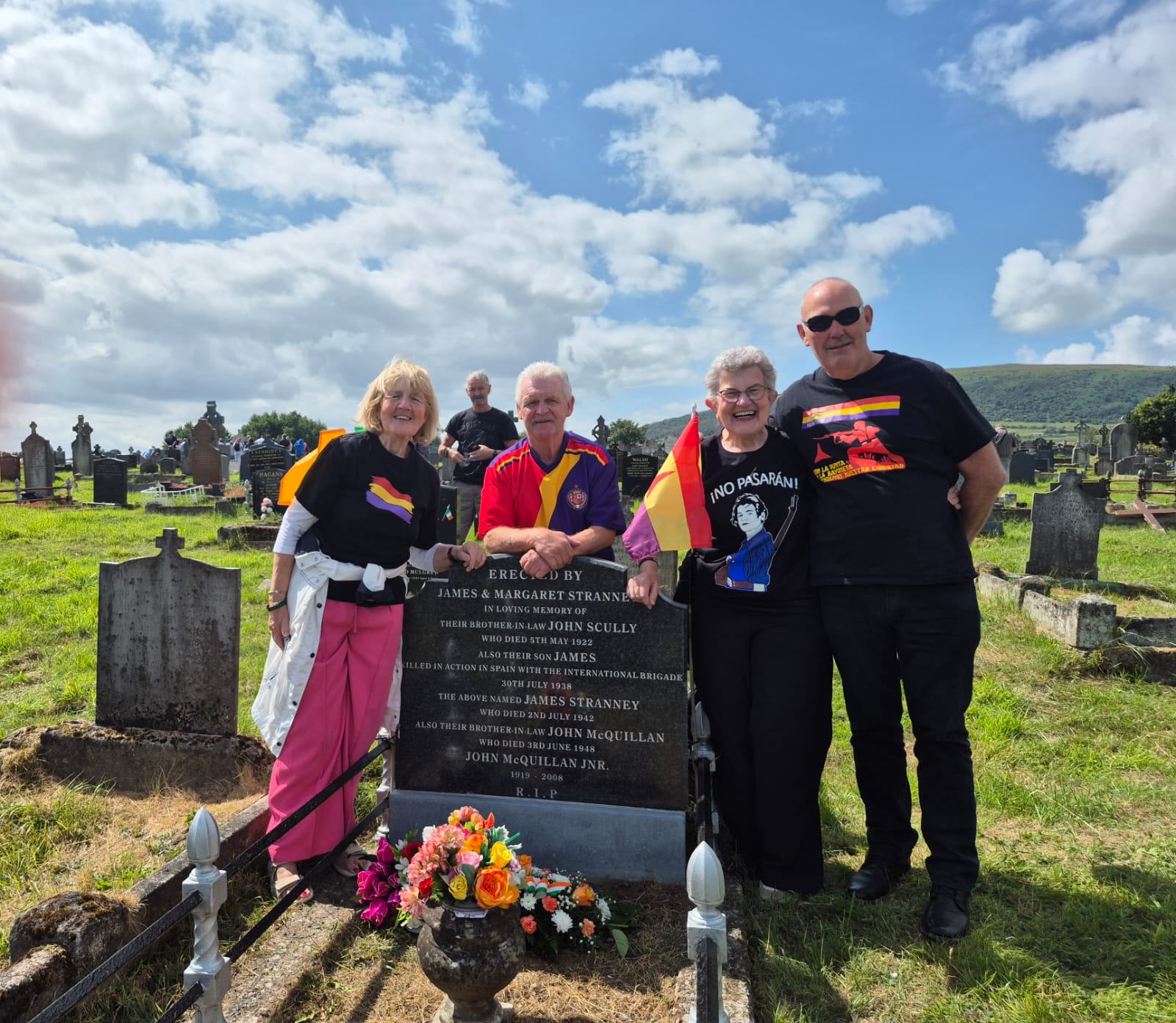
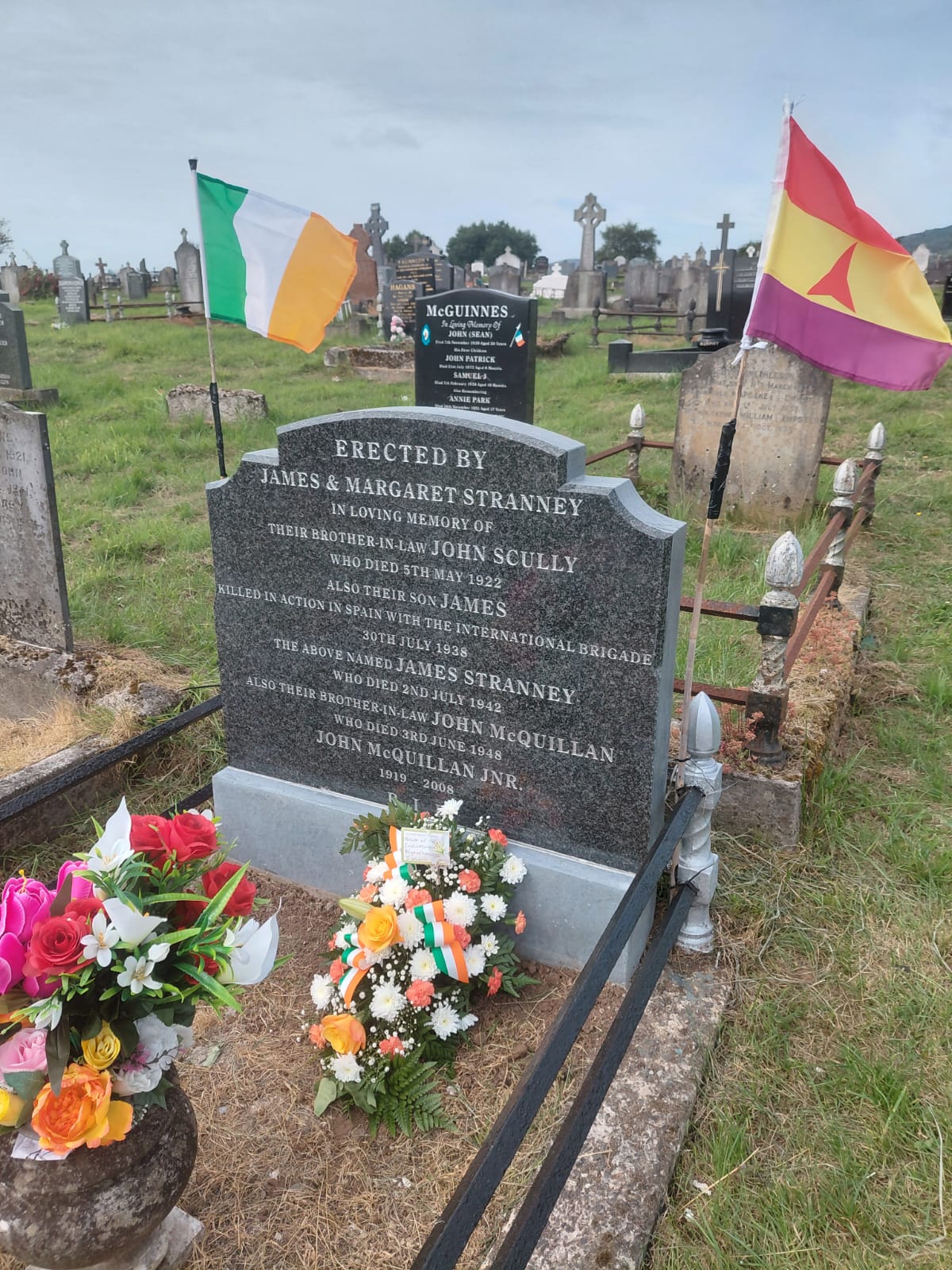
A COMMEMORATION event has taken place and a new headstone erected for a Short Strand man who fought and died in the Spanish Civil War.
Organised by the Friends of the International Brigades in Ireland (FIBI), the event marked the 88th anniversary of Jim Stranney's death.
Like countless others his remains lie in an unmarked grave on Spanish soil but his name was always included in the Stranney family plot in Milltown Cemetery. The previous headstone had fallen into disrepair.
Saturday's rededication marked its replacement, honouring Jim's life and what he stood for.
Born in 1911 on the Lower Falls, Stranney was raised in the Short Strand and witnessed the vicious fighting and social upheaval in the city during the Irish Civil War period.
Despite chronic levels of unemployment, he managed to find work as a labourer and a milkman but coming from a strong Irish republican working-class tradition, it was little surprise that he joined Na Fianna Éireann and then the IRA.
Defying IRA policy at the time he chose to fight in Spain – and his OC Jack Brady even accompanied him and his comrade Willie O’Hanlon to the Liverpool boat to begin the first leg of his fateful journey in late 1937.
Delivering a graveside oration, historian Seán Ó Coinn said: "It is a privilege to speak to you about a young man who without doubt is the epitome of the calibre of men who left this city to fight in a war that history has shown was morally correct and one that I have often cited as the opening shots of World War Two.
"I first came to this grave 28 years ago, because it was Jim Stranney who in the beginning inspired my interest in the Spanish Civil War, not through politics, but through history and community.

"When Jim made the decision to volunteer for Spain in the latter part of 1937, he turned to his boyhood friend and IRA comrade Willie O’Hanlon to accompany him on the hazardous journey that would take them from Belfast to Liverpool, then to London, across to Paris and finally through southern France, and over the Pyrenees into Spain.
"Jim had waited until he was in England before writing home to his father, as he knew he would have tried to dissuade him from volunteering to fight in a foreign war.
"The two men arrived in Spain on September 20, 1937 to undergo basic training and were issued with their service numbers within the British Battalion.
"Jim was No.1306 and Willie O’Hanlon, No. 1299.
"Having completed basic training, Jim and Willie were assigned to No.1 Company’s Anti-Tank Battery and saw action in the fighting at Teruel.
"During April 1938, they were both transferred to an Infantry Company and Jim was promoted to Corporal. The last major offensive of the Republican forces began on the July 25, 1938 in Catalonia with the town of Gandesa in Tarragona as a major objective.
"Five days later during an attack on Hill 481, around Gandesa, Jim Stranney fell in action, giving his life for a cause that for him was as dear as the republican ideals of his own country.
"Jim’s death had a profound impact on his father’s health and he died four years later to the month following his son’s death in July 1938.
"While Jim is immortalised in Christy Moore’s song, Viva La Quinta Brigada, I would like to briefly mention Jackie Patterson who like Jim originated from East Belfast before emigrating to Canada. He died in the same action against Hill 481.
"Jim Stranney, Jackie Patterson, Bill Tumilson, John Campbell and the many others who fell in Spain were Ireland’s loss. They were men of principle, and of conviction, and we bear witness here today, 90 years later, by our very presence at this grave, that their sacrifice was not in vain.
"Jim Stranney, you were of the people and for the people your life was laid."