We look at the stories that were making the headlines in the Andersonstown News this week in 1985...
THE management of the Andersonstown Leisure Centre have made an uncompromising defence of their decision to close down all the centre’s swimming pools during the busy summer months.
In a statement the Centre Heads say they "regret the recent inconvenience caused by the closure of the swimming pools”.
“However", they go on "such a decision must be viewed in the light of the circumstances that already exist within the Centre and the ongoing construction that is at present taking place."
The Management Spokesman says that when reconstruction began, it was divided into three distinct Phases: A. B. and C.

Phase A related to the Lower Corridor Area Squash/Handball Courts, Saunas, Relaxation Area.
Phase B, Main Hall, Minor Hall, Conditioning Room, New Equipment Stores, Administration Area and Social Area. Phase C, Pool Hall and Swimming Pool Area for progress. It was decided to keep the swimming pools open thus ensuring:
1. The use of good swimming facilities to the community, and thereby maintaining community interest, as well as a continued centre programme.
"It was therefore determined that once Phase A and B were completed, permitting these facilities to be made available to the public, then Phase C would commence.
“As it has happened the two former phases are almost completed, thus allowing for the commencement of Phase C. It is unfortunate that timing, due to construction, will result in the pools closing at what would seem to be such a critical time in the calendar year.
"Since the fire we have managed to at least keep part of the centre's facilities available to the community. After we close our pools, the new facilities of Main Sports Hall, new and improved Fitness Room, Social Area and Cafeteria will be available to the public during the summer."
PLANS: Site supervisor Arthur Donnelly officially hands over the completed all weather all purpose pitch at the Whiterock Leisure Centre to the Centre Manager, Danny Corrigan. The pitch will be useful for the coming season and the start of the summer scheme for the local children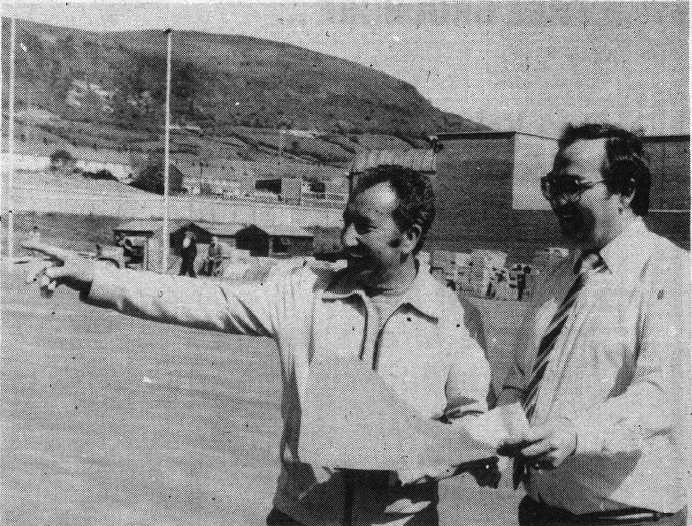

Britain criticised
THREE internationally respected legal bodies have backed Ireland's right to self-determination and blasted the 26 County government for refusing to raise the Irish issue at the United Nations. The groups – The International Association of Democratic Jurists, the International Movement of Catholic Jurists, and the International Federation of Human Rights – met in conference in Paris at the weekend to consider Britain's role in Ireland. After hearing submissions from a wide range of authorities, including Nobel prize winner Sean McBride, Kader Asmal (who chaired an investigation into the shoot-to kill policy last year), and the Association for Legal Justice, the jurists issued a lengthy statement. The primary conclusion of that agreed statement, drawn up by over one-hundred lawyers from France, Britain, Belgium, the United States and Ireland, reads:
"The International Conference of Lawyers for Ireland declares that the right to self-determination of the people of the whole of Ireland must be clearly recognised; observes that through the treaty of 1921 this right was denied; and calls upon the Government of the Republic of Ireland to assert vigorously the right to self-determination of the people of the whole of Ireland, and to ensure that the enforcement of this right is placed upon the agenda of the United Nations General Assembly and other appropriate international institutions.”
The lawyers also slammed the use of emergency legislation and special courts here, and in particular called for a curb on "the excessive powers of arrest and seizure" allowed to the RUC. They also called for the disbandment of the UDR.
The agreed statement denounced the use of plastic bullets "as a serious violation of human rights" and condemned strip-searching in Armagh Jail. It also considered that "as a matter of simple humanity Irish prisoners convicted in England should be able to serve their sentences in the country”.
The document condemned the use of accomplice evidence in trials here, and said the imprisonment of large numbers of people on the evidence of one person constituted "a disguised method of internment”. There was strong criticism of the Diplock Courts and extradition which the lawyers felt should not be permitted against those charged with political offences.
Editorial
ANYONE who remembers the antics at local government meetings in the Fifties and Sixties will not be completely surprised by what happened this week at the first meetings of local councils.
Years ago it was often the frustration of Nationalist politicians at being completely ignored and ostracised which raised the temperature at these meetings, and it is as well to remember that even in Derry City with its large Nationalist population, that the Unionists controlled the council by a cynical manipulation of electoral boundaries.
Let's not forget also that it was the blatant discrimination of a Unionist controlled Fermanagh District Council that caused the first murmurings of civil rights dissent in the late Sixties. The fact that a Sinn Féin man now heads that council, shows that things have progressed somewhat since the bad old days. Not only are the Nationalists not prepared to accept their designated role as second class citizens, but they are demanding and receiving their rights as first class citizens.
It is this change more than anything else that has caused the present Unionist furore, and we shouldn't be too concerned about it because it is only by letting the raging bull of extreme unionism bellow its head off, can it be exhausted and made to settle down with the rest of us in harmonious co-operation.
It will be difficult, because years of Unionist supremacy will be hard to shake off, but we are convinced that it is only by continual confrontation on a political level that the absurdity of unionist domination and British control can be exposed.
That the process will be slow and often bitter there can be no doubt given the reaction of Ian Paisley's daughter Rhonda at the first meeting of Belfast City Council. Her behaviour was described as disgusting by some Nationalist politicians, who were surprised at the strength of her reaction. If this is all we can expect from the younger element in the Unionist fraternity, then the process will be long and painful indeed.