NEW research from the Irish League of Credit Unions shows school costs are weighing heavily on families, with 71 per cent of parents saying covering back to school costs is a financial burden and almost two in five getting into debt. Conducted by iReach Insights in June 2026, the survey received responses from 560 parents across the North.
The annual Back to School survey by the ILCU has been updated in 2026 to provide a broader picture of school costs, from the initial back to school bill to the running costs families face throughout the year. This year’s survey also captures additional costs such as digital devices, branded sports clothing, musical instruments, school lockers, and tutoring.
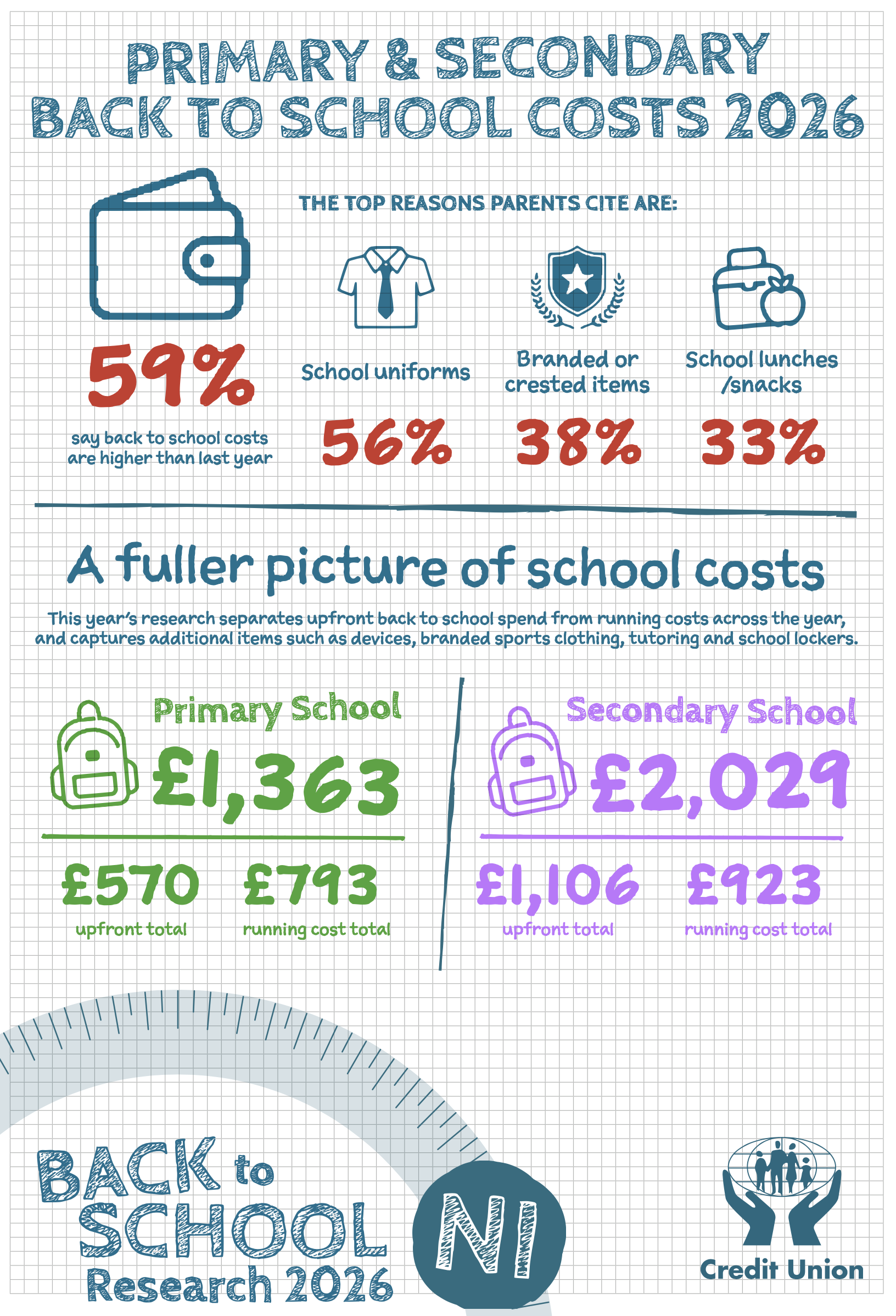
In 2026, primary school parents expect to spend a total of £1,363 across the school year, made up of £570 in upfront back to school costs and a further £793 in running costs.
Secondary school parents expect to spend £2,029 across the school year, comprising £1,106 in upfront back to school costs and £923 in running costs.
One parent responding to the survey summed up the pressure facing families: “Back-to-school costs are way too high for families to afford.”
Immediate and Ongoing Financial Pressures
Almost three in five parents, 59 per cent, say their overall back to school costs are higher than last year. Primary school parents are slightly more likely to report an increase, at 62 per cent, compared with 58 per cent of secondary school parents.
For those who perceive costs to be higher, the main reasons are school uniforms, cited by 56 per cent, branded or crested items at 38 per cent, and school lunches and food at 33 per cent.
Uniforms remain a clear pressure point, with 61 per cent of parents saying they feel under pressure to buy branded clothing, footwear, and other items for their children, up from 56 per cent in 2025. Just 17 per cent have been able to avail of a second-hand uniform, while one in four say none of the lower-cost purchasing options presented to them were available.
Parents also expressed frustration at rules limiting where uniforms can be purchased, with one calling for all uniform items to be available from supermarkets or generic shops and explaining that her daughter’s uniform “is available from only two shops, and her summer blouses were £20 each”.
Secondary school parents are more likely to be required to buy uniforms at full price from a named supplier, at 30 per cent, compared with 21 per cent of primary school parents. Reflecting concerns about the cost and lack of choice, one parent argued that uniforms “should not be branded and only available from one supplier”.
Technology is also adding to the pressure, particularly when children enter secondary school. Parents expect to spend an average of £159 on a laptop, iPad, or other device, while branded clothing for school sports teams costs a further £107 on average. As one parent explained, the cost of school “can vary greatly depending on what is needed”, particularly when families are required to purchase digital devices at the start of secondary school.
The findings also show that 90 per cent of parents say their child’s school asks for a “voluntary” contribution. The average contribution is £110, compared with £87 for a primary school child and £132 for a secondary school child.
The results come as new statutory measures on school uniform affordability begin to take effect across the North. While just 30 per cent of parents believe schools currently do enough to keep costs down, a further 43 per cent say they can see definite improvement. However, 27 per cent say they have seen no improvement.
Funding Back to School
The research found that 71 per cent of parents say covering back to school costs is a financial burden, up three percentage points from 2025. The pressure is similar across both levels of education, affecting 72 per cent of primary school parents and 71 per cent of secondary school parents.
Almost two in five parents, 37 per cent, say they get into debt to cover back to school costs, up one percentage point from 2025. Among those who borrow, the average amount of debt has risen by £47 to £301.
While the likelihood of describing school costs as a burden is almost identical at primary and secondary level, secondary school costs are more likely to result in debt. Some 26 per cent of primary-only parents get into debt, rising to 42 per cent among secondary-only parents and 56 per cent among parents with children at both levels.

General monthly income remains the most common payment method, used by 56 per cent of parents to fund school supplies, while 34 per cent use savings. The proportion using credit cards has risen from 21 per cent last year to 27 per cent in 2026, while a further four per cent turn to their credit union.
Parents are also cutting back elsewhere to cover school costs. Family holidays remain the most common sacrifice at 39 per cent, followed by summer camps or activities at 26 per cent. A further 18 per cent are sacrificing credit card payments, 17 per cent household bills, 16 per cent food and nine per cent loan repayments. For some, this is affecting everyday spending, with one parent saying, “I’m struggling so much that I have had to cut back on my daily routine.”
More than one in three parents, 35 per cent, say they are forced to deny their children certain back to school items because they cannot afford them. Of those parents, 43 per cent cannot afford extracurricular activities, 33 per cent school trips, 32 per cent new gym gear and 29 per cent new shoes. One parent questioned how these costs could be reconciled with the principle of free education, saying that while some uniform expense was understandable, “the additional costs throughout the year and dinner money are just too expensive”.
Martin Fisher, Irish League of Credit Unions, said: “The real difficulty for families is not any one item, but the accumulation of costs across the school year. The initial outlay on uniforms and equipment is followed by lunches, transport, trips, and activities, leaving parents with little opportunity to recover financially. For families already using savings to meet higher food costs during the summer, the new school year can begin before their finances have had any chance to reset.
“The findings also show that this is not solely an issue for the lowest-income households. Families who fall outside existing supports can still struggle with large, unavoidable costs, particularly at secondary level. Greater flexibility around uniforms, fewer branded requirements and earlier notice of expenses would give parents more control. Anyone concerned about meeting the costs should speak to their local credit union before turning to expensive short-term borrowing.”
Other findings from the 2026 research include:
Fewer than one in three primary school children, 29 per cent, receive and avail of free school meals. At secondary level, 20 per cent are eligible and avail of them, while 68 per cent do not have the option of subsidised meals.
Almost four in five parents, 78 per cent, have experienced at least one financial impact because of increased food costs during the school holidays.
One in three parents, 33 per cent, have used savings because of increased food costs during the school holidays, while 31 per cent have reduced spending on other household essentials and 27 per cent have cut back on leisure or family activities.