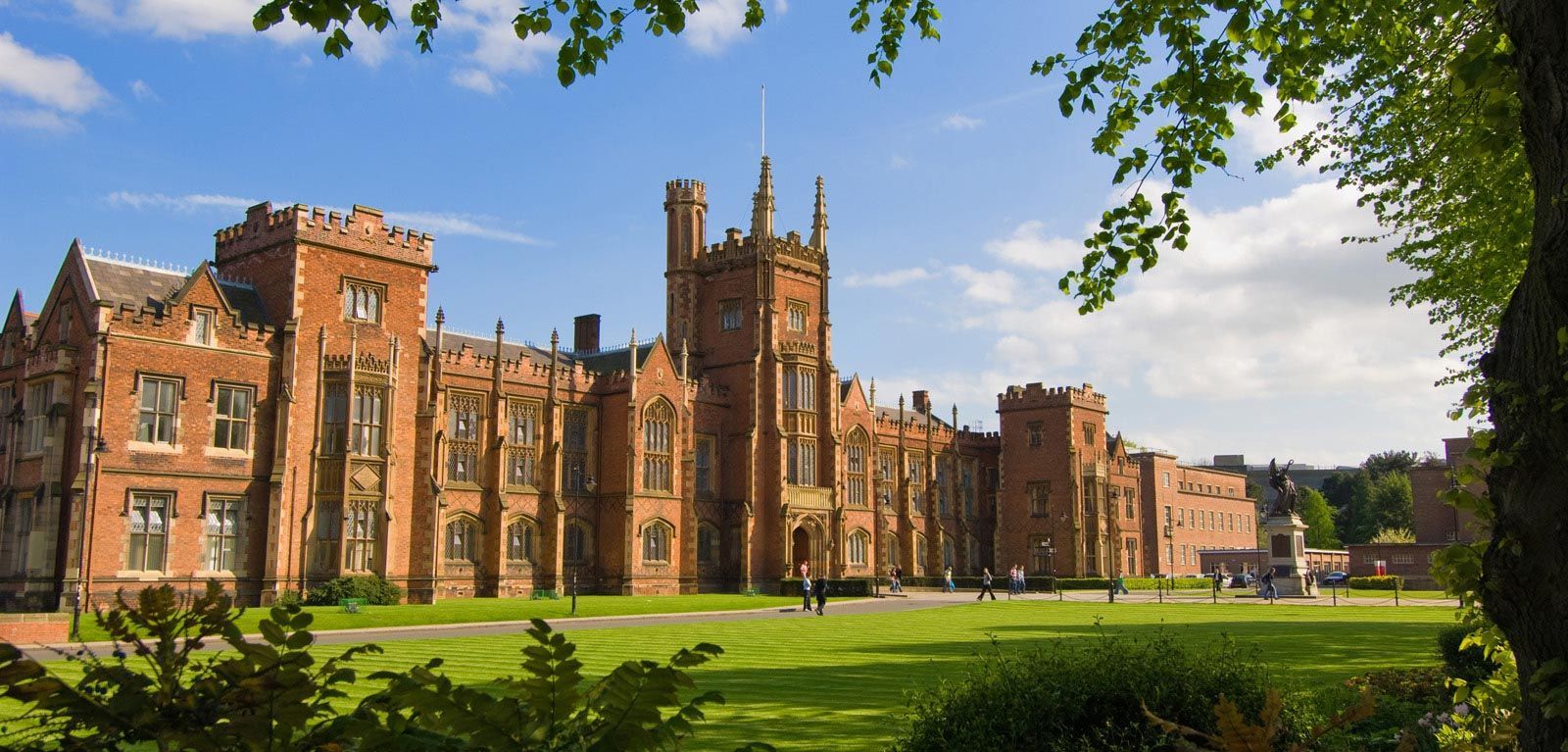
STUDENTS at Queen's have voted to place Irish on an equal footing with English at the university in what has been hailed as a "defining moment for the Irish language" at the uni.
A ten-day online referendum closed on Thursday with the result published today. 4,607 (91.88%) voted in favour of the referendum with 407 (8.12%) voting in opposition.
It's almost 30 years since Queen’s removed dual-language signage from the Students' Union building back in 1997. Although Friday's result is not binding, the scale of the majority will put further pressure on the university to implement dual-language signage on campus.
The following provisions have now been ratified as per the referendum text: “That QUB adopts an Irish Language Policy that gives the Irish Language equal status to the English Language as an official language of the University.
That QUB adopts an Irish Language Policy that implements a bilingual corporate identity for the University and Students’ Union, to include: official bilingual name and official bilingual logo for the University.
That QUB adopts an Irish Language Policy that implements physical bilingual signage in English and Irish throughout campus.
For improved services for Irish-speaking students, which may include: official university forms available in Irish, administration services available through Irish, graduation certificates available in Irish.”

Speaking after the result Eoghan Ó Conghaile from An Cumann Gaelach at Queen's said today marks "a defining moment for the Irish language community at Ollscoil na Banríona, Béal Feirste". He said he hoped the university would respect the students' decision and implement the bilingual policy.
“This result reinforces what we, as a Cumann, already knew: that there is significant interest, demand and support for the Irish language right across Queen’s campus and beyond. An Ghaeilge continues to thrive and grow right across society, enriching the lives of everyone who chooses to engage with it. The outworkings of this referendum will completely alter the linguistic landscape of a university whose outdated, monolingual approach has spanned across decades.
“Our experience with Queen’s University has become a microcosm of the everyday lived experience of countless Irish speakers right across the North, where our most reasonable calls for equality are consistently sidelined or vetoed, pending support or approval from a tiny minority who are fundamentally opposed to the Irish language. This approach has fostered an environment of exclusion and marginalisation, rather than that of inclusion and equality that the university should pride itself upon.”
Comhghairdeas ó chroí libh a chairde @ACGaelach_QUB. #CeartaTeanga https://t.co/KAI9MsDBR5
— Conradh na Gaeilge ⭕️ (@CnaG) March 20, 2026
He added: “We now eagerly await the immediate reinstatement of dual language signage in Queen’s Students' Union and the erection of that same signage right across Queen’s University campus and take this opportunity to call on the Vice-Chancellor, Professor Ian Greer, to provide a public timeframe and commitment for the development and implementation of a comprehensive Irish language policy for Ollscoil na Banríona, Béal Feirste.”
Speaking following the publication of the results of the referendum, Ciarán Mac Giolla Bhéin, President of Conradh na Gaeilge, said: “As a former student at Queen’s who was studying Irish after the university had taken down dual-language language signs from campus, I am absolutely delighted with the historic outcome of this referendum.
"Students have now given Queen’s University and the Students Union a very strong and powerful mandate to implement language equality and give Irish equal status to English as an official language of the University. Senior Management of Queen’s must finally bring to an end their ‘English-only’ policies and immediately implement a comprehensive dual-language approach that is deeply rooted in best-practise and inclusiveness.
"These results demonstrate, as similar public consultations have demonstrated over the years, that there is widespread public support for provisions to support the Irish language in public life here."