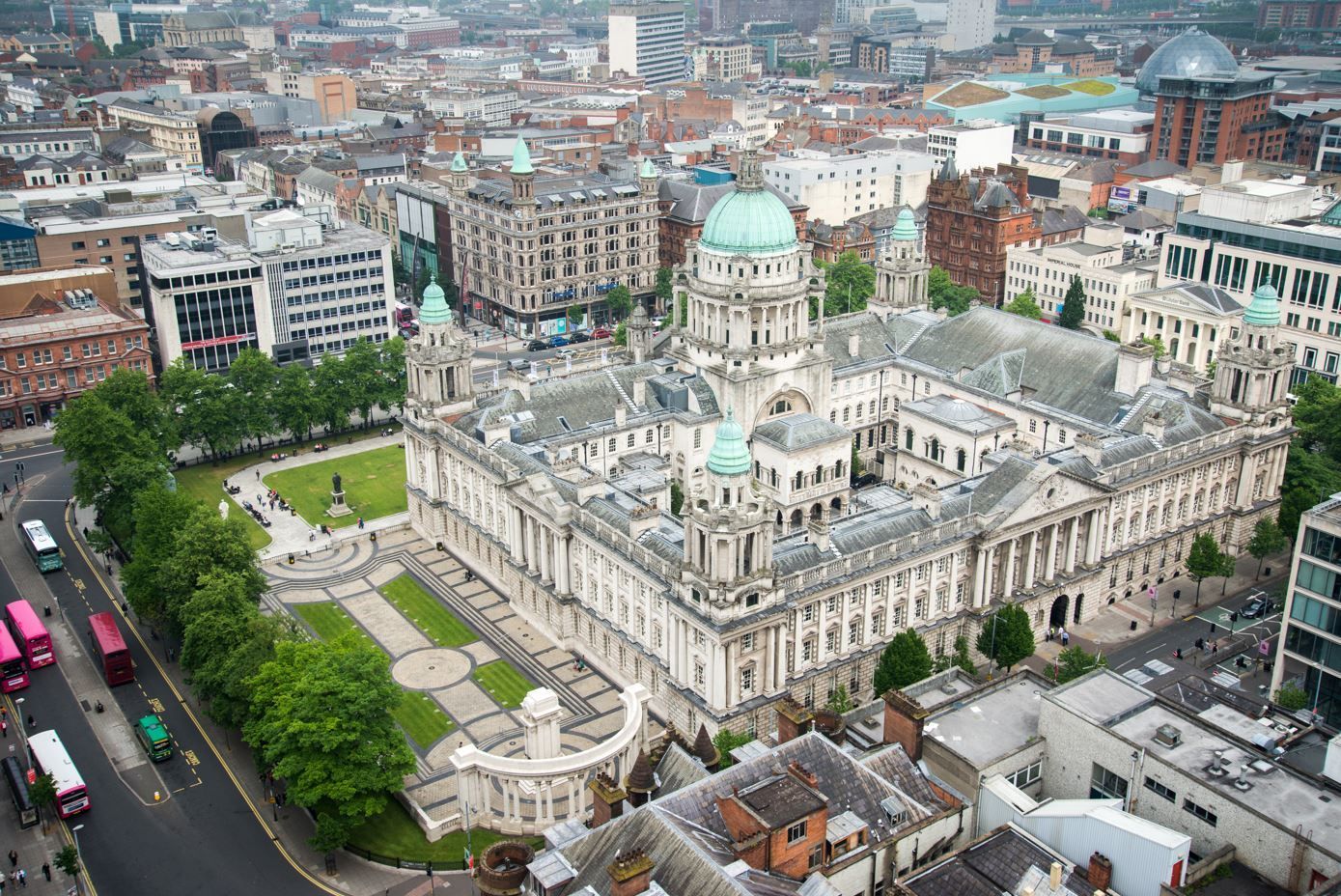
A GIANT step forward for the Irish language was taken this week with the, eventual, passing of a new City Hall policy — backed by £1.9m of spend — which will embed An Ghaeilge into every aspect of Council life.
Bin lorries, Council buildings, the International Convention Centre, even modest litter bins will, from here on in, feature signage in both Irish and English.
Despite unionist misgivings, this clear statement of diversity and inclusion will only boost Belfast's fortunes and prove a boon to all the people of Belfast.
For what the policy merely does is give the official seal of approval to what is already the reality.
Of course, a visitor from Mars popping into PSNI headquarters, Queen's University, the BBC or any of the other august establishments of this great city would, judging by the monolingual signage, presume Irish is not spoken in Belfast. Nothing could be further from the truth.

In fact, the monolingual signage of these institutions reflects not today's vibrant, multicultural Belfast but the city of yesteryear. Ruled by an intolerant unionist majority, the city, back then, turned its back on its priceless Irish heritage in a regrettable act of cultural self-harm. Sadly, unionists conspired to 'disremember' not just their noble Presbyterian ancestors who had risen in '98 but also their rich history of fostering the Irish language.
Over time, the absence of Irish - as seen today across too many of our institutions - became normal.
However, it was never normal for the Northern authorities and their proxies to effectively 'ban' Irish from all aspects of life – from schools (where it was purged by Stormont from the primary school curriculum), from the media where it took the BBC 60 years to work up the nerve to broadcast a 15-minute radio programme in Irish, and from every civic building and published document.
Normal is Irish being seen and heard in Belfast.
Thus we welcome Belfast City Councils' move to to place Irish back in the cherished position a language which has warmed souls here for over 2,000 years deserves.
Where the Council, the oldest democratic body in the city, goes, others will undoubtedly follow.
No doubt this move to normalise Irish will be jarring for some – note the BBC reporting breathlessly on the fact that incoming Lord Mayor Róis-Máire Donnelly is an Irish speaker, as if that news was so exotic that it deserved to headline their reporting. If the incoming First Citizen was a speaker of Kashubian or Minangkabau, we could understand the BBC focusing on her multilingualism but is it really news to the BBC that Irish is the lingua franca of a whole swathe of West Belfast society?
40 years ago, a prominent unionist politician, over whose name we need not dally, announced that there would never be a Lord Mayor of Belfast who could speak Irish. Since then there's been a handful of Lord Mayors fluent in An Ghaeilge and more than a few unionist first citizens who had a good stab at the cúpla focal.
And the Dome of City Hall has not fallen in.
For the truth is that a Belfast which hears Irish, which speaks Irish, which sees Irish on hospital signage, which has Irish emblazoned on its police vehicles and ambulances, which has bilingual notices in its central station (need we go on?) will be a better Belfast.
So kudos to our Belfast councillors for normalising the Irish language — and for signalling the way forward for the linguistic laggards in other citadels of power. Maith sibh.