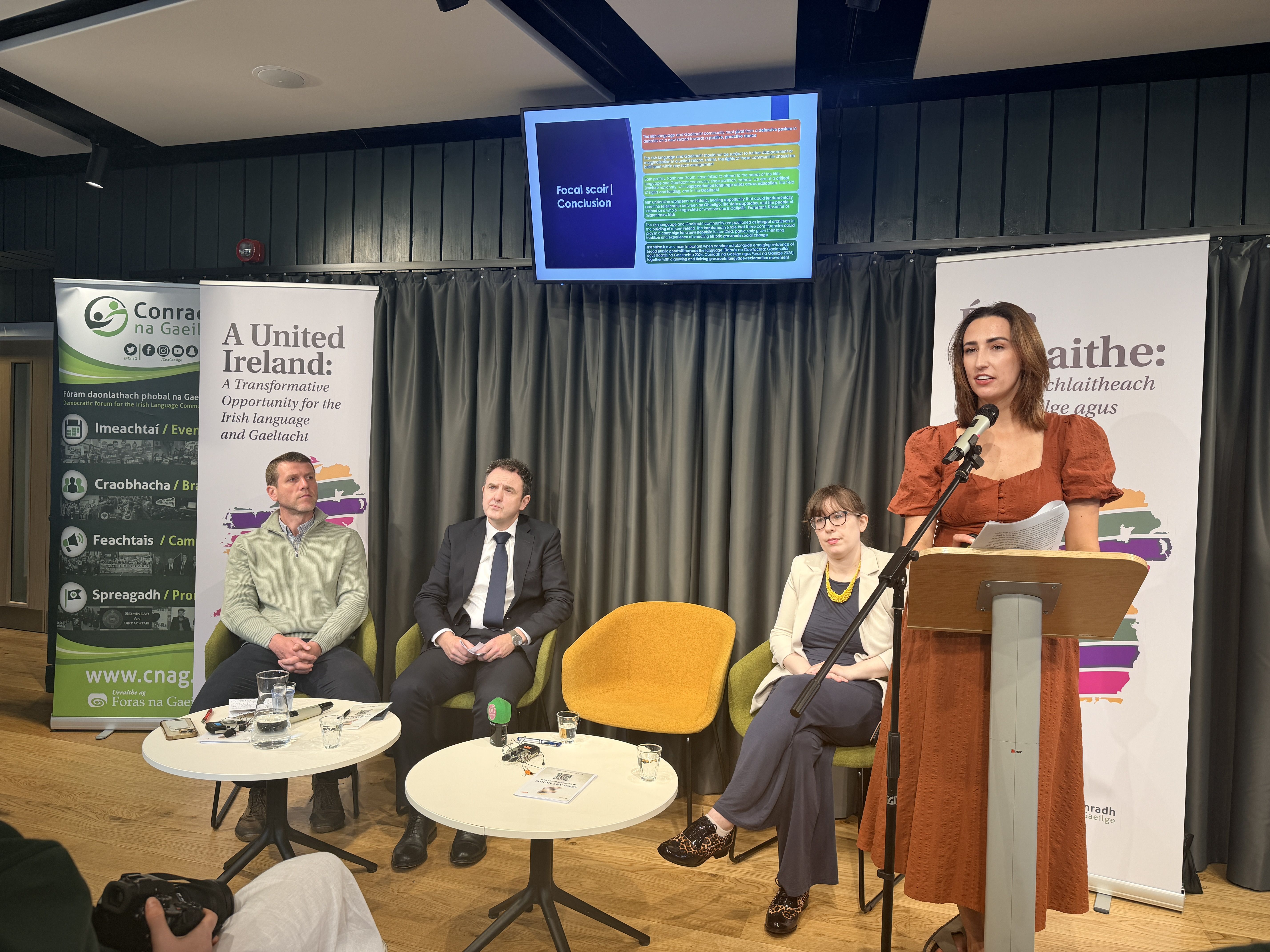
A NEW research report by Queen’s University in Belfast argues that the Irish language community "should seize the historic opportunity" presented by conversations around a United Ireland.
A United Ireland: A Transformative Opportunity for the Irish Language and Gaeltacht was launched on Tuesday at the Séamus Heaney Centre at Queen’s University. It was commissioned by the democratic forum for the Irish-speaking community, Conradh na Gaeilge.
The report was introduced by its author and lead-researcher Róisín Nic Liam. Also speaking at the event was Conradh na Gaeilge President, Ciaran Mac Giolla Bhéin, and Professor Colin Harvey, Professor of Human Rights Law in the QUB School of Law, who was recently appointed to the Council of State by the Uachtarán na hÉireann/President of Ireland in March 2026. The event was hosted by Dr Síobhra Aiken, Senior Lecturer, Department of Irish and Celtic Studies, Queen’s University Belfast.
The report argues that the Irish language community “should seize the historic opportunity presented by the conversations on Irish unity to articulate its own progressive vision and its own demands regarding the future of the language and the Gaeltacht.” The report contends that the Irish language and Gaeltacht communities must “pivot from this defensive position in debates on constitutional change towards a positive, proactive stance”, and that “such a reconfiguration will ensure that the indigenous language of Ireland, and its speakers, are not further marginalised in any future political arrangement.”
Speaking at the launch of the research report at the Séamus Heaney Centre at Queen’s University Belfast, Ciarán Mac Giolla Bhéin, President of Conradh na Gaeilge, said: “In 2019, as the debate around the constitutional future of Ireland gathered momentum, the Ard-Fheis unanimously agreed a motion to kickstart a new national conversation on the role of the Irish language in a new Ireland, mandating a series of debates, discussions and assemblies concerning language rights and the prospects to transform the status of Irish as a result of constitutional change.
"Since then, Conradh na Gaeilge has convened conferences relating to the role of the language and the Constitution in a new Ireland, and how a united Ireland could impact Irish Medium Education, the Gaeltacht and Irish language policies, strategies and legislation north and south. In 2023 Conradh branches and members unanimously agreed a motion to develop research into the role of the Irish language and Gaeltacht in a united Ireland and set out our vision for the time ahead. Since then, we have commissioned Queen’s University Belfast to undertake the research and we were delighted to have Roisin Nic Liam author the report.
“We are delighted to finally present the report to the public and we hope it becomes a major catalyst in the reframing of the debate around the Irish language and Irish unity, one based on rights and respect, where constitutional change is viewed as a generational opportunity for genuine equality and transformative change, and an end to centuries of marginalisation and oppression against Irish speakers across this island and in which the language can act as a catalyst to inspire a more inclusive, progressive vision for a new Ireland.”
The author of the report, Róisín Nic Liam, researcher at Queen’s University Belfast, said the report is a "timely intervention which encourages the Irish language and Gaeltacht community to set out a positive, progressive and rights-based vision for the language in any new political arrangement".
"Indeed, the transformative opportunities offered by potential constitutional change are outlined, and a new, united Ireland is ultimately determined as an unprecedented opportunity to radically reset the relationship between an Ghaeilge, the state, and the people of Ireland in general, following the failure of both the Northern and Southern jurisdictions, despite some historic progress in recent years, to adequately attend to the needs of Irish language and Gaeltacht communities since partition.
“To date, many of the conversations on constitutional change have framed the Irish language through an incredibly regressive and negative lens, rather than as a living community language across Ireland, and subsequently, as a rights-based issue. This has resulted in the Irish language being proposed by academics and senior politicians alike as something which must be reconsidered or ‘de-emphasized’, in the event of Irish unity, or offered up as a bargaining chip or a symbolic concession to be negotiated.”
“The report concludes by positioning the Irish language and Gaeltacht community as “integral architects” in the shaping a new Ireland, recommending that the community “should seize the historic opportunity presented by the conversations on Irish unity to articulate its own progressive vision and its own demands regarding the future of the language and the Gaeltacht.”