WHILE there’s an increasing appreciation of the fact that pallets used in Eleventh Night bonfires are stolen property, the sheer extent of the criminality involved in the annual outbreak of lawbreaking is off the scale.
That’s according to a man we’ve spoken to who has spent his entire working life in the freight and delivery business. He says the most serious crime is also the least-known – the widespread intimidation and threats that allow bonfire collectors to take what they want where they want.
Today we lift the lid on the immense amounts of money involved and the extent of the intimidation, which stretches from the back yard of local convenience stores to the loading bays of high-volume manufacturers and distributors and the vast depots of the multinational supermarkets. And we reveal that the pallet-theft is so huge and so endemic that the police know exactly what’s going on – but choose to turn a blind eye.
This is the story of one of the biggest and most common crimes that our society is faced with today. A crime that has cost countless millions over the years, a crime for which no-one has been – or most likely ever will be – detained or arrested, never mind jailed.
PALLETS – WHAT’S THE STORY?
All too familiar and always taken for granted, the humble pallet is quite simply the beating heart of mammoth global logistics industry. There is little that we consume – from a Kit-Kat to a washing machine – that has not come to you stacked on a pallet.

Quite simply, pallets are forklift-enablers. They are shallow wooden (occasionally plastic) platforms that allow large amounts of stacked goods to be easily lifted and transported on to and from lorries and around yards, warehouses and shops by forklift. They are also important in storage in that they keep valuable goods clear of cold and damp flooring and allow for convenient stacking. Pallets come essentially in two forms: the cheaper unpainted and untreated pallets – known in the industry as ‘white wood’ pallets – which are to all intents and purposes disposable. These are made of thinner, lighter wood and their life cycle, even if not stolen, is a relatively short one. Pallets painted blue and red, meanwhile, are made of thicker and more robust wood and are manufactured to much more exacting standards that allow them to remain in the supply chain for years. That means, of course, they’re much more expensive.
WHO OWNS WHAT?
The blue pallets are the exclusive property of one company, CHEP (Commonwealth Handling Equipment Pool), an Australian company with a massive global reach. The red pallets, rather less common but manufactured to the same durable specifications, are the exclusive property of French company and CHEP competitor LPR – La Palette Rouge/The Red Pallet. (For the sake of convenience ‘blue pallets’ in this report will refer to all of the more expensive and durable pallets.) The cheaper and flimsier white wood pallets are generally owned by manufacturers and retailers and are bought and sold in bulk on the open market.
WHO USES WHAT?
It does not make financial sense for manufacturing and retail companies which move unimaginably large amounts of freight – Cadbury’s, Boots, Heinz, Tesco, and so on – to buy or own their own pallets. Therefore they lease pallets, overwhelmingly from CHEP AND LPR. So the pallets are part of a circular supply chain of lease-and-return. Naturally, this business model dictates that when manufacturers and retailers fail to return pallets – overwhelmingly when they are stolen for bonfires – financial penalties apply.
NUMBERS GAME
Estimating the number of pallets stolen every spring and summer across the North is an impossible task. The pallet leasing companies and the manufacturing and retail companies won’t release commercial information, and as we will see, they are reluctant to antagonise the pallet thieves. So what we’re left with are necessarily rough estimates based on visual evidence; information provided by bonfire builders; and media reports.
From online newspaper and broadcast sources, and from loyalist cultural websites, the best estimate is a very rough one – around 200 to 300 bonfires are built annually across the North. A 2021 interview with the builders of the Craigyhill bonfire in Larne contained the claim that the bonfire consisted of 17,000 pallets. That bonfire is a notably large one, which has grown considerably bigger in the five years since as the builders unsuccessfully attempted to win a place for their bonfire in the Guinness Book of Records and last year stood at around 210 feet. But it is far from unique. We are in the era of ‘super bonfires’ when builders and districts attempt to outdo each other in height and scale. Any estimate of the entire number of pallets stolen in a single spring/summer cycle must consider the smaller rural bonfires, standing at perhaps 10 to 20 feet; the standard bonfire, which is perhaps 30 to 40 feet in height; and of course the monster bonfires which capture the headlines year after year.
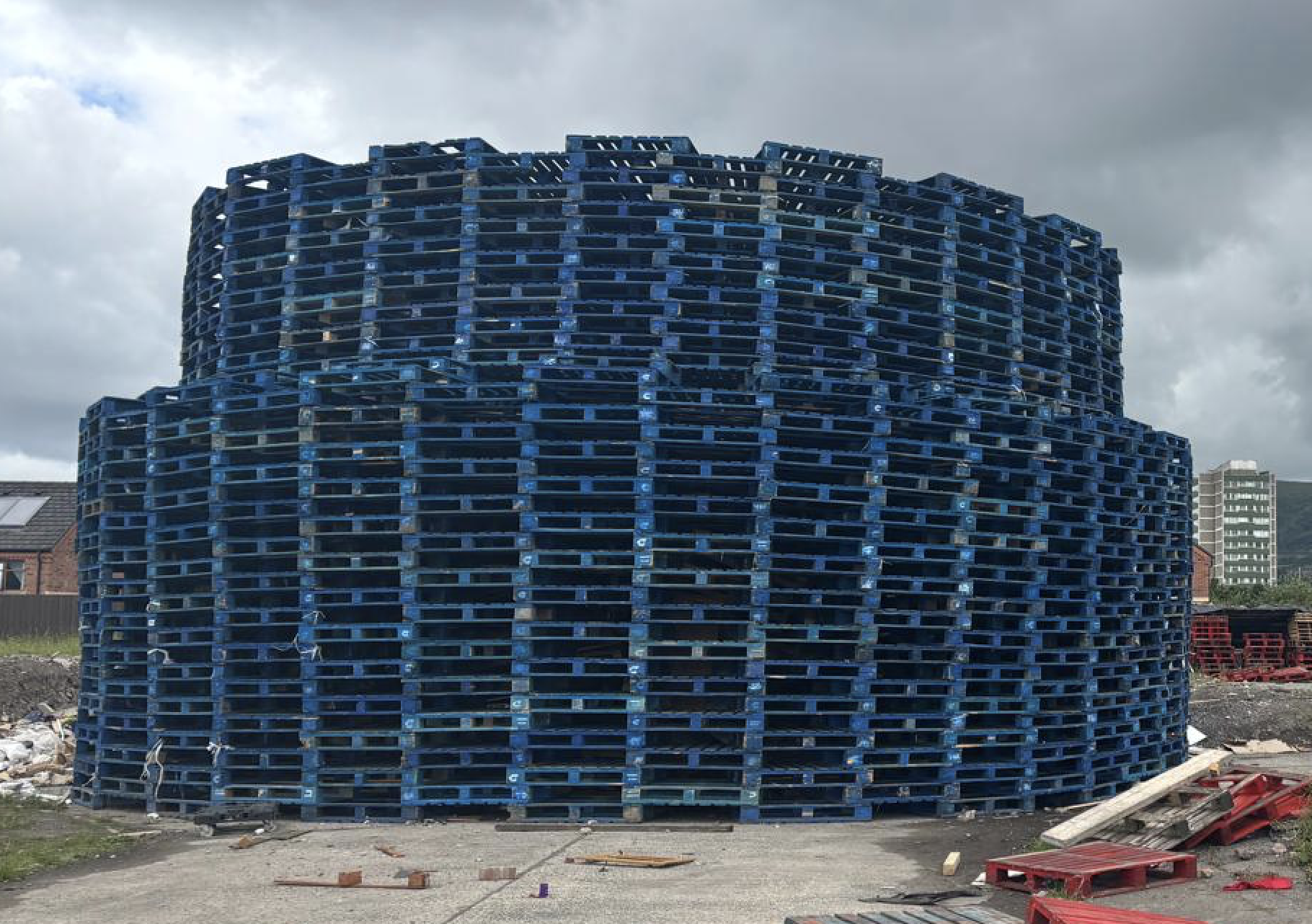
HERE’S WHAT A HALF-MILLION POUND BONFIRE LOOKS LIKE... According to the bonfire builders, there are at least 17,000 pallets on this Craigyhill bonfire. 80% are the most expensive red and blue type – every single one stolen. That figure is from 2021. Today the bonfire is much bigger. Based on the 2021 figure, the pallets on this bonfire are worth £414,000. That sum is paid by the manufacturing, retail and freight companies – and ultimately by you, the customer
CRIME SCENE: The monster Craigyhill bonfire in Larne;

MIX AND MATCH
The value of blue pallets to bonfire builders is the same value that they have for the freight industry: strength and durability. The cheaper white wood pallets are simply not strong enough for taller, heavier bonfires and will crack, splinter and/or crumple at a relatively low height. Blue pallets, on the other hand, are heavy load-bearing pallets more suited to bigger heights and weights. Generally, the blue pallets are used for a strong and solid bonfire base and the white wood pallets are in great numbers higher up, interspersed with shallower reinforcing rows of blue pallets so that the bonfire looks like a layer cake.
SO WHAT’S THE DAMAGE, CHIEF?
A visual inspection of bonfires suggests that blue pallets generally make up around 50 per cent of the average bonfire. The CHEP penalty imposed on a company on failure to return a leased blue pallet is £28 per unit. The notorious Craigyhill bonfire, however, pictured above, is so huge that its mammoth weight requires around 80 per cent blue and red pallets. Let’s stick with the 2021 figure of 17,000 out of an abundance of caution. 80% of 17,000 is 13,600, which means the cost of the stolen blue and red pallets to industry is £380,800. With white wood pallets coming at a cost of around £10 per unit, the total cost of stolen pallets on this bonfire alone is £414,000. As for the overall picture, we can only extrapolate (again, conservatively). Let’s take the lower end of the estimated annual bonfire number – 200. Those comprise monster bonfires, mid-range bonfires and smaller local bonfires. If we put the average size of a bonfire at just just 20 per cent of Craigyhill (ie 40 feet), and if we reduce the number of blue pallets in them to 50 per cent, we arrive at a figure of around £20 million per annum in stolen pallets. And as you can see from our maths, that figure is almost comically conservative.
CHEERLEADERS
Year after year, broadcast and print media are happy to join in the festival spirit encouraged by bonfire builders and local community groups. This despite the fact that the bonfires are in reality nothing more than vast repositories of stolen goods. Feelgood stories abound about that Guinness World Record attempt, for instance; adjacent children’s play spaces; bonfire building techniques; family days out; picture specials fill double pages; and so on and so on. The almost entirely benign media atttitude towards the bonfires and associated pallet crime takes the pressure off the police, who have repeatedly shown themselves to be hugely reluctant to get involved in bonfire controversies. And of course local unionist politicians either say nothing or actively defend the bonfires as a vital aspect of traditional Orange and loyalist culture. What seems clear is that as the bonfires keep getting bigger every year and more and more pallets are stolen, the police will continue to sit on their hands while industry waits for the help they’re too scared to ask for.
• We asked the police for figures on pallet theft arrests and charges – they invited us to submit a freedom of information request. CHEP and the Department for Infrastructure had not replied to our queries as we went to press.