DUTCH is a tough language to master. Not as tough as Portuguese, which I’ve been trying to get my head round without a great deal of success for some years now as a mark of respect for my Portuguese son-in-law and my Portuguese-Irish granddaughter.
Dutch is a mish-mash of Germanic, Romance and English influences, delivered in a back-of-the-throat, no-nonsense way whose cadences and subtleties are unknowable to all but its native speakers.
Me and my mate Al fell victim to Dutch once when we were very young – 18 or so. We were working a summer job of boxing tulip bulbs while staying in a campsite outside the south Holland town of Noordwijk.
It was a summer of long, badly-paid days in a warehouse followed by boozy evenings of Amstel lager and pool in the campsite bar. One hot day in a bookshop in Noordwijk I bought a thick omnibus of James Herriot’s All Creatures Great and Small and every night from then on when the two of us got back to the tent happy and drunk, I’d read the book to Al by lamplight, being scolded by him every time I forgot to do the dialogue in my not-bad Yorkshire accent.

“Nah then, Maister ‘Erriot, what does tha reck’n abaht Daisy’s chances?”
“Ay oop, Vit’nry, tha’ll be gooin’ easy on’t bill this time rahnd, in’t that reet?”
I’d stop reading from time to time to see if Al was still awake and when he wasn’t I’d fold the page and slide my book arm into the sleeping bag. Mornings bright and early after cornflakes and cheap cola we’d take our towels, toothbrushes and enamel mugs and bowls to the wash hut. Some yards away from the hut door was a large sink, over which was a water tap and a hinged wire cover. Before entering the hut we’d wash our mugs and bowls there and leave them to drip-dry on the wire while we washed.
There was always a lot of holidaying German families on the campsite, Noordwijk being a seaside town, and sometimes we would play badminton with the older kids, with whom we got on well. But every morning as we washed our mugs and plates at that big sink their parents would regard us sternly and either ignore our cheery greetings or mumble something non-commital. We put it down to the fabled German boorishness and hid our hurt feelings with a bit of the old “F**k you” Belfast spirit. Came the time when an English bloke arrived on the campsite to work in the same place as us. He was a grizzled tulip fields veteran of at least 25 and in the campsite pub on the night of his arrival he regaled us with advice-laced stories of his previous Noordwijk tours of duty.
Next morning he arrived at the big sink just as we were finishing our washing-up. “What in Christ’s name are you doing?” he asked, his eyes wide in disbelief. Receiving no information from our blank expressions, he pointed to a sign in over the sink which was too much for our ‘twee biertjes’-level Dutch.
Long story short, turned out the sign read ‘Empty your chemical toilets here and rinse after use.’
We looked at each other, me and Al, together coming to a fuller understanding of those German dirty looks. Teenagers are achingly susceptible to blows to the ego and it was some time before the humiliation began to subside. And it was many years before we realised that more important than the fleeting sting of embarrassment was the significant PR damage we inflicted on the Irish nation.
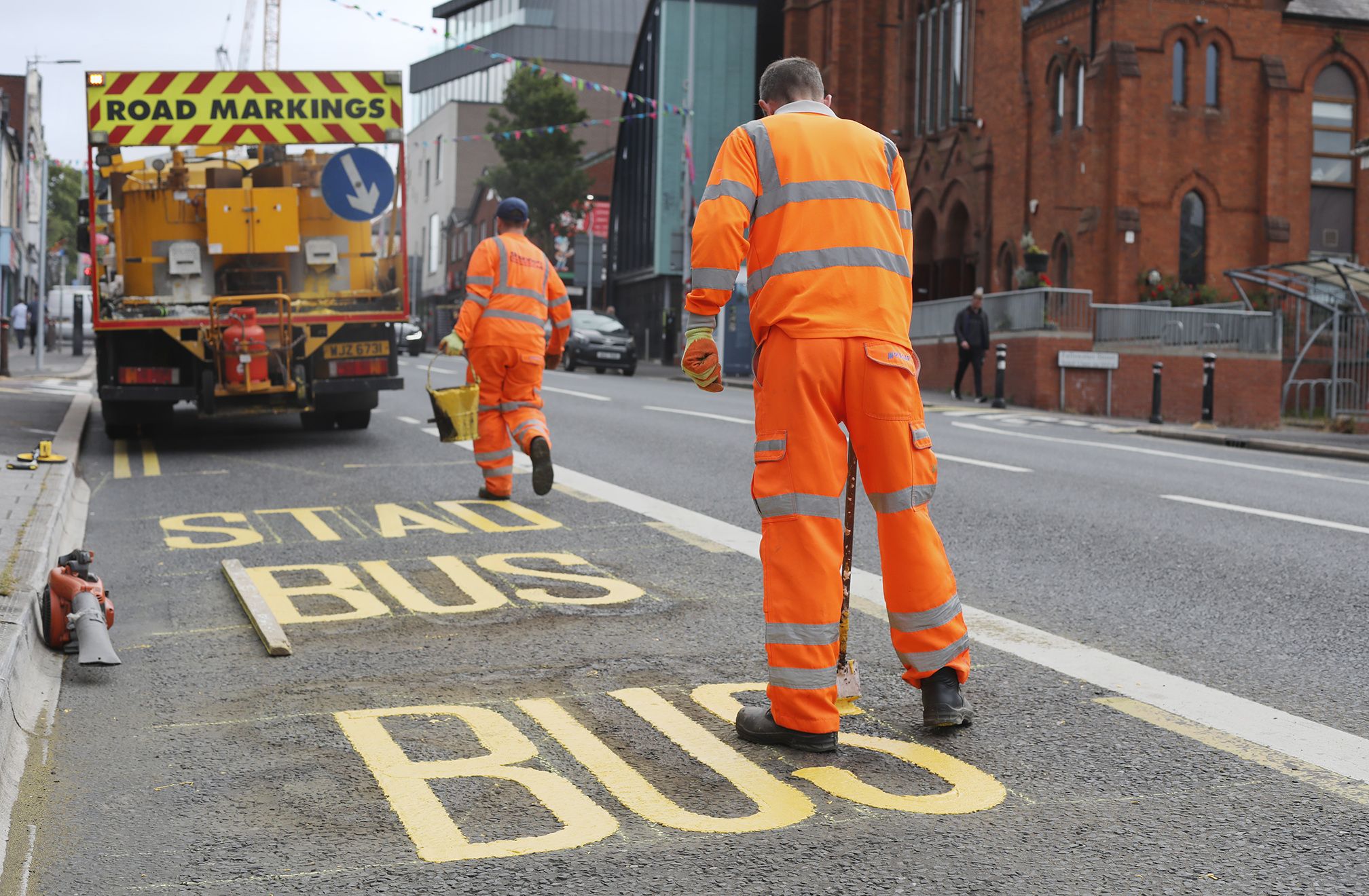
What’s this all about?, you’re doubtless wondering as you harrumph at your paper or your phone. Well, it’s just that this week they began painting the tarmac on the Falls in Irish: ‘Lána Bus’ on the bus lanes and ‘Stad Bus’ at the bus stops. And the media coverage prompted the usual round of online disgust/contempt/fury from increasingly disgusted, contemptuous and furious subjects of the Kingdom of Loyal Ulster.
‘Way to confuse the public, lads.’ ‘Who’s paying for this nonsense?’ ‘No idea what that means.’ But let’s be honest here, ‘Lána Bus’ is not ‘Lieg hier uw chemisch WC en spoel daarna af, bedankt.’ No motorist is going to evade a fine for driving in the bus lane by claiming they didn’t know what Lána Bus means, particularly when the words are repeated in English beside it.
Which is to say that ever-louder and ever-more shrill objections to dual language signage in our public spaces are not based on technical concerns, as is often claimed. Nobody who uses public transport is going to be adversely affected by an imaginary arc of unwelcome possibilities stretching from ‘Missing the bus’ at one end to ‘Getting run over’ at the other. The difficulty that some ordinary unionists and all political unionists have with the Irish language, when we get right down to it, is not the smorgasbord of grievances financial, utilitarian and egalitarian that they evince. It’s just that they don’t like looking at it. And the DUP, UUP and TUV don’t like looking at Irish simply because every word they see translates into ‘Change’ and every sentence they read translates into ‘Those days are gone, pal.’
I’m not going to pretend that the Irish language problem of unionists is less acute or more easily fixed because it’s one of discomfort rather than rights; far from it. I can’t fluff up the pillows for Gavin Robinson, Jon Burrows and Jim Allister; all I can do is tell them that I’ve spent a lifetime of growing up and living in a city that was not indifferent to my Irishness but actively hostile to it. And from where I’m sitting two languages is a pretty good deal when the alternative is them taking over that well-worn seat that I’ve recently vacated.