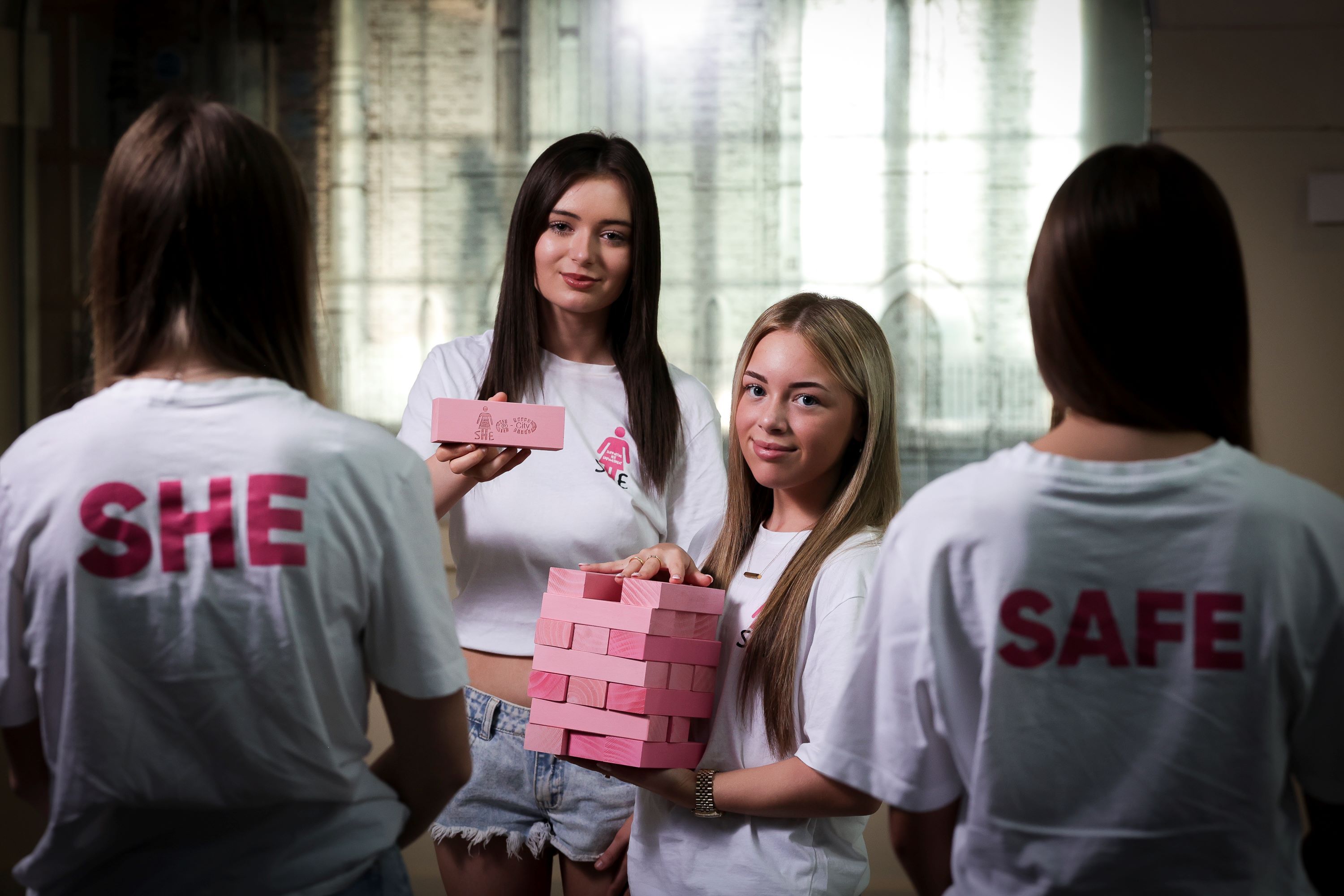
YOUNG girls in North Belfast have come together to develop an interactive game to help end violence against women and girls – block by block.
The SHE: Building and Leading game is a Jenga-style puzzle created by female members of RCITY Belfast, based in the Spectrum Centre, with funding provided by Belfast City Council’s Local Change Fund.
It is one of 50 Belfast community and voluntary-led schemes benefiting from almost £600,000 of grants to tackle violence against women and girls across the city, using culture, arts, sport and community participation, as part of the NI Executive’s seven-year Strategic Framework to End Violence Against Women and Girls.
The free game, available for youth and community groups to use, explores topics like consent, health and wellbeing and steps to feminism to help young women open up about their lived experiences and improve access to the support available locally.
Each puzzle piece invites participants to answer a question or provides easily accessible information about a subject to boost understanding of why violence occurs and to reinforce positive steps everyone can take to help women and girls feel, and be, safe everywhere.
Acknowledging the project, Lord Mayor of Belfast, Councillor Tracy Kelly, said: “This is a really impressive piece of work by a strong group of young female leaders – known as the SHE Ambassadors – and I commend them for their efforts in raising awareness of this vital topic.
“They’ve used their own experiences of what it’s like to be a young woman today to develop a resource which will have a direct and positive impact on them and their peers, both male and female. This game, made possible through funding from our Local Change Fund, provides very practical support in initiating what can often be an uncomfortable conversation and turning those discussions into a fun and valuable learning tool for young people.”
Alongside the game, the SHE Ambassadors have been taking part in the SHE SAFE (Safety Assured for Everyone) programme, supporting 13 to 16-year-old girls to navigate safety in all aspects of life, from online safety and self-defence to emotional wellbeing and career security.
Many of the topics covered in the year-long course are reflected in the SHE: Building and Leading game, with participants also gaining the skills and confidence to facilitate the resulting conversations with their peers and younger youth groups.
Tori Haveron, Youth Development Co-ordinator with RCITY Youth said: "As youth workers, we know that some of the most important conversations are often the hardest, including conversations about equality, safety, identity, confidence, justice and wellbeing.
"They can feel overwhelming for young people, as well as the adults who are supporting them, so creating meaningful, engaging and accessible resources like SHE: Building and Leading matters so much.
"All of us at RCITY are extremely proud of this piece of work, just like we are of the SHE Ambassadors who have poured so much dedication and commitment into the design and creation of this resource over the past year. They are a credit to us at RCITY and their communities, as they pave the way for future leaders across the city.”
Dr Siobhán McAlister (Centre for Children’s Rights, Queen’s University, Belfast), whose research ‘It’s What Just Happens’, along with Dr Gail Neill (Centre for Youth Research and Dialogue, Ulster University), draws on the lived experiences of young women in Northern Ireland and informed the game’s development, also spoke at the event.
“Our research revealed the high levels of gender-based violence girls and young women experience in everyday life, including harassment and intimidation in public and online spaces,” she said.
“Many young women saw these behaviours as ‘just what happens’ because they were so common. Working with the SHE Ambassadors, we used the research to develop a video to challenge the normalisation of these harmful behaviours and encourage wider conversations about everyday violence against women and girls.”
“Alongside supporting the development of the game, we worked with young women and RCITY staff to create evidence-informed materials and facilitation guidance to help youth workers confidently use the resource in safe and supportive ways,” said Dr Neill.
“Grounded in the lived experiences shared through our research, the game is designed to encourage discussion, raise awareness and support young people to recognise and challenge everyday gender-based harms.”