WITHIN days of becoming prime minister in July 2024, Keir Starmer visited Stormont, stating he was committed to “rebuilding strong public services”.
After years of Tory austerity and Brexit chaos, the mood was promising, but not for long. First Minister Michelle O’Neill recently said that Starmer refused to meet with the Executive over the past two years and, in effect, treated the people of the North as “second class citizens”. When Andy Burnham visits, what will he be faced with and will anything change?
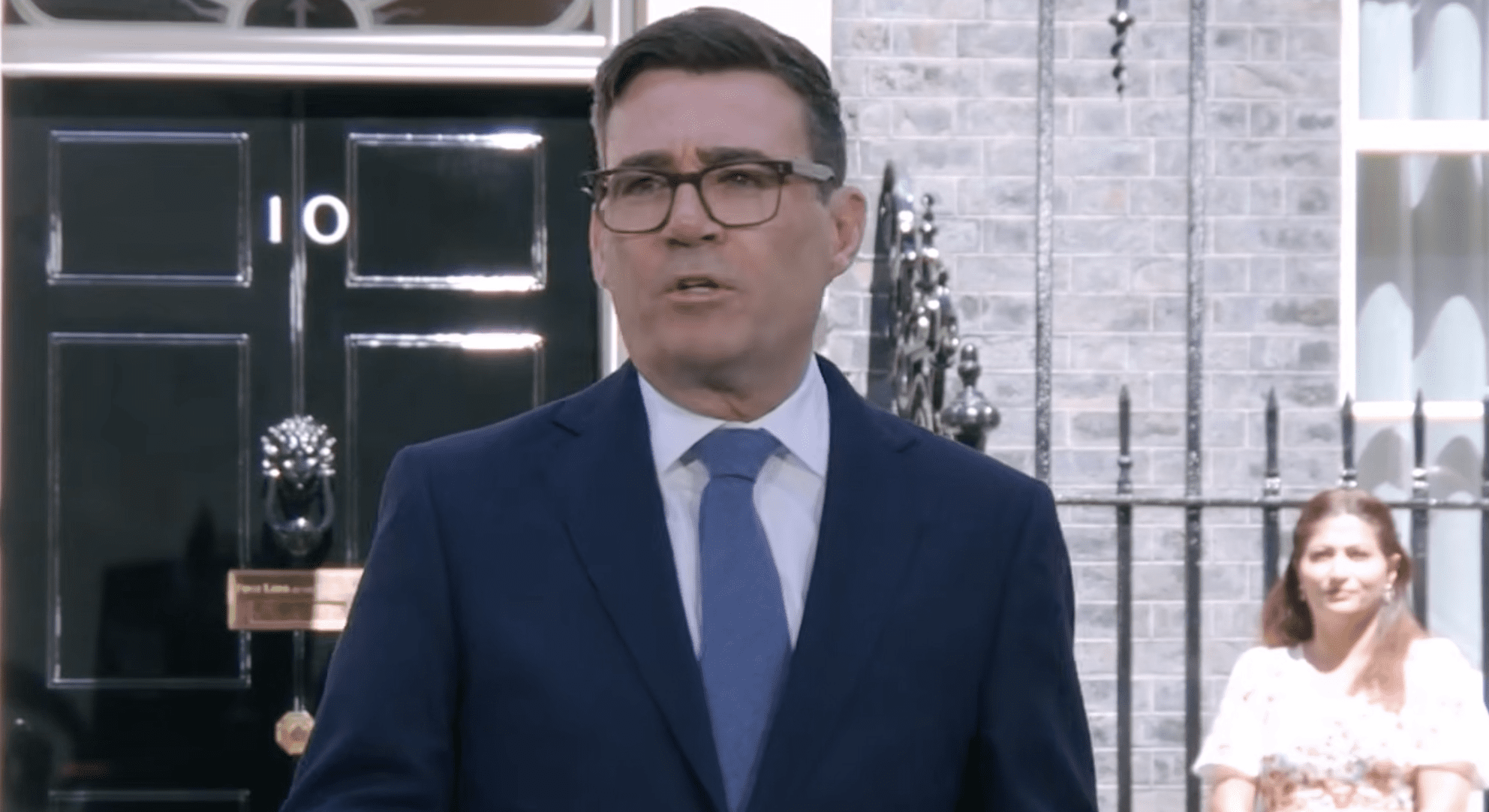
In his 'Manchesterism' speech (below, 29 June) Burnham promised to take power away from Whitehall and to deliver “good growth in every British postcode”.
The vehicle for this is to be “Number 10 North” which will be the “nerve centre of a rewired Britain”. There is no question that Britain has a serious problem of regional disparities in GDP, productivity, life expectancy, education and so on, and that these have persisted for decades and even worsened over the last twenty years.

Of all European countries, we know that the gap between the richest and poorest areas (as measured by average disposable household income) is highest in the UK (not just Britain). At least we did know that until Brexit removed the UK from Eurostat statistics in 2019. Note: the Republic of Ireland, alongside Denmark and Austria, has one of the lowest regional inequalities.
Clearly, Burnham is mainly thinking about England in his devolution design. Although his speech referenced Dundee and Bangor (North Wales not Co. Down), the “rewiring” in our case is very vague. It will be about “offering new opportunities to extend devolution in Scotland, Wales, and Northern Ireland by taking power deeper down”. The only flesh on that bone seems to be Sue Gray’s idea of metropolitan mayors for Belfast and Derry.
Before getting too carried away with Manchesterism, we might remind ourselves that the population of Greater Manchester is one and a half times that of the six counties, and that we already have unitary bodies running public transport, housing and a few other things.
The problem is we don’t have enough money to improve services. But saying this requires justification as we have had 18 months of public argument suggesting, for example, that health service waiting lists, crumbling schools, lack of water service infrastructure and lack of progress on emblematic projects such as Casement Park or the A5, are all down to politics, or incompetence, or a bloated civil service and general inefficiencies, not Treasury constraint.
Burnham – and we are the least of his priorities – will immediately be confronted by the budget, or rather the lack of progress on agreeing to Finance Minister John O’Dowd’s proposed three-year budget, or even to a budget for the year we are already a third of the way through.
BLOCK BASELINE
What is supposed to happen is that the Treasury decides the overall block grant baseline, enhances it and the Executive agrees the budget for each department based on the block grant and any locally-raised revenue from rates (around five per cent of revenue) and charges.
It’s a lot more complicated than this because of funding that lies outside the block grant (mainly social security benefits), borrowing and special packages to support political deals – Stormont House Agreement, Fresh Start Agreement, Confidence and Supply Arrangement, New Decade New Approach, NI Protocol and City Deals – which some members of Westminster’s NI Affairs Committee are fed up with.
The largest of such deals was the £1 billion agreed between the DUP and Theresa May’s minority government, signed off by convicted rapist and paedophile Jeffrey Donaldson (then the DUP’s chief whip at Westminster) in June 2017. Typically the agreed amounts are not fully drawn down, but nevertheless, the end of these special deals is part of the current budget crunch, according to the Fiscal Council.
BARNETT FORMULA
Once the Treasury establishes the block grant baseline, it is then adjusted to account for differences in population between England and the devolved governments, using the Barnett formula which Joel Barnett himself described as “grossly unfair” and a “terrible mistake”, as it was only supposed to be a temporary fix to political arguments over Scottish devolution at the end of the 1970s.
The formula is applied only to any changes to spending programmes in England: if Westminster decides to spend more on health, then we get a population weighted enhancement to our health budget. Barnett has been applied to N. Ireland since 1979 but attracted little political attention during direct rule and the period of blank-cheque funding for policing, prisons etc. during the conflict.
The formula is not dissimilar from the “Goschen proportions” established in 1888 to distribute funding for services as between England & Wales, Ireland, and Scotland (80:9:11). At the time, these proportions gave Scotland and England and Wales slightly more funding than their population share merited.
But Ireland received less – 9 per cent of the funding for 12.6 per cent of the population. Following partition, Scotland continued to be funded above its population share and this advantage over England and Wales grew as the formula remained the same but Scotland’s population declined relatively. The same effect applied to Scotland after the introduction of Barnett, an advantage that Westminster has been reluctant to challenge in the face of the growing demand for Scottish independence.
This history is important because of the way funding advantage and disadvantaged gets baked in over time. The alternative to a crude population-based formula is one based on “needs”, but this is a can of worms the Treasury has always been reluctant to open as it involves complexity, change and difficult political arguments.
The Holtham Commission (2010) concluded that the Barnett formula lacked any objective justification and had survived for 30 years “solely for reasons of political and administrative convenience”. It recommended that funding for Wales be based on a simple needs formula reflecting population structure and diversity, deprivation and extra costs arising, for example, from population sparsity. Holtham’s formula now provides a funding floor (115 per cent of English funding per head) below which the Barnett-based block grant for Wales must not fall.
Funding for Wales is currently above the level of the floor and there is also a cushion in place to prevent funding falling too suddenly towards the floor.
HOLTHAM FORMULA
Applied to NI, the Holtham formula suggests that our funding floor should be around 124 per cent of English funding and since 2024 that figure has been used by the Treasury in arguments with the Executive about our block grant.
Most recently that argument took the form of the Treasury’s ‘open book’ review of the Executive’s budget, made public at the beginning of June. The review admits that “all devolved governments receive at least 20 per cent more per person” than England which is above the level of relative need for each jurisdiction: Scotland's level of need is assessed at 105 per cent, Wales' at 115 per cent and NI's at 124 per cent. This is why Michelle O’Neill and John O’Dowd argue that NI is funded less generously than Scotland and Wales.
Before the open book review was made publicly available, the key Treasury findings and argument were briefed to the BBC’s highest paid journalist for his morning radio show on 23 April.
This was all about promoting the view that the Executive should raise more revenue and reduce expenditure. It was claimed, for example, that £1.3 billion could be saved from the health budget if funding was at 124 per cent of English levels instead of 152 per cent, a figure challenged by the Nuffield Trust and by the Fiscal Council. Indeed the Council’s analysis of the O’Neill/O’Dowd position is not only supportive of their claim that the Executive would be £1 billion or £3 billion better off if funded at Welsh or Scottish levels respectively, it goes further to suggest these figures are an underestimate.
Of course the Executive could raise more revenue (through the rates if nothing else), and of course there are always ways of making cuts to public services, but no one round the Executive table wants to do the Treasury’s bidding.
The Westminster government has yet to come up with a convincing argument as to why NI is being treated less favourably than Scotland and Wales, so the standoff continues. If SoS Chris Bryant reads the News Letter, he may be inclined to follow Owen Polley’s advice to impose a budget on the Executive.
Or he may persuade the Treasury to come up with another billion which will mean, as the finance minister told the Assembly (28 April), “we would have a multi-year Budget in place and that, over the next three years, Ministers would be planning for delivery and transformation of public services."