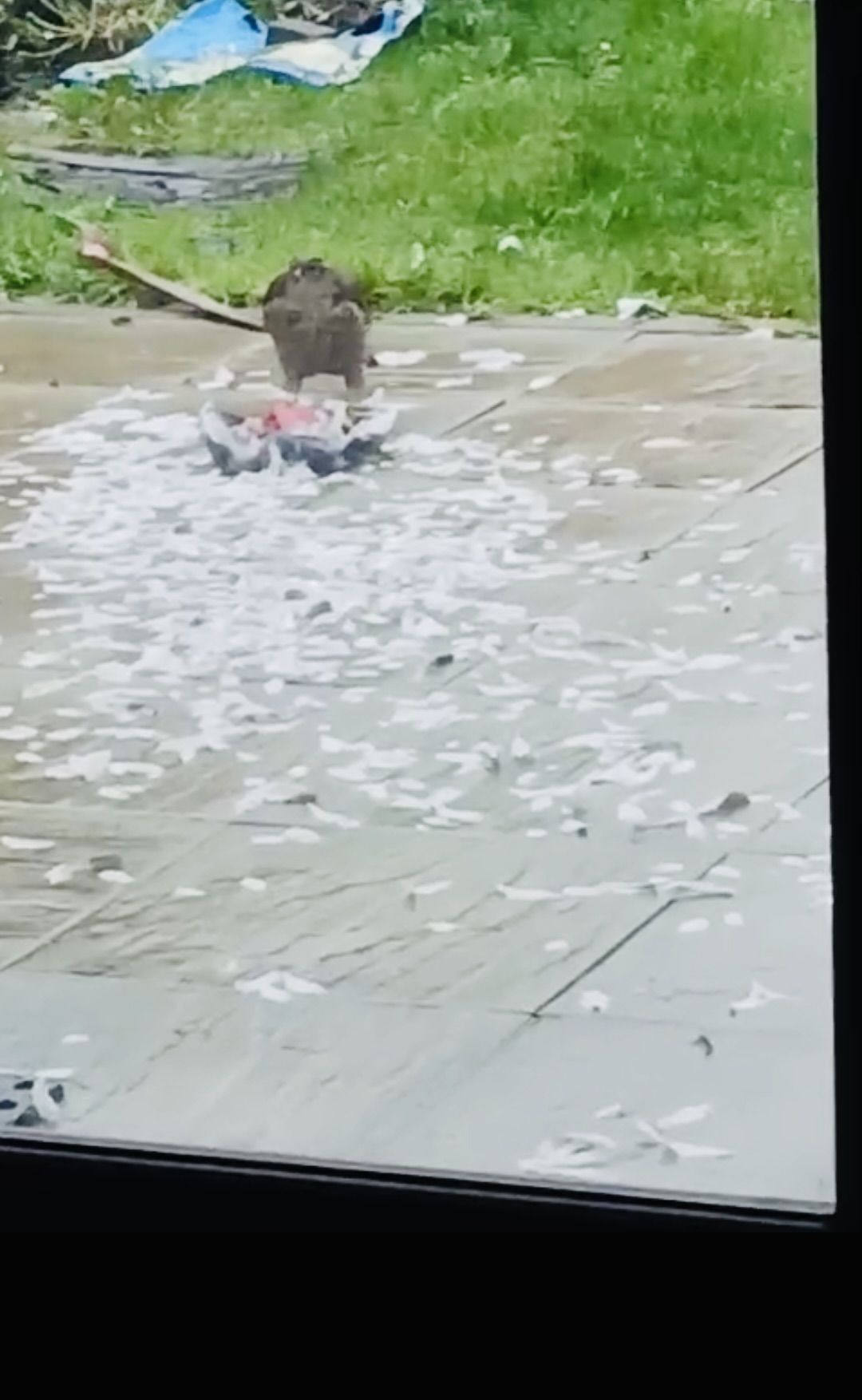
TERESA Girvan’s once-beautiful patio is quite the mess – thanks to a sparrowhawk.
The Owenvarragh grandmother watched – part in horror, part in amazement – for 15 minutes this week as the bird of prey dismantled a pigeon right before her eyes.
And this bird is one messy eater. “It was a massacre outside my door!” she said.
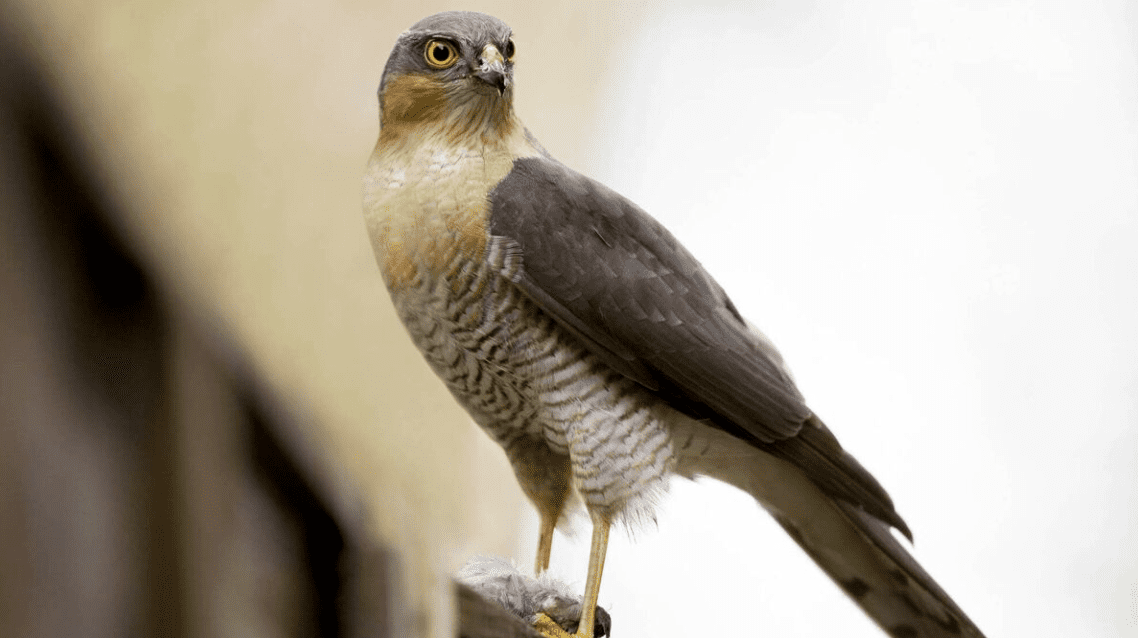
Mum-of-three Teresa contacted Dúlra to help identify the killer bird. It’s a female sparrowhawk, and the sex of the bird is important because in the raptor world, females are much bigger and stronger. Only the female sparrowhawk could confidently tackle a pigeon; her smaller mate, on the other hand, will turn his attention to smaller types of passerine.
Teresa had another question for Dúlra. She was minding her daughter’s eight-week-old Pomeranian puppy Hazel, and she wondered if the tiny little pup is safe in the garden from the talons of Madame Sparrowhawk. Dúlra was pleased to confirm it is. Sparrowhawks feed on birds and sometimes mice and there is no record of one ever killing a dog, even a toy dog. But when Teresa sent him the video of the patio massacre, Dúlra called her back. “You might be better to err on the safe side and keep Hazel indoors for a while,” he said. “There’s always a first!”
Sparrowhawks, spioróg in Irish, are increasingly hovering over the streets and gardens of West Belfast for victims and barely a week goes by without a reader sending Dúlra a video of a kill. Last month a woman in Tullymore had to wait to get into her house because a sparrowhawk was busily devouring its prey on ther front doorstep.
Teresa’s garden backs on to Casement Park and Dúlra asked bird expert Geordie Hynes if he had any idea where these spectacular birds of prey might be breeding.
“We know they breed on Black Mountain – they need good tree cover and don’t like to be disturbed," he said. "But they also could be breeding in the City Cemetery or Lady Dixon Park, perhaps even Musgrave Park, although I’m not sure if there's enough cover for them there.
“These hawks will come down from the mountain in winter to catch the garden birds. You can find their nest easily enough because there’ll be a plucking post nearby, where they bring their prey before taking it to the nest for their young. They might use an old magpie’s nest and there will be downy feathers all around it from the birds they kill.”

Dúlra used to find their nests every year in small fir trees in the grounds of the old St Patrick’s home. They were evicted when Glenmona was built but they are obviously still breeding locally in great numbers.
Geordie, one of Belfast’s pre-eminent bird experts, who honed his trade in the Bog Meadows, is certainly in a position to know – he’s still involved in surveying birds as part of an incredible scheme to get farmers to devote more of their land to nature.
Geordie does regular site visits – even in freezing January – and says that when fields are given back to nature, the change can be incredible.
One of the farms he is surveying is on the outskirts of South Belfast not far from Forestside where the farmer has been paid to plant three of his fields with flower seeds that traditionally attract birds – and already rare species have returned. One farmer said he never thought he'd be getting paid for growing flowers rather than crops!
It’s an eight-year survey and Geordie has to visit half a dozen times every year and walk the same square kilometre counting the birds.
“You have to know your birds to do this – I usually use my ears rather than my eyes,” he says.
“This winter on this farm there were 15 yellowhammers and 20 twites – you’d never think these birds could be found so close to the city. It’s proof that by just making small changes, the birds will come back.”
And maybe if the farm birds return, the sparrowhawks will withdraw from the city – and wee Hazel will be able to enjoy playing in the garden once more!
•If you’ve seen or photographed anything interesting or have any nature questions, you can text Dúlra on 07801 414804.