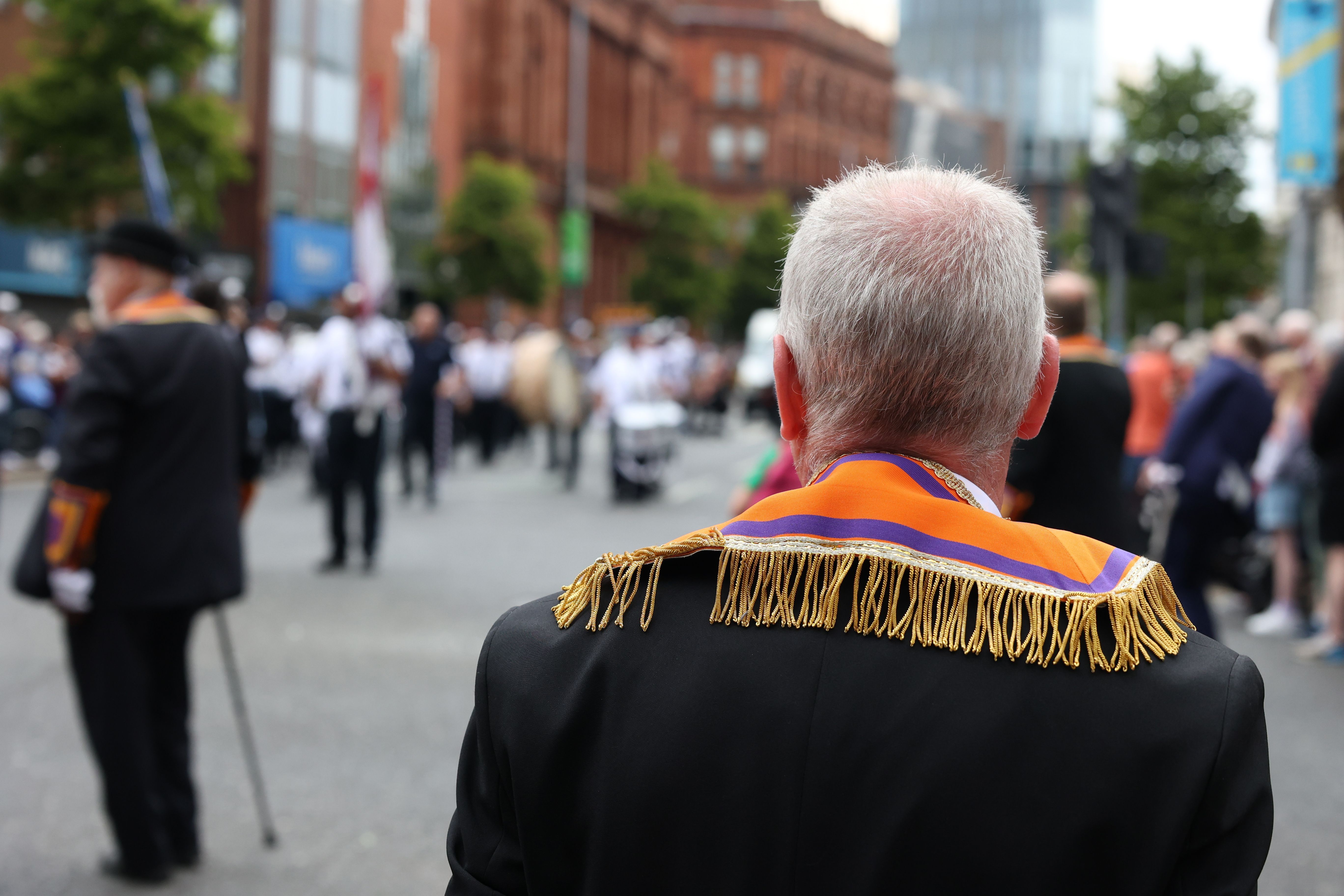
AS June heads towards July the distant beat of your drums is pounding out their rhythm. The marching season for all of the Loyal Orders is well under way and the 12th of July is fast approaching. One July, sitting during yet another negotiation into the early hours with Tony Blairm the rat-a-tat-tat of Lambegs sundered the quiet. We paused as he asked if I knew what that was. “Yes,” I replied, “that’s the Orangemen.”
“Jungle drums?” he said.
I am minded to remind you that the Battle of the Boyne was fought on the 1st of July, not the 12th. The date changed in 1752 when the English adopted the Gregorian calendar introduced by Pope Gregory. The war was part of a much wider European conflagration – the Nine Years War. James was backed by the English aristocracy, by France and by the Irish Catholic aristocracy. William, who was James’s son-in-law and King of Holland, was backed by the English merchant class, by Pope Innocent XI, by Spain and Germany and by Protestant settlers in Ireland. At its core it was William leading a ‘Grand Alliance’ of Europeans to curb the power and expansion plans of the French king.

The Pope contributed to William’s expenses and when news reached Rome of the victory there was a Te Deum hymn sung in a “joyous proclamation of praise, thanksgiving and faith.” The Pope was front and centre of it all. So much for No Pope Here!
After the Reformation sectarianism flourished. It has contaminated politics on this island for centuries. The exploitation of religious differences has been to the detriment of all who live here – all supposedly Christian.
Since the Orange Order was founded in 1795 it has served the interests of the British establishment and the landed and business interests. This crystallised in the creation, by way of a coup d’état of the Orange State, the partition of Ireland.
But this Orange State is no more. The Orange Order doesn’t have the same influence that it once had. The North is a far different place today than it was when some of us marched for civil rights in the 1960s. The Orange was against this but you failed in your efforts. Demographic and electoral change is partly responsible for this but so too are the new ideas, new concepts, and an increasing willingness by some to look beyond the rigid red lines of the past.
For example, what about the British identity in a united Ireland? Those of us who favour Irish unity have repeatedly emphasised our commitment to respect the British identity of our neighbours and to accommodate that identity and its traditions in a new and shared Ireland. That includes the Orange. We are also committed to the safeguards and guarantees, contained in the Good Friday Agreement, being carried through into that new Ireland.
These commitments are also rooted in the principles and beliefs of those – mainly Presbyterians – who embraced Republicanism in the 18th century. People like Wolfe Tone who called for a “cordial union among all the people of Ireland.”
So we need a new constitutional model for this changing society. One which protects and defends and upholds citizens’ rights. One which is built on democratic rights and equality. Not fear. Not diminishing the humanity of others. A new way of inclusivity which embraces all citizens respectfully. A home for all of us who live on the island of Ireland.
The Orange Order is an all-Ireland body. Ireland is your home as much as anyone else who lives here.
As good neighbours, Republicans are willing to explore with you what Britishness means to you and how we all can accommodate it in the future. That includes Orange marches.
Our unionist neighbours have been abused and used by a British system that works to its own agenda and has consistently broken its promises and commitments.
Whether it was Harold Wilson who called unionists scroungers or Margaret Thatcher signing the Anglo-Irish Agreement or Theresa May or Boris Johnson or any of the other myriad British leaders over the generations who have lied and manipulated unionism, the fact remains that no sensible Orangeman should trust a British government to deliver on anything. And the truth is you don’t trust them. And with good reason. That should include Mr. Farage. He will be no friend of yours unless it suits him.
British interests are about London’s interests, not those of anyone living on the island of Ireland – unionist, nationalist or neither.
Despite this, you hold to a different narrative – a different mindset. Irish unity is perceived as a threat to your sense of Britishness. You hold the belief that only through the union with England can your constitutional, civil and religious rights and entitlements be protected. But these rights and entitlements have been dependent for centuries on the denial of those same rights and entitlements to others. This was never sustainable.
Now things are changing. The Good Friday Agreement and the peace process have been the catalyst for this. They provide an opportunity to break the cycle of division and conflict. In May 1998 over 70 per cent of people in the North and over 90 per cent in the South voted for an Agreement that provides for a unity referendum and for a simple majority to determine the outcome.
That is the democratic option.
In between times, we have had the disaster that is Brexit and a series of internal unionist crises as the various unionist parties wrestle with each other over who speaks for unionism. Is it the new hardline leader of the UUP John Burrows, who recently successfully shafted the old leader Doug Beattie? Or Gavin Robinson of the DUP? Or Jim Allister of the TUV? All of them trying to outdo each other in the rhetoric of the past.
It’s time for the Orange to look to the future. Yes, celebrate your past without threat to anyone else, but tell us where you want to be in ten years’ time, or twenty years’ time.
The past is important but it’s also over. So give us your hopes. What is the Orange vision for the future?
New Bodenstown picture book tells a story of patriotism and pride
“TO say all in one word, Ireland shall be independent. We shall be a nation, not a province, citizens not slaves.” Wolfe Tone
On 28 June Republicans from across the island of Ireland will travel to Bodenstown, County Kildare, to stand in homage at the graveside of Theobald Wolfe Tone, the founder of Irish republicanism.
For those who know of Tone and for those who don’t, I want to recommend a new publication: Bodenstown: Honouring Wolfe Tone – A Pictorial History. It tells his remarkable and inspirational story and recounts the generations who have travelled to Bodenstown each June to remember and celebrate his life.
This new publication profiles Tone and publishes photographs of many of the commemorations that have been held there. The first image of Bodenstown is of Pádraig Pearse delivering the oration in June 1913. The Irish Republican Brotherhood had asked Pearse to speak and the event was chaired by veteran Fenian Tom Clarke. Both were executed by the British less than three years later following the 1916 Easter Rising.
Others photographed include Countess Markievicz, Liam Mellows, Prioinsias Mac Art, Daithi Ó Conaill, Jimmy Drumm, Martin McGuinness, Rita O’Hare, Joe Cahill, Mary Lou McDonald and a rain-drenched Michelle O’Neill.
Honouring Wolfe Tone is produced by An Phoblacht. It is written by Micheál MacDonncha and designed by Mark Dawson. They are two stalwarts of the republican struggle. Among his many talents Micheál is a historian. A one-time editor of An Phoblacht, Micheál has written frequently on the history of Irish republicanism. He was centrally involved in the writing and production of Sinn Féin’s centenary book marking the foundation of the party in 1905: Sinn Féin – A Century of Struggle. Mark Dawson too was a part of the team that produced that book and he has been a first class designer of Sinn Féin publications, including An Phoblacht, for forty years.
This is an excellent, timely publication. It is available at An Fhuiseog, 55 Bóthar na bhFál, BT12 4PD, and at www.anfhuiseog.ie/
It can also be purchased from the Sinn Féin Shop at www.sinnfeinbookshop.com
Cúpla focal eile
ANOTHER few words í nGaeilge as part of this column’s contribution to the effort to use whatever Irish we have even if it is only a wee bit. Here are a few more bits and pieces to replace their English equivalents.
Lá breithe shona duit means Happy birthday to you.
It also sounds really good when sung by a crowd at a birthday gathering. Or even on a one to one basis. Try it. Use the same air as the English version.
Tiomaint go curamac means drive carefully.
Sliothar is a hurling ball.
Tóg go bóg é means take it easy.
Slán abhaile means Safe home.