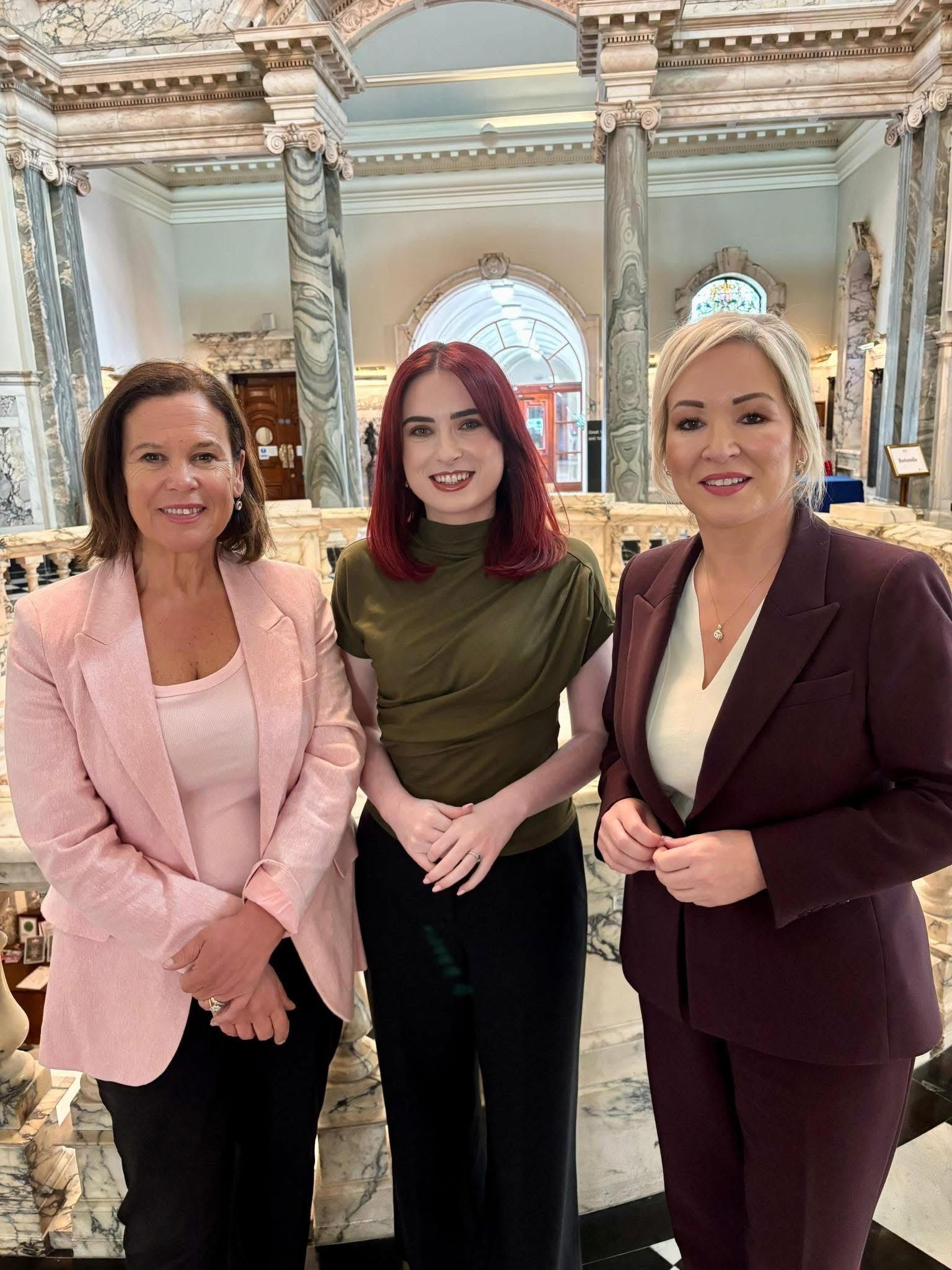
THERE was a time when younger people I used to bump into would say to me by way of introduction “You used to know my Mammy.” “Or my Daddy.” Nowadays they say to me “You used to know my Granny.”
That would have been over fifty years ago when Grannies and Grandas were young and well before the Grandparent stage. That’s when I first met the late Mrs Donnelly, the Granny of our Ard Mheara Róis-Máire. It was in 1969/70. She was living in Westrock Drive off the Whiterock Road and then in Springhill Drive. Mrs Donnelly was a lovely woman. She was originally from McDonnell Street in the Falls area and lived for a time in Ballymacarrett in East Belfast before returning to the west of the city.
As a young girl, May had been one of hundreds of women who prayed outside Crumlin Road prison during the night and into the morning Tom Williams was hanged in September 1942. In the decades that followed, especially during the conflict following the pogroms of 1969, May was one of those indomitable women in the greater Ballymurphy area who stood against the brutality, harassment and raids of the British Army. May was a kind, compassionate woman whose door was always open to republicans.

Two of May’s sons, Paddy and Jim, were imprisoned. Paddy, I’m proud to say, was in Cage 11 with us. Jim’s daughter, Róis-Máire, was born while Jim was in the H-Blocks. She was christened in the prison. May is holding Róis-Máire in a photograph taken in the prison chapel. As she grew up, Róis-Máire was very close to both her Grannies and her Mammy Geraldine as well as her Daddy Jim. Good decent people doing their best in hard times.
She spent the first five years of her life living with her Granny Rosie on Ballymurphy Road and with her Mammy Geraldine.
So, Róis-Máire is now part of a younger generation of republicans who are determined to achieve Irish unity. She is a proud Gaeilgeoir. The Irish language is very important to her. She believes that it can play a very positive role in building a new future for everyone and a big part of her focus in the year ahead will be to persuade those who are opposed to Irish to realise that it belongs to everyone.
Rois-Máire with her Granny Donnelly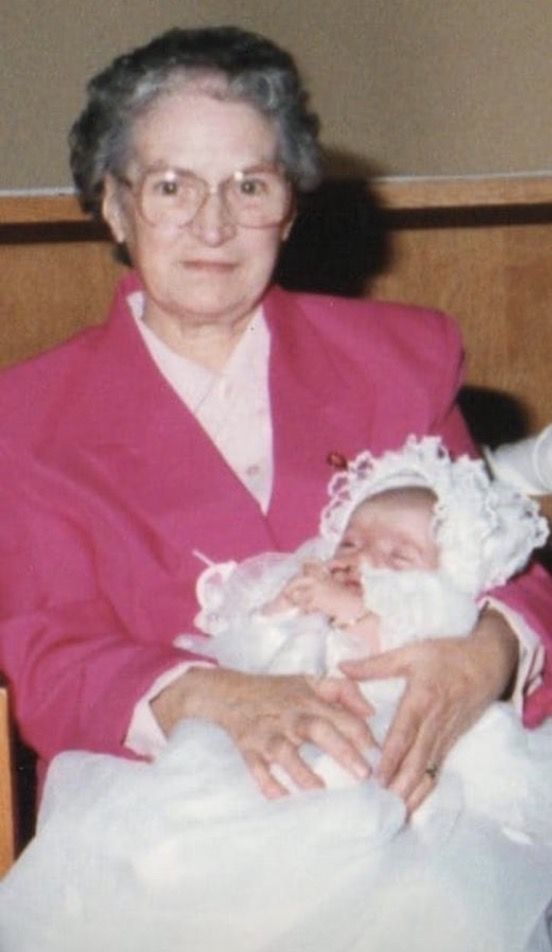

In 1992 the SDLP’s Joe Hendron won the West Belfast Westminster seat. Even though Sinn Féin lost, we went ahead with a planned motorcade around West Belfast to thank our voters. People came out in defiant droves to salute us. It was overwhelming. By the time we got to Springhill there were hundreds waiting to greet us and we had to abandon our cars. Prominent among those who were there that night were Mrs. Donnelly, Mary Austin, Harriet Kelly and other local Amazons. Revolutionary Grannies. They presented me a bouquet of flowers, a bottle of champagne and two ounces of pipe tobacco. There were hugs all round.
I remember an SDLP spokesperson remarking ruefully “You would think they won the election. They organised a victory cavalcade!”
We hadn’t won. But that night we started fighting the next election and May Donnelly was with us all the way. In 2009, while Róis- Máire was at St Dominic’s Grammar School, she had to write an essay about the biggest influence in her life. She chose her Granny May, and years later when May died she read it out at her funeral.
At her installation as Mayor this week, thirty-four years later, Róis-Máire wore her Granny May’s pearl necklace. Well done, Róis-Máire. You will be a great Mayor for all the citizens of Belfast. In the course of two generations those you represent have moved from pariah status to claim our basic entitlements. We have more to do in the time ahead but we enjoy these modest rights because Granny Donnelly and others made a stand. Wear her pearls with pride, Róis-Máire. Ádh mor ortsa. Up the Murph!
Ireland has a proud history of principled boycott
IN his most recent comments on the two Ireland-Israel soccer internationals due to be played in September/ October, An Taoiseach Micheál Martin chose to pass the buck to UEFA rather than take a principled stand and oppose the game. He sais “Ireland” does not want to be “self-defeating” – whatever than means – in its approach to the games.
Martin claims that while everyone knows the government’s opposition to the actions of Israel – he avoids mentioning its disgraceful response to the Occupied Territories Bill – he says that “everything shouldn’t be reduced to just one match.” Why not? Russia was banned by UEFA following its invasion of Ukraine. Israel has killed close to 100,000 people in Gaza and the West Bank, stolen Palestinian land and invaded its sovereign neighbour Lebanon. Why should it be treated differently? Ireland has a deserved international reputation for its anti-imperialist, anti-colonial stance, its support for human rights and for the peace process.
UNHAPPY: Irish captain Seamus Coleman has asked for the Israel decision to be taken out of the players’ hands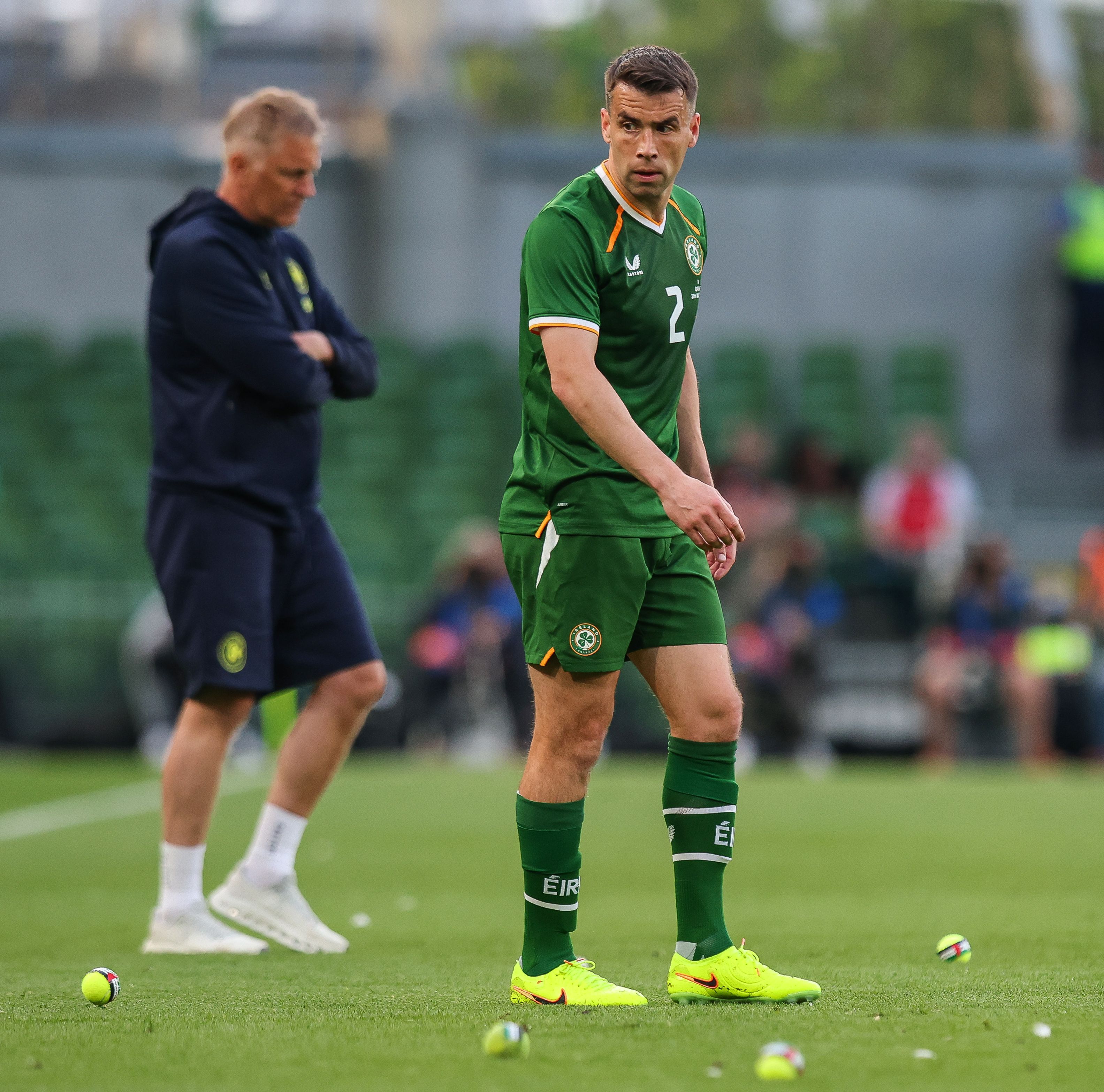
ANC comrades in South Africa still speak highly of Irish opposition to the Springbok rugby game in 1970 and the courage of the Dunnes Stores workers who refused to handle South African goods in 1984. It took three years for an Irish government to ban South African imports but in 1987 it eventually caught up with public and international opinion and did the right thing.
Stopping the games is the right thing to do.
DUP blockers
LAST week at a meeting of the Executive the DUP chose to block the Good Jobs Bill. Why did they do this? The Bill will be good for all workers. It makes no distinction based on religion, politics, ethnicity or gender. Workers who vote unionist would benefit as much from this Bill as would workers who vote nationalist or for neither of these.
The legislation being proposed by Caoimhe Archibald, the Minister for the Economy, contains common sense measures making it easier for trade unions to represent workers; replace zero hour contracts; protect employees tips and gratuities; strengthen neonatal leave and pay; and improve paternity entitlements and redundancy protections for workers who are pregnant.
The DUP claim they need more time to scrutinise the legislation, but the place for that is on the floor of the Assembly where it can be debated and amended.
The truth is that the DUP is opposed to equality. Since going into the power sharing arrangements in 2007 it has often engaged in a tactical game of delaying and frustrating the work of the Executive and Assembly. This has led to the collapse of the institutions on occasion.
Regrettably, the DUP approach reflects a unionist ethos that still believes the North, carved by the British out of Ireland as a permanent unionist state, should only reflect their values. Change of any kind threatens that status quo and is resisted by the unionist parties, but especially the DUP.
Current DUP strategy in advance of next year’s Assembly election is to maximise the unionist vote behind it. This means engaging in more extreme, more strident rhetoric while opposing Sinn Féin and anything that reflects Irish national. Identity, culture and language. In this way it believes unionist voters will rally behind it and vote to replace Michelle O’Neill as First Minister.
But this assumes that all unionists vote on sectarian lines. This might have been true at one time, but no longer. Many are increasingly open to the conversation around a new Ireland. They are also dismayed by the shambolic politics in Westminster; the basket case that is a failing British economy; the growth in far right politics; and they are closely watching the electoral shifts in Scotland and Wales and the constitutional cracks in the British union. They also resent Brexit and their exclusion from the EU.
A new Ireland can redress all of these. We would be back in the EU and have greater control over the direction of our health system and economy. At 20 per cent of the population unionists would have a greater say in and control over their lives in what Wolfe Tone described as a ‘cordial union’ between the people of Ireland. Unity offers hope for the future.