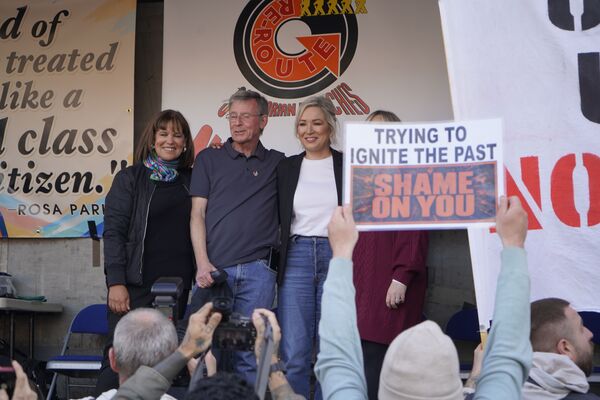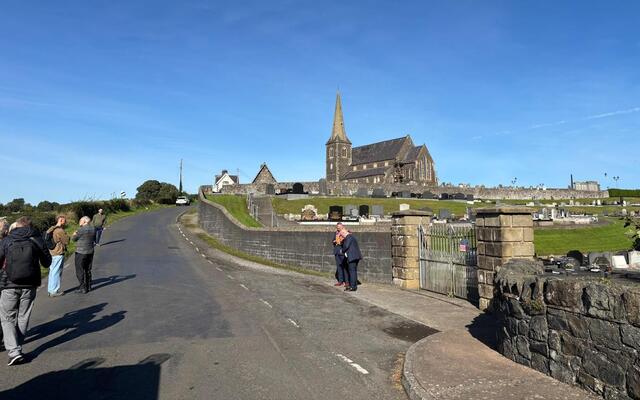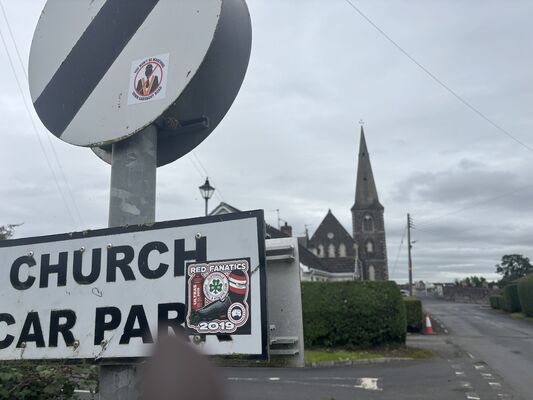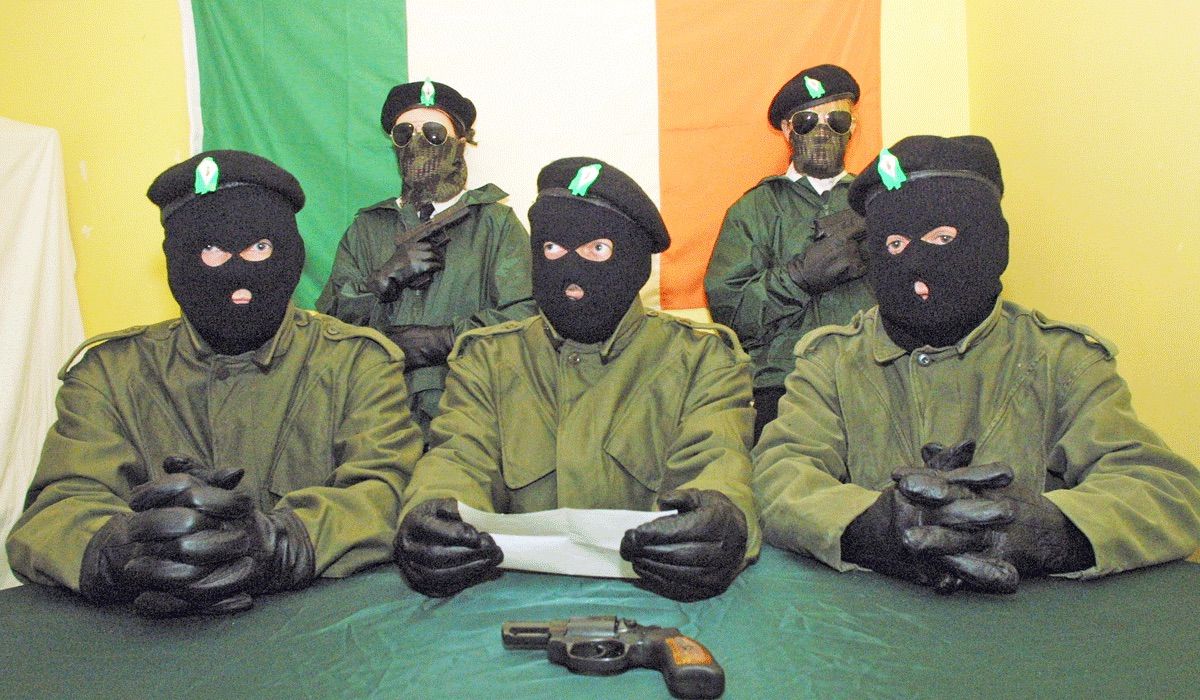
I DON’T mind if people wear balaclavas on social media. As multiple DUP members said in the wake of BalaclavaFest in Scarva, people cover their faces for a host of reasons.
They might not want to get into trouble at work, or to be the subject of gossip or speculation there. And after the glorious 22 degrees-plus weather of the previous week, there was a distinct 16-degree nip in the air in the County Down village on Saturday afternoon.
The DUP didn’t mention it at any stage, but there’s also a chance that the people wearing masks were intent on directing violence towards Gaza marchers on the other side of the Newry Canal and were frustrated in their ambitions by a robust policing operation. A policing operation that the DUP now say was the cause of all the trouble.

When I say I get my fair share of stick on social media I don’t do so to garner pity. If I wanted to do that I’d tell you about my bad eye or my worse ankle. I bring the subject up only to make a wider point, and that wider point is that most of the abuse directed my way online comes from people in hiding; people who are mostly identified by an ironic cartoon, a bunch of flegs or a figure from history. Overwhelmingly they are of the reformed faith and overwhelmingly they don’t take kindly to anything that smells of Mass or Dublin.
There’s a growing body of opinion that argues for balls-out honesty on social media platforms, for the banning of anonymous accounts. But while the argument is superficially attractive, I’m not buying it – even though in my experience superficially attractive things generally get a bad rep.
I feel much the same way about digital balaclavas as the DUP feel about Scarva balaclavas: Lots of people wear them for very good reasons. I part company with the DUP when I point out that lots of people wear them for very bad reasons too. But it’s my calculation that those who hide their identity online for good reasons – fear-connected, mostly – shouldn’t be kicked off social media because of those who hide their identity with malign intent.
When I hesitatingly come out in favour of online anonymity, I do so with a caveat, and that caveat is that you don’t – or shouldn’t – enjoy the same rights online as people who take responsibility for what they write. In other words, you shouldn’t say things that you wouldn’t say if your name was attached to your thoughts. And mostly that means that you shouldn’t insult or abuse people who have the courage of their convictions; people who use their own names, in other words. It’s a caveat I flag frequently on social media and while I naturally have no way of knowing how effective my homely moralising is, judging by the intense reaction of people on Twitter when I call them out for insulting me from the shadows, it does have a certain sting.
DUP latest: The Scarva guys only wore masks so they wouldn’t get sacked or identified on social media.
— Squinter (@squinteratn) June 8, 2026
Call me mad, but if you don’t want to get sacked don’t do anything that might get you sacked.
I’ve just had perhaps the most revealing exchange on the subject so far. The gentleman in question revels in the name of ‘Choyaa’, which Professor Google tells me is a fragrant Asian paste consisting of sandalwood, musk, saffron and ambergris. His bio is a skimpy one, revealing only that he is an Orangeman, and while that doesn’t necessarily mean that not being a Catholic is the most important thing in his life, it certainly suggests that it’s a quality he greatly admires in himself.
His aversion to things Popish notwithstanding, Choyaa seems a decent enough spud, and his tweets along with his writing on the political website Slugger O’Toole have earned him a not entirely undeserved reputation of being a liberal Orangeman (much as that will be viewed by many as a 24-carat, ocean-going, museum-quality oxymoron).
Choyaa and I have butted heads on a few occasions, but no blood has been drawn and we’ve remained on good if only half-familiar terms.
Until the weekend.
In the immediate wake of the Scarva balaclava convention, Choyaa issued a milquetoast denunciation of events which can, I think, be reasonably summarised as ‘Hurling obscenities and slurry only damages unionism.’ It’s a classic liberal unionist play: A thing is called out as wrong not because of the effect it had on the victims – in this case the Gaza marchers who were the object of the abuse and the slurry – but because of the effect it has on unionism.
I wrote back in my Squinter Twitter account that it’s kinda funny for an Orangeman to give off about bad behaviour at marches, parades and rallies when Orange parades routinely feature UVF and UDA bands and songs. That was too much for Choyaa, who immediately went No More Mister Nice Guy. There followed a quite extraordinary grilling which included queries about my name, the inevitable But-the Ra claim about my relationship with Gerry Adams and about things I wrote 25 years ago.
I don’t intend to litigate or analyse the relatively brief but fiery exchange that followed, if you’re online you can go on Twitter and make your own mind up about it. Here’s what I will say, and say loudly and firmly. What kind of person thinks it’s fair, reasonable or conscionable to have a debate with someone about the known name and identity of another person while hiding their own name and identity? The answer can only be a person who’s so terminally online that the simplest and most basic rules of human interaction disappear amidst the raucous clicks and beeps of a billion routers, servers, URLs and hyperlinks.
Choyaa, whose right to anonymity I still defend, decided to go online and enter ‘Robin Livingstone’ into a search engine in pursuit of tweets, stories, pictures and columns that might prop up whatever latest point he was making. In doing so, he had access to everything about me, professional and personal, that has ever been put online – by me or by anybody else – since the first www was ever attached to words. I don’t mind that people have access to this data, it’s part of contract you strike with the internet the moment you go online. I’ve had the importance of thinking twice before putting anything online drilled into me at a number of staff training sessions down through the years. And so I think twice. And then go ahead and put up whatever I think is worth putting up. And that sits there beside every story, column, picture or thought I’ve ever submitted in the internet age, alongside anything written by others about me.
There’s something deeply dystopian about the simple fact that people who hide their identities can use that wealth of information while their anonymity remains. There’s something malevolent about a person who draws close to the screen and inserts themselves into the professional and personal life of another while their own life remains carefully hidden. More than dystopian and malevolent and dystopian, it is deeply, thoroughly dishonourable.
I don’t pretend to be a paragon of rectitude. But I’d rather slowly dip my face in a pan of boiling chip fat than insult or deride an identified human being while I myself lurk in the shadows. I think that’s something that the vast majority of ordinary human beings would identify as being a pretty basic tenet of decency, but it's a simple quality which means nothing to the internet’s Army of the Nameless. The paradox is that it’s all pretty natural, explainable and… human. It’s the dialogue of disconnection; digital disinhibition. Just as road rage exists only in those whose face is framed by a car windscreen, so the abandonment of foundational principles of communication is more likely when one’s face is lit by a laptop or phone screen.
Frequently over the years I’ve invited anonymous tweeters who are uncompromising in their low opinion of me to call into the office for a chat. Nobody’s ever taken me up on it. It’s not a huge surprise. The mask doesn’t slip easily.