THE Ireland Palestine Solidarity Committee is walking past Scarva on Saturday afternoon. The march gets under way in Lurgan at 8.30am and makes the journey to Omeath to draw attention to Israel’s continued genocide in Gaza.
A goodly part of the walkers’ route is the Newry Canal Towpath, which they will join at around 10.30am and which will take them all the way to, ah, Newry. Given an average walking distance of 5mph, the march should have covered the 10 miles to Scarva by around 12.30pm, when they will be welcomed to the village by around 100 good folk amassing under the banner of Scarva Concerned Residents.
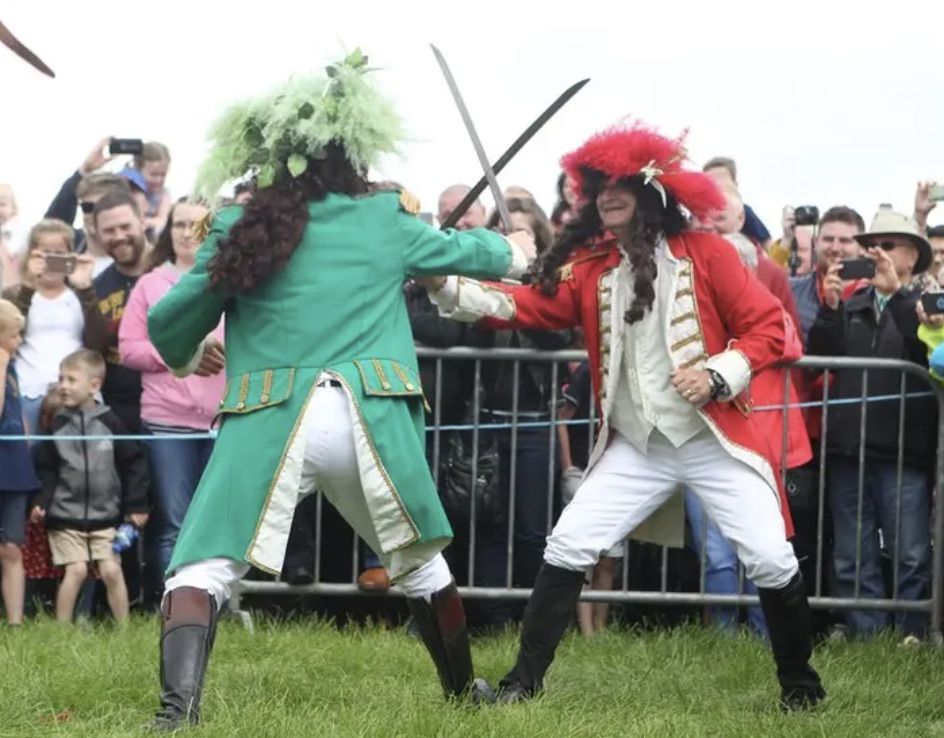
Scarva is not unused to marches and parades. It is, of course, the venue for the Royal Black Institution’s July 13 Sham Fight, an opportunity for Loyal Ulster to watch King Billy put King James to the sword. More importantly, it’s an opportunity for anyone suffering a banging hangover from the day before to get stuck into another blue bag to banish The Shakes and The Fear.

I’ve been to the Sham Fight three times and the turnout is absolutely mahoosive. Sadly, since there’s no grandstand or raised seating, the sword fight between two portly men in black curly wigs is witnessed by relatively few people and so the attention turns to that other cultural staple of the marching season: heavy drinking.
I’ve been at the junction of Sandy Row and the Lisburn Road on the Twelfth where the amount of drink taken is positively Homeric. I’ve been a couple of times to the Somme Parade in East Belfast on July 1, where a few years back then DUP leader Arlene Foster, comfortably ensconced in a pavement deck chair, patted my late dog as we squeezed by. The fumes alone from the amount of drink consumed on the Newtownards Road and environs at that event is enough to make your liver exit your rear end with its hands up. But Scarva is something else. Scarva is the Loyal Ulster Drinking Olympics. Scarva is the World Cup of Alcohol Abuse.
They put it away in impressive amounts in the short walk along the town’s main drag, the Gilford Road. But it’s in Scarva Demesne, the sprawling 18th century meadowland estate at the top of the town where the Sham Fight takes place, that undreamt-of new heights of imbibing take place. In particular, there’s a wooded area to the left immediately on entering the estate where hot and tired bandsmen and their friends and girlfriends gather in the shade to push their vital organs to their limits. It’s enough to make a Grand Master turn Pioneer, but it’s also strangely impressive, especially when empty cans and bottles are impaled on tree branches and as the hours pass by the Demesne forest begins to look like something out of a Salvador Dali painting.
All of which is to say that the residents of the majority Protestant village of Scarva (circa 400) are no strangers to disruption and chaos, even if the disruptors wave the same flag as they do and even if the chaos merchants cheer on the same guy as they do when the Sham Fight starts. The Great March for Gaza will feature no drinking, no drums and no party tunes, but even so, Loyal Scarva isn’t having it. The pissed-up bandsmen and their followers may be raucous and they may leave a hell of a mess, but at the end of the day, they’re our pissed-up bandsmen.
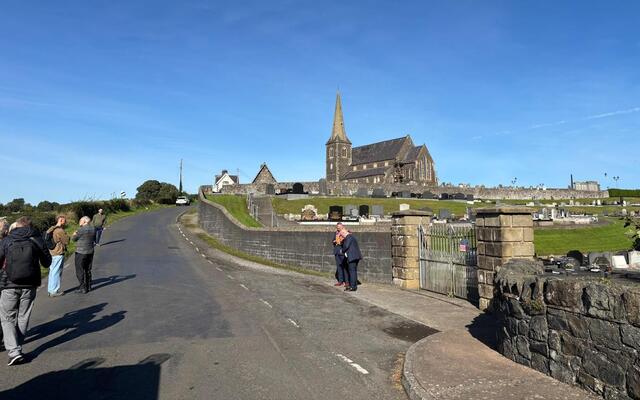
You’ll note that in my first paragraph I pointed out that the Gaza parade on Saturday will walk past Scarva and not through it. That’s because the Newry Canal Towpath is a kind of rural bypass, a one-horse lane separated from the village by a hundred metres of fields and trees and hedgerows and water. I’ve walked there before of a weekend with my dog outside the marching season; the four-mile hike from Banbridge to Scarva is a lovely one and a cold drink afterwards in the dog-friendly local pub was always very pleasant. So I feel I’m qualified to tell you that the Scarva stretch of the Newry Canal Towpath is not exactly the York Street Interchange at rush-hour.
Should the Scarva Concerned Residents be incensed enough to want to confront the Gaza marchers, they’ll have to leave the village via the bridge at the T-junction and make the admittedly short walk to the towpath, where they will presumably be met by a line of Trevors, since the Parades Commission in giving the march the go-ahead flagged it as ‘sensitive’.
With clanging inevitability, aggrieved unionists point to the Drumcree Orangemen, who since they were last allowed to walk the Garvaghy Road in 1998 have been plaintively gathering every Sunday morning to protest the grave injustice of their not being allowed to walk past Catholic homes any more. The inevitability of the comparison is matched only by its imbecility. The Garvaghy Road is a busy thoroughfare through a residential/commercial area and allowing the brethren to walk its length again would require closing it down and importing enough PSNI and British soldiers to take a town in Ukraine.
There’s no need to close down Scarva to let the estimated 1,500 Gaza marchers go about their business on Saturday because the parade won’t be going through the village. The odd blackbird may scurry into the towpath undergrowth as the marchers appear and one or two brown trout may blow bubbles of surprise in the canal as the crowd passes, but that will be the extent of the disruption. Unless...
The DUP led the magnificently indignant but failed attempt to persuade the Parades Commission to ban the Gaza march past Scarva. Even for a party which views short-termism not as a drawback but as a mission statement, this is an odd bridge on which to die. The number of disputed marches that the Parades Commission has to deal with every year is shrinking fast and they are overwhelmingly Orange-hued.
And not only are those disputed parades allergic to the rattle of rosary beads and the smell of Mass, they proceed along obviously busy thoroughfares and not along country boreens.
This failed attempt to stop a march from walking through a village that it was never going to march through in the first place is not the way to win friends and influence people. It’s not only ill-advised, it’s thicker than the trunk of the trees that line the canal.