MY da Archie loved the horses and he loved a bet. He’d come home from work of an evening and after his dinner he’d settle into his seat with the Belfast Telegraph and lose himself in the tales of the turf.
Those were the days when the Telegraph was an evening paper with a number of editions from early to late and it was, of course, the late paper that Archie would pick up because on the back page in a single column it carried the late racing results in blue ink. Funny how newspapers have gone backwards in the past 50 years when it comes to late news – and sport. The technological and digital revolution has given production staff at newspapers the tools to produce rapid and eye-popping visuals at the touch of a keyboard and mouse, but back when stories and photos were laid slowly and meticulously out by hand on the page with craft knives, metal rulers, hot wax and cow gum, you’d get incredibly late news and results in that blue ink late section – right up to 6pm, I seem to remember. All the dailies are morning papers now and it’s not unusual for them to miss the result of a key game from the previous evening because it went into extra time.
Come Saturday, Archie would fish out his biscuit tin from down the side of his chair in which were bookies dockets, pens and newspaper cuttings and he’d write out his day’s bets in slow and methodical copperplate. He’d then summon whichever of his sons happened to be closest to go to the bookies for him. When the chore fell to me, I’d race down the Suffolk Road to McCartan’s (or was it McGranaghan’s?) with dockets and the correct money gripped in my fist. At the door of the bookies I’d say to the first man to turn up: “Mister, my daddy says will you do these for him?” Hardly anyone said no and nobody ever disappeared with the money. As I stood waiting outside and the door opened and closed with every arriving and leaving punter, I’d catch tantalising sight of the place I wasn’t allowed into: the newspapers tacked to the walls, the marker chalking the blackboard, the floor carpeted with ‘baten’ dockets, the tinny race commentary on the Tannoy – all glimpsed throught a thick haze of cigarette smoke.
Not surprisingly, I caught the gambling bug and I’ve been punting all my adult life, and a little bit of my childhood one. Responsibly, I think, because I never suffered the fate about which over-enthusiastic drinkers and gamblers were warned when I was a boy: I never ended up in Castle Street. But here’s the thing: I know if I started my gambling days now the chances of me ending up down and out would be immeasurably greater than when I placed my first legal bet in 1979. And it’s not just because there’s so much more to bet on and so many more places to do it – it’s because the online bookies are absolutely taking the piss and the politicians who are supposed to be regulating them are instead drinking free champagne and eating their fine food in the bookies’ corporate boxes at Wembley, Silverstone, Epsom, Down Royal, Aintree and the Curragh. (Declaration of interest: I’ve been royally wined and dined in corporate boxes at the football, tennis and racing all over Ireland and Britain, but then I’ve never been involved in a crucial vote on regulation and I’ve never knocked out an 800-word feature in return for my drink, food and seat.)
Four years ago I opened an online account for the first time. I had resisted the temptation for years, even though all around me in the pub of an afternoon and evening my friends were tapping out bets on the live sport on their phones while I sat with a small pile of crumpled losing bets at my feet. I didn’t open an account quite simply because I thought I’d spend too much. Without an online account, when you’re in the pub and your bet’s bate you either suck it up or make the trek to the nearest bookies, which in the case of the Roddy’s meant a half-hour return trip on Shanks’s mare in often heavy going to the Shaws Road.
Covid broke my resolve. With no bookies open, it was either open an account or stop gambling. And you don’t need me to quote you a price for what route I decided to take. It was then that I learned that the ‘Gamble Responsibly’ protocols that the online layers have put in place, supposedly to stop people ending up in the fabled Castle Street, are an extremely unfunny joke.
Here's what you have to understand if your only gambling is the lottery, the Derby or the Grand National: the online bookies don’t want people to bet on horses, football, golf, snooker and the jawdroppingly long list of other world sports on which you can punt online 24/7. No, wait, that’s not exactly true. They do want you to gamble on those things but only as a poor second to what they really want to lay you odds on – their online slot machines. No, wait, when it comes to online slot machines the bookies don’t lay odds because the machines give the bookies pure profit with no element of chance involved. The machines are not lame horses or golfers on a hot streak; they’re not no-nonsense midfielders likely to commit at least two fouls per game or snooker players with bad nerves. In other words, they are not fallible and they will never do or not do something that may cost the bookies money. They are programmed to pay out exactly what the online companies want them to pay out; guaranteed; no element of luck. That’s not to say that you or I can’t win. We can. You see and hear pound coins rattling manically out of slot machines in pubs all the time. It is rather to say that over a set period of time a slot machine will give its owner a precisely set percentage of every pound that’s put into it. And so while a bookie can have a bad day at the Masters golf, all the company’s days on slot machines are good days. And while a bookie may be praying for an even-money favourite to get beaten in the last race at Cheltenham to pull the firm out of a hole, they don’t even bother checking the slots because they know it’s all gravy and no lumps.
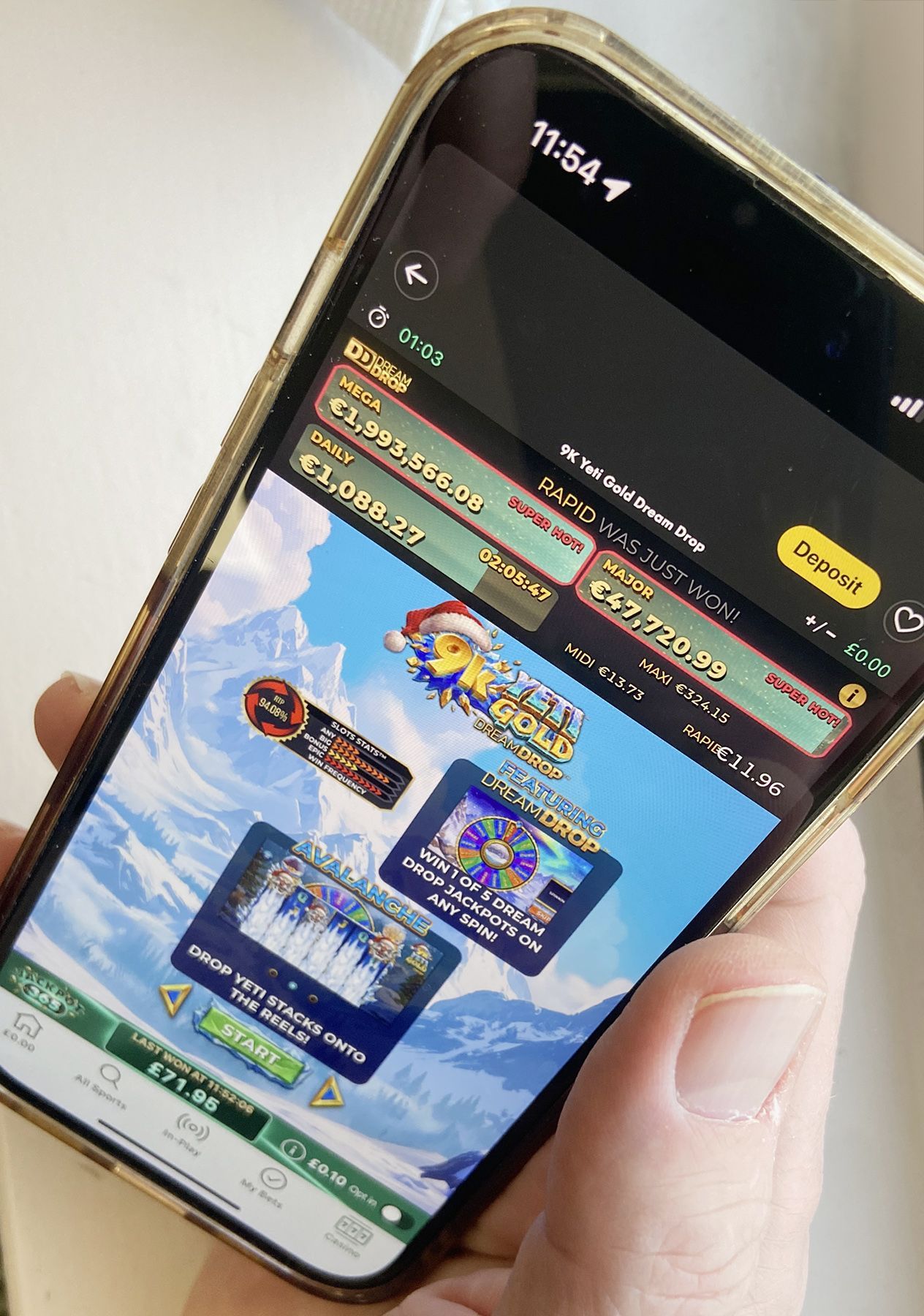
Which brings us back to me. I don’t play slot machines. Never have. But my online bookie wants me to play slot machines so badly I can hear them whimpering every time I open the app. It’s like they’re only laying me odds on horses and football to keep me hanging around online while they try to rope me into the slots. Boy are they persistent. And boy are they apparently generous. What’s the point, I ask myself, of my online bookie telling me to gamble responsibly when at every fart’s end they’re offering me multiple free spins in an attempt to stop me spending my money on something I might occasionally win at and get me instead to feed it into the Machine That Never Stops Giving?
I don’t need to rehearse – do I? – the sensory imperatives that make slot machines the crack cocaine of the gambling world – the mind-bending mixture of overloaded synapses and cascading dopamine that turns rational human beings into saucer-eyed, frazzled shells. I see the lost and almost-lost punters every time I go into a bookies: there they sit, slack-jawed and in terminal thrall to the whirling, buzzing, flashing icons, perched on a stool deliberately made too heavy for them to throw at the machine when things go lemons up. But I don’t see the many more others playing the slots online at home, where there’s no closing time and no staff to shout at and abuse, only family.
Gambling is a devolved matter here. Which is to say that the Executive has the power to do what I believe would be the single most effective thing that it’s possible to do to combat problem gambling, and in particular problem gambling at home, where misery and violence are its constant companions: Ban online companies from offering free spins.
I have no reason to believe that gambling companies have the same grip on the Assembly as they have on the House of Commons, where Ministers and MPs drool at the prospect of a fully-comped director’s box seat for themselves as much as they pant after Taylor Swift tickets for their children. And the conservative and progressive sides of the Stormont aisle are united, I imagine, in their distaste at the prospect of potentially vulnerable individuals being offered free fixes of a gambling drug they haven’t yet tried. Whether that distaste is driven by an appreciation of the class inequality of problem gambling or a stern socio-religious disapproval of it doesn’t really matter.
Is anyone, any party, willing to take the ball and run with it? The odds aren’t good, but then when it comes to bookies and gambling, they never are.