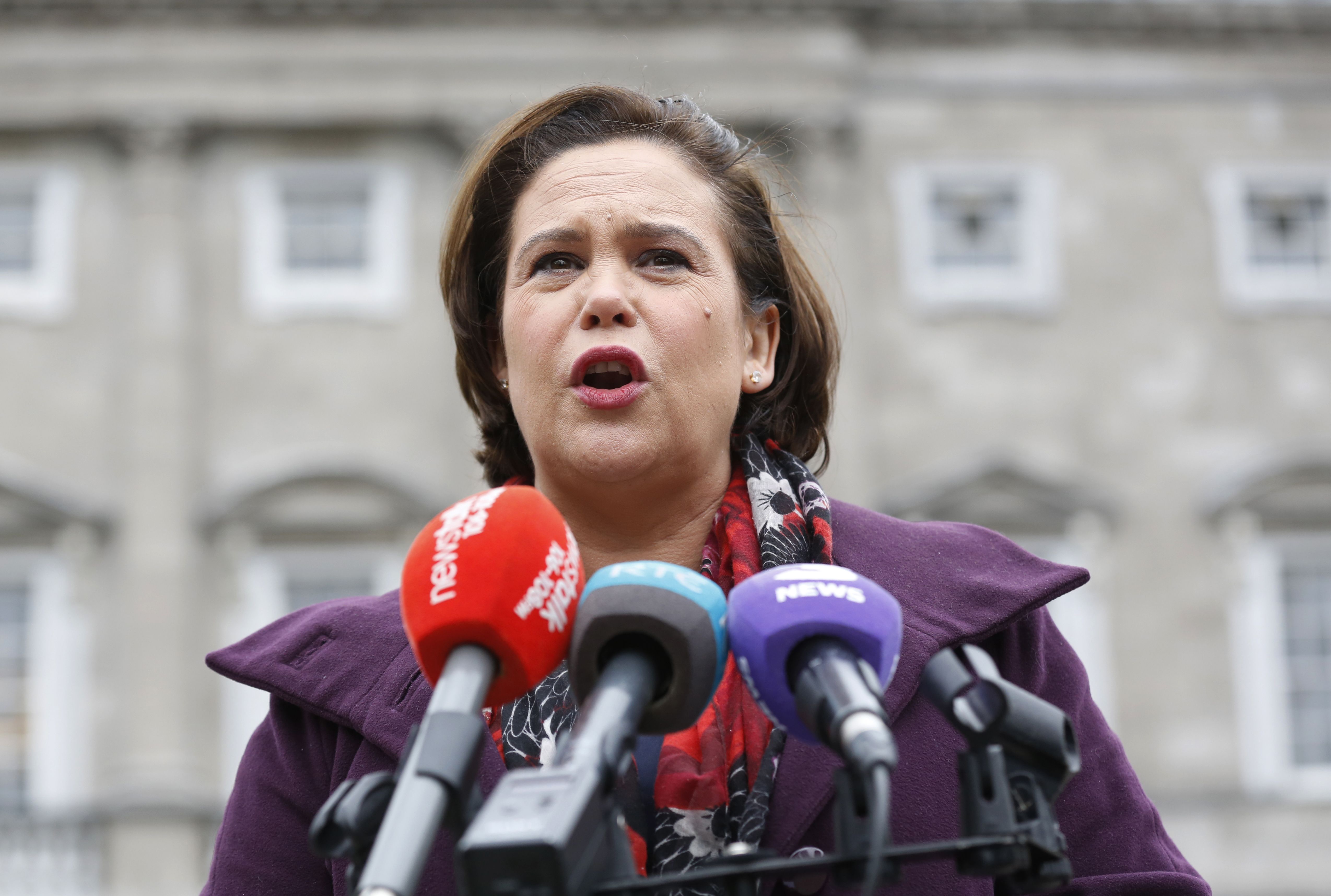
LAST Monday Sinn Féin leader Mary Lou McDonald announced that her party would not be travelling to Washington DC for the traditional St Patrick’s day series of events.
“The situation on the ground in Gaza and the West Bank remains dire,” said Mary Lou. “Israeli attacks on Gaza have not ended. The genocide continues. It is important that Sinn Féin uses its voice to demand that international law is upheld and peace and justice prevail.”
The announcement didn’t come as much of a surprise, if the truth be told. Sinn Féin stayed away from the White House last year, after all, and as the grotesque pretend-ceasefire continues to give Israel cover to kill whoever and however it wants and grab what land it covets in Gaza and the West Bank, the chance of the Chucks crossing the pond this year for the wearing of the green leaned to the latter side of slim to none.

The story flared with moderate brightness and by close of business on Tuesday it was gone. Until five days later, when the Irish Times reported: ‘Sinn Féin not invited to St Patrick’s Day White House events, says US embassy’. While the headline was undoubtedly a fairly accurate reflection of what the Irish Times wanted the Ambassador to say, it was a poor representation of the actual words that came out of his mouth.
The Irish Times said it had asked Ambassador Edward Walsh “questions” about the Sinn Féin announcement that it wouldn’t be at Donald Trump’s Paddy’s Day bash, although they disappointingly failed to tell us what those questions were. Ambassador Walsh told the Irish times that “no members of Sinn Féin have been invited to the White House and none are expected to be invited.”
Anyone familiar with the importance that diplomats put on commas and dashes, never mind words, will understand that when an ambassador says that no invitations are “expected”, the word leaves a tantalising gap.
The Ambassador could, had he been so minded, said that Sinn Féin will not be invited “period”, as they like to say in the States. He didn’t. He issued a mildly ambiguous response which, while clearly suggesting that an invite was highly unlikely, lacked the definitive heft of the Irish Times headline.
But aside from the reliably SF-hostile nature of the IT story, a more interesting titbit lay elsewhere in the story. Continuing his answer, the Ambassador said: “Announcing a boycott of an event for which invitations have not been extended nor finalised is premature.”
Hmmm. Interesting.
So on Friday past, February 20, the US Ambassador told the Irish Times “invitations have not been extended nor finalised”. Not “invitations to Sinn Féin”, just “invitations”. And yet despite the fact that the DUP had not received an invite to the White House by last Friday, the DUP said as early as February 8 that senior figures would be travelling to Washington DC for St Patrick’s Day, regardless of the fact that at stage no invitations had been issued, as per the Ambassador.
In the wake of the US Ambassador’s statement, the DUP’s reliably excitable Education Minister, Paul Givan, said: “It is frankly embarrassing that SF’s Michelle O’Neill briefed about ‘not going’ to St Patrick’s Day events in Washington, only for the US Embassy to confirm they weren’t invited in the first place.”
What the DUP thinks about the DUP accepting an invitation to Washington 12 days before the Embassy said that no invites had been issued is not clear at this point.
Amazing how much can happen – and not happen – in 120 BBC minutes
TWO hours the BBC had to edit the Baftas before the awards ceremony went out on Sunday night on a delayed broadcast.
Not an easy job, given there’s a lot going on and a lot being said, but Squinter’s grateful to the corporation for being sufficiently alert to spot Outstanding Debut winner Akinola Davies Jnr saying ‘Free Palestine!’ at the end of his acceptance speech. The offending words disappeared, never to sully the ears of the BBC audience.
MIND YOUR LANGUAGE: Bafta Best Actor winner Robert Aramayo and Maxine Peake in I Swear

Sadly, the editors didn’t do such a great job when it came to protecting viewers’ and listeners’ ears from the word “n****r”, shouted from the Bafta audience by guest John Davidson at black awards presenters Michael B. Jordan and Delroy Lindo. John lives with Tourette’s Syndrome and his life is the subject of the new film ‘I Swear’, for which Robert Aramayo won Best Actor.
Quite simply, the BBC showed infinitely more concern about an entirely legal and common statement of support for Palestine than they did about the most infamous racist epithet in the English language.
Squinter hastens to add that it’s not the fault of the editors working to a deadline. It’s the fault of senior management so in thrall the Israel lobby after the Bob Vylan Glastonbury debacle that staff find themselves working in an environment of fear and confusion.
The frontline staff on duty during the live Bob Vylan Glastonbury gig were told by to “step back” from their day-to-day duties, although, like you, Squinter has absolutely no idea what that means. Whether anybody will be told to “step back” after the broadcast of the ‘n’ word isn’t clear at this point. But if BBC heads do roll, you can be sure that once again it will be deputy heads.
Kerb clash
FORMER DUP leader Arlene Foster appeared before Stormont’s Assembly and Executive Review Committee on Tuesday to share her thoughts on – among other things – dual language signage at the new Central Station. Arlene goes these days by the splendid moniker of Baroness Foster of Aghadrumsee, her title taken from the name of a south-east Fermanagh village, whose name in turn is a straight phoneticism of Achadh Dhruim Salach, the historical Irish name of the village, which translates into English as ‘Field of the Ridge of Sallows’. Thus, straight off the bat, Arlene was appearing at the committee meeting with a title that’s in triple signage. So we could fully expect her to have a personal and rounded understanding of the nuances and sensitivities that surround the historically and globally familiar process of native languages being swamped by, ah, visitors, shall we say?
Sadly, no. Arlene’s contribution to the session was rather more in keeping with her former party’s King Canute-style stance on the old teanga. Asked by Sinn Féin committee member Pat Sheehan whether she considered the erection of signage at Grand Central was controversial, Baroness Achadh Dhruim Salach, sorry, Aghadrumsee, replied: “Well, I do because of the history, and because of the way in which, unfortunately, the Irish language has been used as a weapon against unionist areas, and it almost becomes a demarcation in the way that marking of kerbs happened in the past.
I regret that, but unfortunately, that is very strongly the perception that is out there in the unionist community. So, therefore, it was a controversial issue in my opinion that needed to come to the Executive for discussion and for agreement, and have an incentive to find agreement around those areas.”
The thing is, though, the painting of kerbs and the flying of tatty flags on lampposts – overwhelmingly unionist/loyalist pastimes – are not something that Arlene, or indeed any other DUP leader, have traditionally opposed with the passion they deploy against the Irish language. On the contrary, it is generally understood that the DUP has been and remains… how shall we put it?... very well disposed towards issuing three cheers to the red, white and blue, particularly when the Lambegs are Lambegging and the flutes are fluting.
If, in the autumn of her career and after stepping back from the renewable heat of politics, Arlene finds herself even mildly opposed to the painting of Ulster’s urban infrastructure, that’s to be welcomed, even if there’s little now that she can do about it.