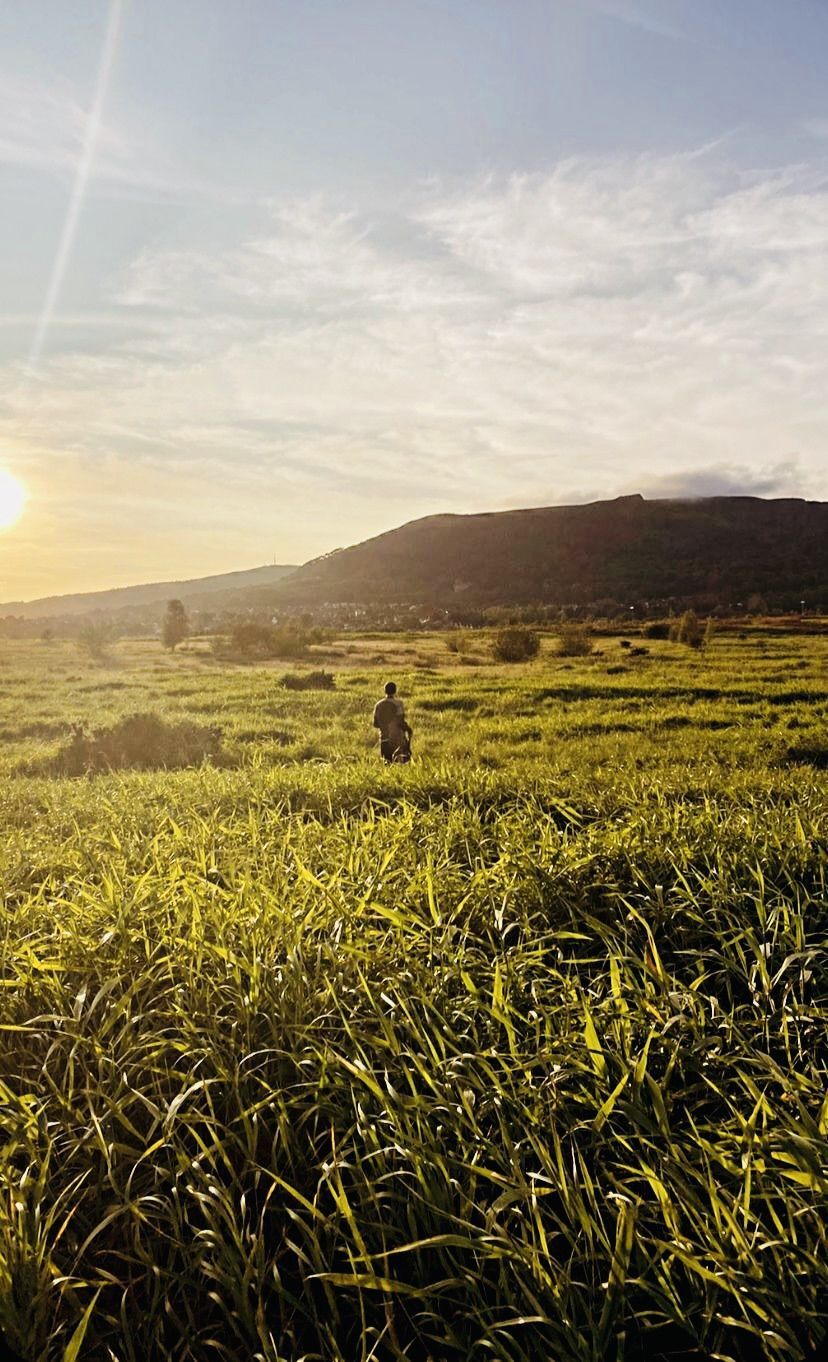
THERE was magic in the air last Thursday – you could almost touch it as Dúlra and two pals met up for a dander on wasteland down at the docks.
Maybe it was the weather – never before since records began had the sun shone so hot here on this day in May. The sky glistened, the air was as still as the grave and the grass beneath our feet swayed gently like a green sea.
On days like this you know that anything can happen. Walking in the countryside is taking a step into the unknown. And May is by far the busiest month – the pinnacle of nature year when every bird is breeding. Whatever the dangers – and there is no lack of them – the existence of their species depends on them procreating right now.
And so we started off, walking across a part of Belfast that has been abandoned to nature – and is all the better for it. Dúlra travelled light – his bins around his neck and his favourite walking stick, owned by his late father-in-law who left us more than 20 years ago. No self-respecting nature lover would ever be without a walking stick – as well as helping you balance on uneven ground, it’s useful for so many things, like searching prickly whin bushes for linnets’ nests!

We set ourselves a target of finding three nests – which Dúlra thought was conservative seeing one of our company was renowned bird expert Geordie Hynes, who actually earns a living finding birds’ nests as part of his annual bird survey work. He manages to successfully mix expert knowledge of bird behaviour with an amazing amount of patience – the greatest quality when trying to find a nest.
In the end we found only one – and that was a crow’s nest! Andy Graham – famous for building hundreds of nest boxes which are dotted across our hills – spotted it on top of one of the few trees down here – sorry there are no prizes for finding a crow’s nest Andy!
The mother hooded crow popped her head out of the mass of twigs and looked down on us as if to say – shouldn’t you lot be in the city?
On we strolled, keeping apart as we cut through the long grass, maximising our chances of finding the nest of a meadow pipit or skylark. At one stage a male reed bunting appeared and Dúlra lay on the grass to admire it in full through the binoculars.
Then some sort of commotion caught our attention. A couple of birds were darting over the grass at the top of the hill, rushing this way and that. It was as if an alarm had been pressed and it was an emergency situation. Something was happening so quickly that we had difficulty computing it. Among the scattering of birds was a bigger one, about the size of a pigeon. It looked like it was chasing birds, but it too was being chased.
It disappeared for a moment and then reemerged, this time clearly chasing what looked like a meadow pipit.
But it lost its quarry and flew on, landing on a post in the distance. We focused the bins. Was it? Could it be?
This was a bird, dead centre in Dúlra’s crisply focused Swarovski’s, that he had never seen before. One that he never thought he would ever see. A bird of prey which is in real danger of extinction in Ireland. A merlin.
The small hawk sat on the fence long enough for us all to study its markings – the streaked body, yellow feet and fanned tail. Before long two similar-sized birds arrived to attack it – maybe missile thrushes, the ones we had seen earlier – and successfully chased it off into the distance.
Merlins – meirliún in Irish – hunt down small birds as prey, flying fast just a few feet from the ground and chasing them relentlessly across open ground. It’s the last thing the meadow pipits of Belfast’s docks need!
Dúlra was delighted. He had gone out earlier that day hoping to find nests, but this was so much better. Historic even. He’d seen a merlin – we all had! Our day was complete. We walked on, talking over each other in our excitement. And then, five minutes later, Dúlra realised – he’d forgotten his walking stick.
“I can’t lose it,” he said. “I’ll have to go back.”
He’d obviously put it down in the grass while watching the merlin. Dúlra retraced his steps as best he could through the waist-high grass – but it was like finding a needle in a haystack.
From elation to despair in a matter of minutes.
He didn’t want to give up. He even whispered the words of desperation – the prayer he’s been told never fails – “Jesus was lost, Jesus was found”. But there was no point. The walking stick was gone.
Then Andy shouted from the hilltop. Dúlra looked up to see him waving a stick in the air.
While Dúlra had gone back to where he’d watched the merlin from, the other two hadn’t walked on as Dúlra thought, but they’d gone to search the spot where we’d earlier seen the reed bunting – and the stick was there, lying on the flattened grass.
Seeing a merlin and finding a lost walking stick – two miracles in one day.
* If you’ve seen or photographed anything interesting or have any nature questions, you can text Dúlra on 07801 414804.