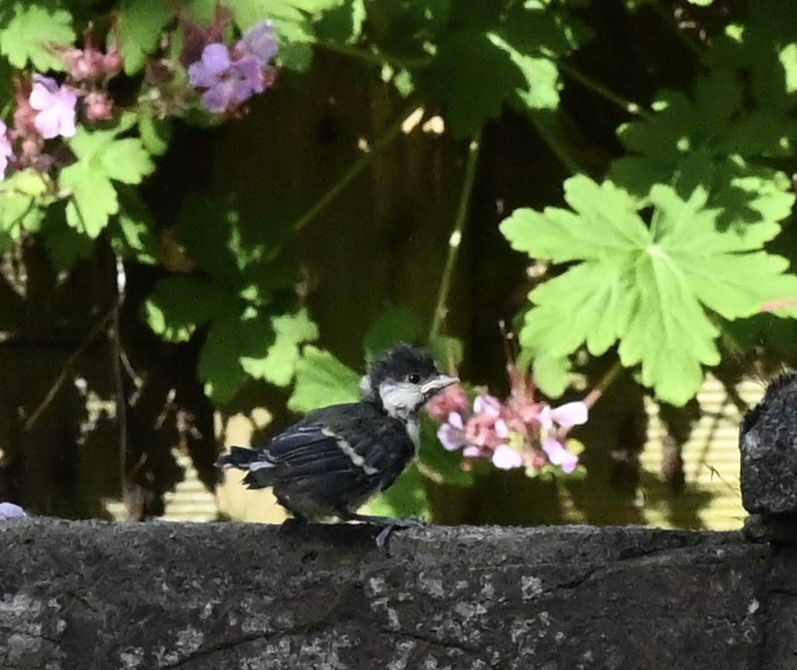
THIS bird certainly doesn’t look its best – but when you’ve just spent three weeks packed into a tiny box along with half a dozen brothers and sisters, you’ve got a good excuse.
The baby great tit leapt from the nestbox in the garden just seconds before Dúrla took this photograph. In a single bound, its world went from a muffled dark cave to one bursting with sound and colour.
Even evolution hasn’t been able to prepare theh youngster for that sensory overload. It just sat there on the ground, stunned by what it saw. (Dúlra’s garden has that effect!)
But this wasn’t the time to be in awe of the fabulous surroundings in this heatspell because it’s a time of huge danger. Birds like great tits lay so many eggs because so few of them make it to adulthood. And Dúlra would guess that a big proportion of them don’t get past day one.

No brain could contend with such a complete change. These chicks need time to readjust. But nature is merciless. A whole army of predators stands ready to snuff it out. Raptors and cats are this baby’s main threats, but a magpie will take a wide-eyed chick too.
The parents were on top of the hedge, calling it towards them. It needed cover quick – or it would be picked off. They say chicks should always be left alone to fend for themselves – they might look abandoned but the parents know where they are. But Dúlra couldn’t abandon this bedraggled bird on the concrete yard. And so he sat at the door to ensure no magpie would pounce.
Finally the fledgling realised that it had wings and it flapped them, rising to the top of a wee garden wall, where this picture was taken.
That it took just 21 days to turn a tiny chick hatched from a minuscule egg into a perfect if dishevelled fledgling is a miracle. And Dúlra saw that miracle continue as the parents were like a tag team bringing fat caterpillars to their offspring from dawn to dusk.
The parents continued to call from the hedge, and the wee bird tried one more weak flight and disappeared into it.
Job done, Dúlra thought. This one would make it.
• A friend reports a pine marten wiped out a kestrel’s nest in a man-made box on the Belfast Hills. The animal – whose Irish name – cat crainn/tree cat – is a more accurate description, scampered up the tree trunk and into the box, killing all the chicks. It’s nature, of course, and it’s brutal, but it’s another example of how we often put creatures in more danger by trying to help them. Those kestrels would, in the absence of a nestbox, probably have nested on a quarry face that no pine marten could get at.
Dúlra, too, faces similar quandaries. He attracts finches and pigeons to his garden, where they are easy prey for sparrowhawks.
With the welcome arrival of the pine marten back to its native territories, many of the bigger boxes we have placed to help owls and birds of prey could now be vulnerable.
• Finally, a public apology. The neighbours have been besieged by a continuous banshee-like screeching for a couple of weeks now as Dúlra tries to attract swifts. And with each passing day, he gets a little more desperate and increases the volume of his recorded call by a notch.
So far the neighbours haven’t complained, but he almost expects to find a posse of them at this door with a signed petition calling on him to turn it off. So far no swift has responded although a few have flown past high up in the sky. And by now all the migrants have returned, so it’s not looking good.
Gransha on the Glen Road is a hotspot again this year with at least a dozen pairs nesting there. Surely they could send some Dúlra’s way?
• If you’ve seen or photographed anything interesting or have any nature questions, you can text