WHEN Rathlin Island made the incredible announcement last week that the island was now ferret-free after years of diligent work by environmentalists, one guy from West Belfast appreciated it more than most.
Aaron Kelly spent a year dangling off cliffs on the County Antrim outpost as part of an ambitious project to rid it of rodents – and become one of the few human-dwelling islands in the world to do so.
Aaron’s real celebration won’t happen for another year or so – when the island, hopefully, will be declared rat-free as well.
It takes two years with no evidence of a ferret or rat before the official announcement can be made.
Aaron – now a warden on his beloved Black Mountain – worked on Rathlin from June 2024 to April 2025 and it was a life-changing experience. When he arrived he was afraid of heights, today he does cliff-climbing with friends in his spare time!
Aaron says that by the time he arrived, it was clear that the island’s ferrets – which had gone feral when they escaped while being used to hunt rabbits – had been exterminated. But the rats were a much bigger challenge.
One of the problems was that the rats were able to live happily on the cliff-faces, where they could feed on the nesting seabirds’ eggs and chicks.
“They did the surveys from boats and they could see rats all over the cliffs, running up and down. There are what they call ‘aprons’ on the cliffs, a wee crag that has soil and grass on it, and that’s perfect for nesting birds. But rats were feeding on them and doing untold damage.”
In the biggest such nature project in Ireland, around 40 people took part in the plan to get rid of both pests and save the birds.
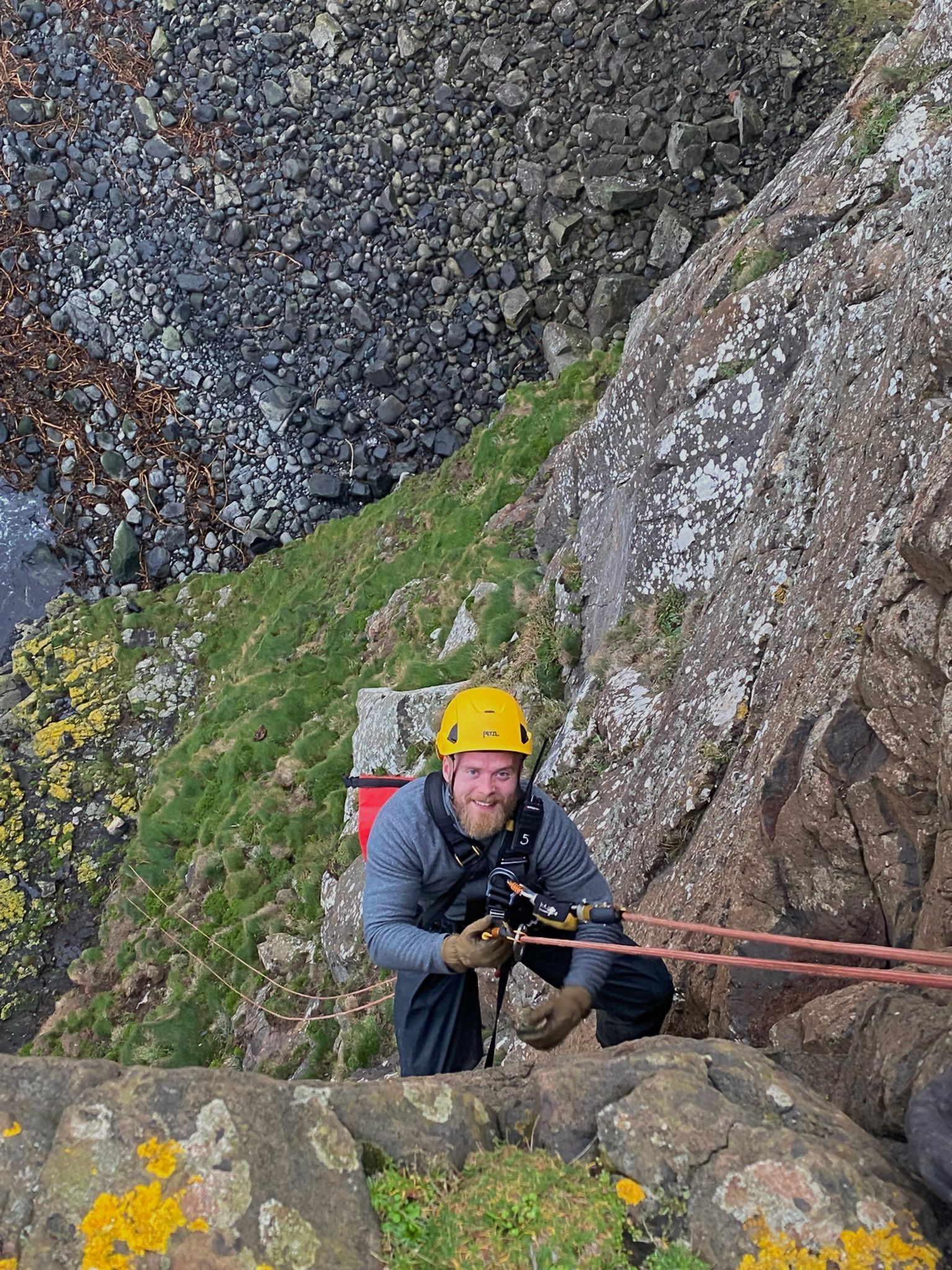
“It was no easy job,” Aaron told me. “I was on the climbing team, the plateau team worked on the land, checking bait stations. But even though I was scared of heights, I knew I had to do the cliffs. I couldn’t miss the opportunity.
“Even if you’re not scared of heights, it’s a different thing jumping off the edge of a cliff. That took a bit of getting used to.
“I remember the first day my legs were shaking like crazy. But I thought to myself, it’ll be worth it. And now I do cliff climbing in my spare time with a few friends. And it’s going to help me on Black Mountain when I’m putting up cameras for nests.
“You were going up and down these cliffs carrying nearly 60 kilos on your back. It’s the fittest I’ve ever been.
“We set the bait stations out on the cliffs. Each day it was a different bay or cliff station, where we checked if bait was taken and replaced it if it had. Everything was logged constantly. The first few weeks every bait station had been emptied of bait, but by the time we had finished, nothing was being taken.
“On the cliffs you got to see the island properly. You were seeing so much good scenery you became immune to it.”
While trying to eradicate rats, the team kept their eye out for any sign of ferrets, but there was none.
“We checked the ferret traps, but by the time I arrived they were away,” he said.
Now the island is in the monitoring phase where they are on constant lookout for any sign of rats.
“There are wax blocks all over the island that are flavoured with peanut butter, shrimp and chocolate.
“You check them for teeth marks and you can distinguish between rats and shrews and other animals. As far as I know there hasn't been any sign of a rat.”
The biggest challenge now is making sure that no rats or ferrets return, considering that rats are among the smartest animals on earth and manage to find their way almost everywhere.
Aaron says strict biosecurity measures are now in place – not just on Rathlin, but at its mainland service port, Ballycastle.
“If you ever go there you’ll see the signage everywhere and bait stations at Ballycastle harbour where they check everything rigorously.
“They even have a sniffer dog, Woody, that’s trained to smell out the rats and ferrets and he’ll sniff around the boats going back and forth.”
The results of all that work are already being seen.
“It’s that quick. Ferrets were not only eating the birds but the leverets,” said Aaron. “Hares will flourish as will corncrakes.
“Puffins are back breeding in their old habitats. And birds that used to breed on the island are returning, like storm petrels and Manx shearwater, which bred there for the first time last year.
“Manx shearwater nests are easy pickings for rats or ferrets – when people are ringing them they just go and pick them off the ground they are that tame.”
Arron says his year on Rathlin opened his eyes. “I don’t know how I could have called myself a nature lover and never gone to Rathlin Island. It’s a spectacle – around 250,000 breeding birds. It’s mind-blowing, like something out of a David Attenborough documentary,” he said.
“I’m really glad to have been part of it. When the numbers of breeding birds go up, I’ll look back on it and say I chipped in a bit.”
Chipped in is an understatement. When you see the pictures of Aaron scaling the rocks, you see that this guy put his life on the line to save Rathlin’s birds!
•Dúlra was left feeling uneasy at the weekend when he saw a birds of prey ‘show’ at an open market. The powerful raptors were all placed out in the open so people could get their pictures taken with them, for a price of course. Among the birds was a beautiful barn owl – and Dúlra couldn’t help but think that this night-hunting bird should really be asleep instead of providing ‘entertainment’ to passers-by. If Dúlra had his way he would ban the keeping of any birds of prey, except when it’s part of a breeding project to boost their numbers in the wild. They are truly stunning to see up close, but they are not there for our entertainment. The best thing we can do for them is protect their environment so they can thrive in our countryside. So give things like this a miss.
• If you’ve seen or photographed anything interesting, or have any nature questions, you can text Dúlra on 07801 414804.