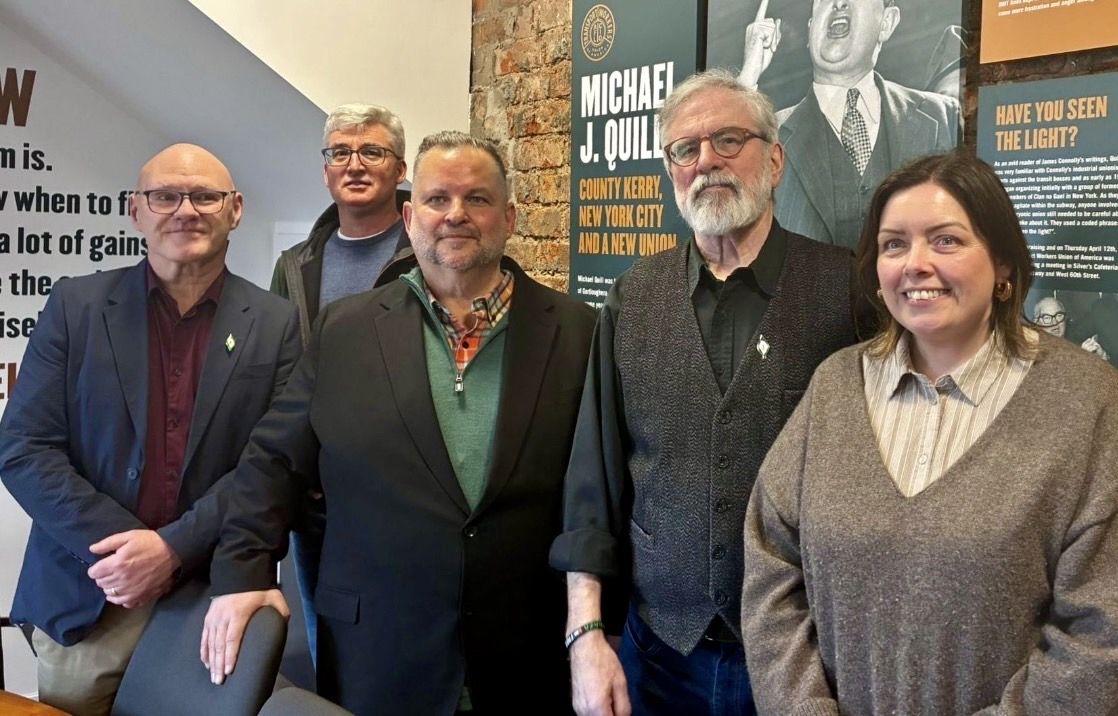
I JUST spent an enjoyable couple of hours in the company of my good friend, American trade union leader John Samuelsen, and the staff of Áras Uí Chonghaile and Fáilte Feirste Thiar – the West Belfast Tourist Board. Unbeknownst to John, both organisations had agreed to name one of the Áras rooms after him and a former Transport Workers; Union, (TWU) President, Mike Quill.
John, the current International President of the TWU, was genuinely surprised and delighted at the recognition of the strong connections between the labour movement in Ireland and in the USA and the part played by the TWU, LiUNA and others US-based unions in helping to fund Áras Uí Chonghaile.
‘Seamora Quill – Samuelsen’ and the graphics and information it contains tells the story of that connection and will remind visitors of the key role the Irish played in building the trade union movement in the USA.
Lorcan Collins, historian and author, told the story of Mike Quill, a Kerryman and former IRA volunteer who along with his two brothers was very active on the anti-Treaty side during the civil war that followed the Treaty in 1921.
In March 1926, like many other republicans of that generation, Quill travelled to the USA, where he eventually got a job with the Interborough Rapid Transport Company (IRT). He worked long hours, seven days a week.
Quill closely identified with the ideas and philosophy of James Connolly and in 1933 along with several other Irish leaders he established the Transport and General Workers Union. In the years that followed he built the union into one of the most formidable in the USA. But Quill never forgot his roots and remained a vocal advocate of Irish unity and a member of Clann na nGael. He was also a determined advocate of equality and anti-racism. In the 1940s his union organised a nationwide campaign against lynching and he was a strong supporter of Martin Luther King and the civil rights campaign.
When Quill died in January 1966 Martin Luther King said of him: “Mike Quill was a fighter for decent things all his life – Irish independence, labour organisation, and racial equality. He spent his life ripping the chains of bondage off his fellow man. When the totality of a man’s life is consumed with enriching the lives of others, this is a man the ages will remember – this is a man who has passed on but who has not died.”
So, the next time you have some time to yourself, visit Áras Uí Chonghaile. Its exhibition of memorabilia connected to James Connolly and the 1916 period is second to none. The story of Mike Quill, of John Samuelsen, Terry O’Sullivan and the contribution made by the American trade union movement, are central parts of that narrative. They also have a café that makes a great snacks and good coffee.
www.arasuichonghaile.com
An Easter anniversary that’s well worth celebrating
THIS Easter the Good Friday Agreement is 28 years old. It only seems like yesterday that we were all gathered in Castle Buildings wondering if David Trimble was going to take the leap. He hadn’t spoken to Sinn Féin at any time during the negotiations – except on one occasion when I said hello to him in the toilet and he told me to grow up. But on Friday, April 10, 1998, he signed up to the Agreement.
It was a defining moment in our recent history. It was a compromise between conflicting political positions. For the first time since partition the Agreement brought peace, stability and hope, and the opportunity for a better future for all the people of the island of Ireland.
However, that Easter Sunday as I travelled to Carrickmore in County Tyrone to deliver the Easter speech I still wasn’t sure how the republican grassroots was going to respond. Initial feedback was positive. But it is a truism of such processes that the hardest negotiation is always with your own side. So that Easter Sunday in 1998, as we walked through the Tyrone town on a cold, but beautifully clear April day, the jury was still out.
The crowd was larger than usual, and indeed this was true of the commemorations everywhere that year. As I looked around I knew many of the faces. I was talking to Sinn Féin activists, republicans who had struggled over the decades, relatives of our patriot dead and undoubtedly some IRA volunteers as well.
I paid tribute to the IRA for providing the opportunity for peace. I appealed to everyone to read and study the Agreement carefully. The key question was, in the context of our future strategy, policy and objectives, could the Agreement advance our struggle? The conclusion of the talks had ended one phase of struggle but the one opening up would present many new challenges.
When the commemoration ended I was surrounded by many well-wishers. Among them were the mothers of some young IRA volunteers who had been killed in Tyrone not long before, at Loughgall and Cappagh. I particularly remember Mrs Arthurs, mother of volunteer Paul Arthurs, and Mrs Quinn, mother of John Quinn. They both hugged me. I felt a huge sense of relief. If these brave women supported our effort then the future looked hopeful. We had, I believed, dealt a significant blow to the union with Britain. The inclusion of the unity referendums within the Agreement opened up a peaceful and democratic path to a united Ireland. Our task was and is to make it happen. That remains our clear objective.
In the years since then, despite the delaying and obstruction tactics of the unionist parties and the British, and the failure of successive Irish governments to embrace the potential for unity, progress has been made. Electoral advances and political and demographic change mean that Irish unity is within our grasp.
As Deirdre Hargey MLA said in her Easter address in Belfast last week: “Our patriot dead had a vision. A vision of equality, sovereignty and freedom. For Catholic, Protestant and Dissenter. Theirs was a pledge, that the Irish people could be the masters of their own destiny.”
So, our task is to keep the faith and make real the opportunity for a free, independent sovereign Ireland that has been the goal of Irish people for generations.
RIP Cruncher
IT was with profound sadness that I heard on Sunday of the death of my friend and comrade Terry ‘Cruncher’ O’Neill. Cruncher was an incomparable singer of Irish songs of resistance. Type his name into Google and you will discover videos and audio recordings of Cruncher singing.
My memory is full of occasions when he enthralled an audience. There is a great Frankie Quinn photo of Cruncher, Joe Cahill, me and Gerry Kelly singing ‘Something Inside So Strong’ at the top of our voices outside the old Sevastopol Street office. Cleaky is in the foreground looking after us.
JOY: Joe Cahill, Gerry, Cruncher, Gerry Kelly and, front, Cleaky Clarke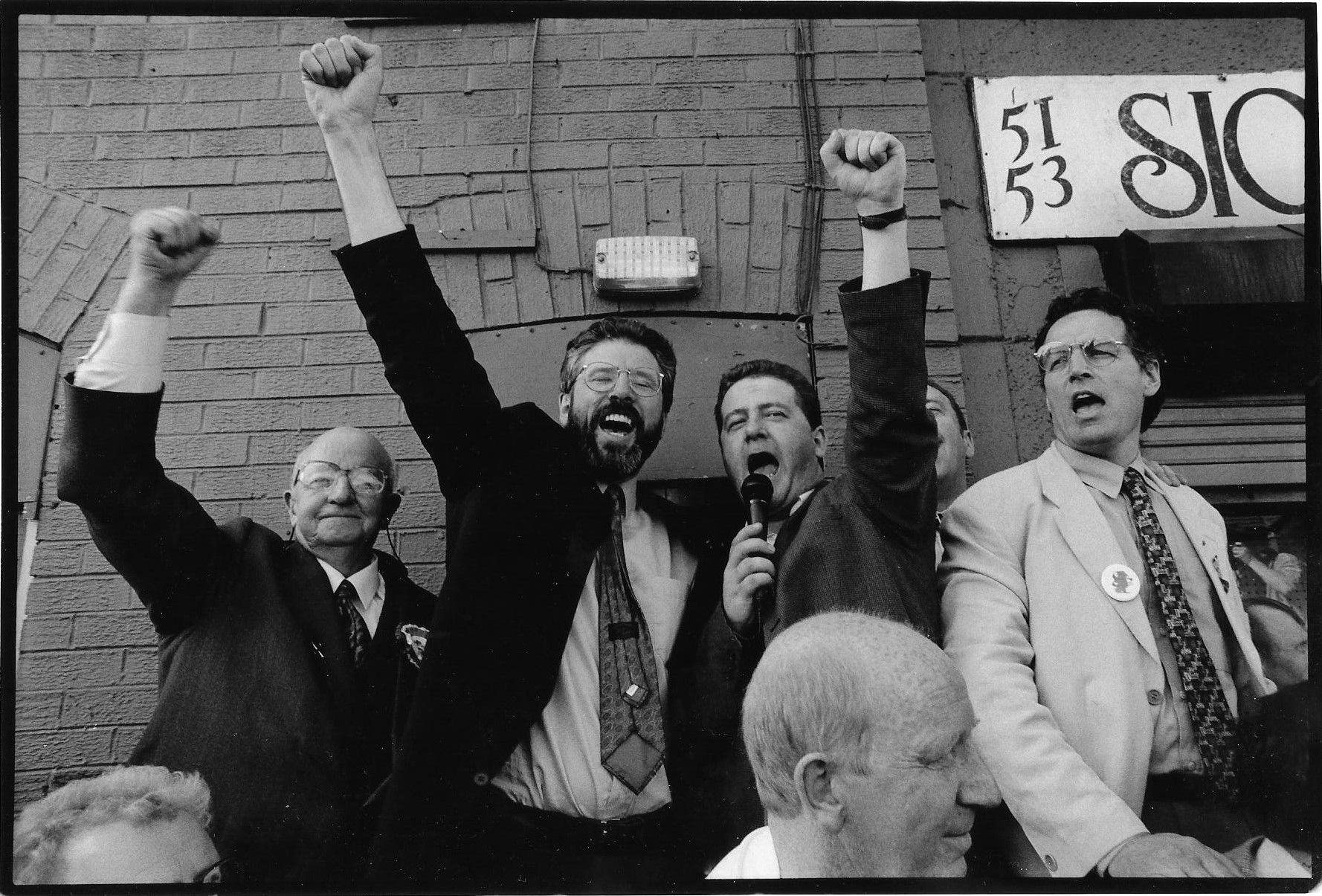

Cruncher, who was named Terry after his father, was originally from the Lower Falls area but his family moved to the New Lodge in the north of the city when he was five. Despite living there almost all of his life, he often joked that to the people of North Belfast he was still a wee Westie. Cruncher’s father could play guitar and music was an integral part of his family growing up.
The family was also strongly republican and he remembered watching the local IRA out defending his area in 1969/70 and later. At the age of ten he started to learn guitar and he never looked back. He tortured anyone who could play guitar to teach him more. He also enjoyed acting and participated in plays by Dubbeljoint Theatre Group.
Terry was a committed Irish republican. His death is a huge loss to his family and also to his wider republican family. Tá sé ar slí na firinne anois.
I am also sorry to hear of the death of Gabriel Rosenstock, poet, playwright, haikuist and writer. Gabriel was one of the leading lights of Irish language literature. Gabriel was the author and translator of more than 180 books and publisher of over 400. He translated Bobby Sands’’ ‘The Rhythm of Time’ into Irish and was delighted when the Bobby Sands Trust produced it as a poster.
Gabriel’s contribution to Irish language and world poetry is simply immeasurable. Apart from his own work, including writings for children, Gabriel translated into Irish Heaney, Beckett, Yeats, Bob Dylan, Kate Bush, Leonard Cohen, Van Morrison, Bob Marley and many more.
Mo comhbhrón ar a bhean chéile Eithne agus a chlann. Ar dheis De go raibh a anam dilis.