WHEN I was a wee buck growing up in Ballymurphy there was a river at the back of the houses across from our home place at the corner of Glenalina Road and Divismore Park. The river ran the length of our street and the length of Ballymurphy Road before exiting below the Whiterock Road and into the City Cemetery. From there it meandered down to and under the Falls Road beside the bus depot and onwards to the Bog Meadows. You can see it there to this day. The stretch which used to border our street was long ago captured and incarcerated in a pipe below ground.
Before then it was one of our favourite places to play. The Ordnance Survey maps name this rivulet as the Ballymurphy Stream. I can’t find its Irish name. It rises in the mountain and cuts under the Springfield Road beneath a very high arch just up from our street. It used to be at its widest at that point. Perfect for jumping. Swinging across on a rope. Falling in. Catching frogs. Plastic sandals were all the go. Perfect for walking on water. On the other side of the river there was a huge field. Huskey’s Field. There was a big house there. Later it became a clinic where we were supplied with cod liver oil and orange juice. A little bridge connected Divismore Park to the clinic. There was a long tree-lined avenue from the front of the house up to the Springfield Road. When Springhill was built this became the main street. Springhill Avenue. Westrock Bungalows connected the new estate to the Whiterock area. Corrigan Park formed another perimeter with St Thomas’s school at right angles to the Naomh Eoin’s playing field. Families of the Traveller community used to camp on the waste ground behind St Thomas’s with their horses and barrel shaped wagons.

Springhill estate and later Corpus Christi chapel replaced all this. The green grass of Huskey’s Field was suffocated by acres of concrete and grey-clad maisonettes. Every inch of green was cemented or tarred. Ugly looking three-storeyed homes were provided for mainly young families whose parents were either unemployed or in low-paid, casual jobs. Like the rest of the Upper Springfield, poverty was rife. Fr Des Wilson was among the many stalwarts, including the builders of Bombay Street and other strong Gaeilgeoirí like Liam Andrews, who stood with this community over the decades. In 1969 the British Army commandeered local utilities for their troops, including the Henry Taggart Church Hall overlooking our street and close to Springhill. The area was under intense military occupation. British Army snipers were also deployed in Corry’s Yard whose high walls overlooked parts of Springhill/Westrock.
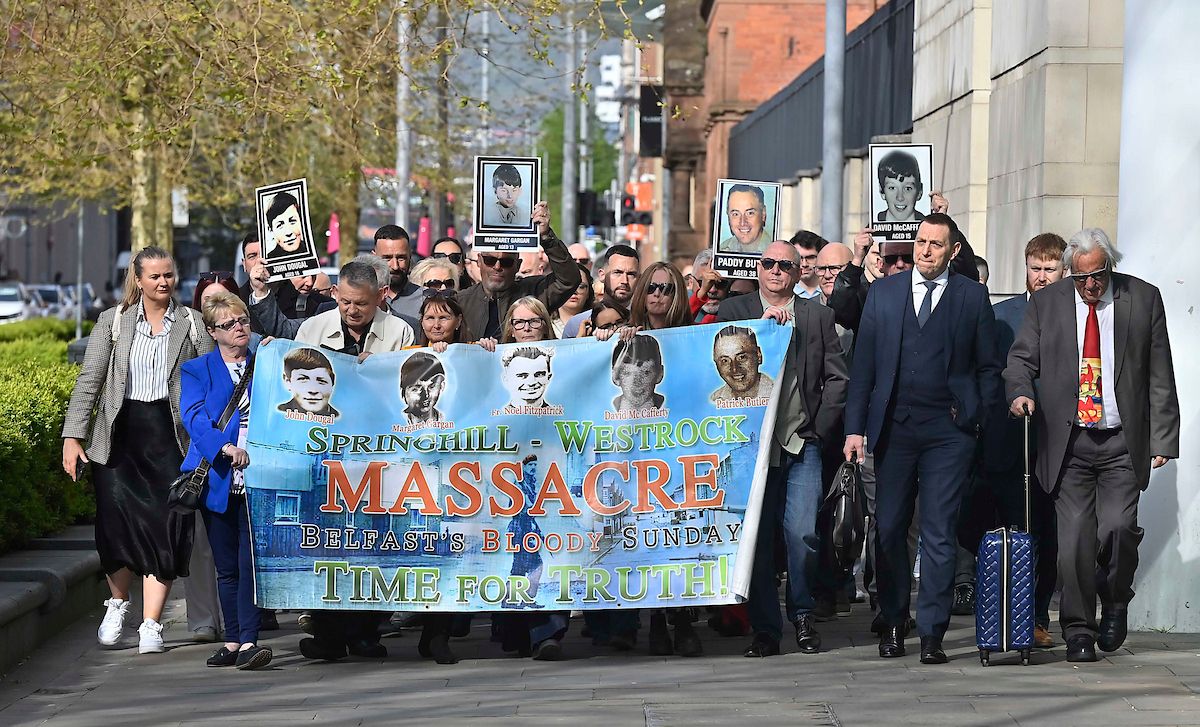
During the internment raids of August 1971 eleven of our neighbours were killed by the British Army during the Ballymurphy Massacre. Some died beside our wee river. Almost a year later in July 1972 five more neighbours were killed in Springhill and Westrock by British riflemen. They included three teenagers, a local priest – the second priest to be killed by British soldiers in that time – and a father of six children. Others were seriously wounded.
Since then their families and the people of Springhill have campaigned for the truth. The British Army and its political representatives claimed the dead had attacked them. Same as they said about the Ballymurphy Massacre. And Bloody Sunday. Last week, 54 years later, the families of Fr Noel Fitzpatrick, Paddy Butler, David McCaffrey, Margaret Gargan and John Dougal were vindicated
All of these families are decent, working class people rearing their families in hard times in a war zone. I’m sure none of them planned to be activists. Yet throughout the generations they kept faith with their loved ones and with the support of committed legal advisers and the rest of us they have prevailed. We give thanks and we salute these heroes and all those who struggle for justice.
Bobby Sands’ example continues to inspire us
IT does not feel as if 45 years have passed since the death on May 5, 1981, of Bobby Sands on hunger strike. Bobby’s death and that of his nine comrades changed so much in our struggle and opened up so many new opportunities that it is rightly viewed as a tipping point in recent Irish history.
On Sunday, former hunger striker Pat Sheehan MLA gave a wonderful speech at Bobby’s statue in Twinbrook. The courage and heroism of the ten men who died and those who took part in the hunger strike, and of Michael Gaughan and Frank Stagg, are a huge part of our republican history.
But we should never lose sight of the fact that Bobby and his comrades in the H-Blocks and in Armagh Women’s Prison were more than political prisoners. They were family members, friends, neighbours, comrades. They were ordinary young men and women who enjoyed life.
Cage 11 was where I first met him. He and I used to sit in what was called the study hut. I would be writing and he would be playing guitar and singing. Bobby was a committed Gaeilgeoir. When Coireall MacCurtain arrived in from Limerick and started Irish ranganna his teaching included a singing rang. Bobby was an enthusiastic student. He learned ‘Gleanntáin Ghlas Ghaoth Dobhair’ and ‘Báidín Fheilimí’. He later went on to write his own songs i nGaeilge.
I remember him playing and singing it our Cage concert at Christmas 1975, not long before he was released. His friend Tomboy got out later and Bobby played at his homecoming gig in Unity Flats. Later the two of them formed a group. Phoenix was their name. They had only two gigs before Bobby was re-arrested and Tomboy was back on the run. Bobby’s life story is now familiar to many. His time on the blanket. His efforts to negotiate an end to the barbarity of the H-Block regime and then the hunger strike and his death. Bobby’s poetry and prose will be remembered long after those who tortured him are gone. He will be remembered with love and awe by generations for the hope he inspired and the courage he demonstrated.
At the end of ‘One Day in My Life’ Bobby wrote: “They cannot or never will break our spirit... ‘Tiocfaidh ár lá,’ I said to myself. ‘Tiocfaidh ár lá.’”
Global icon
FREEDOM struggles across the globe have their heroes. Nelson Mandela, Che Guevara, Bobby Sands and in Palestine, Marwan Barghouti .Last September a mural celebrating Marwan’s leadership and resistance to Israeli occupation and the oppression of the Palestinian people was unveiled at the international wall on Bóthár na bhFál. Two weeks ago at the Ard Fheis I met with Marwan’s son, Arab. Since then we have spoken by Zoom. His family and those, like me, who believe he should be released are fearful for his life.
The similarities in the struggle for Irish freedom and that of the Palestinian people is clear in the treatment of political prisoners. Marwan Barghouti is a Palestinian leader who was the victim of a show trial that was condemned internationally. He is one of ten thousand Palestinians currently in prison. Over 300 are children and over 3,000 are internees. Marwan has been held for 24 years and for the last two and a half years he has been held in solitary confinement. He has not seen his family in that time. Only his lawyer, Ben Marmarelli, gets to see him occasionally.
SOLIDARITY: Gerry Adams with Alice and Arab Barghouti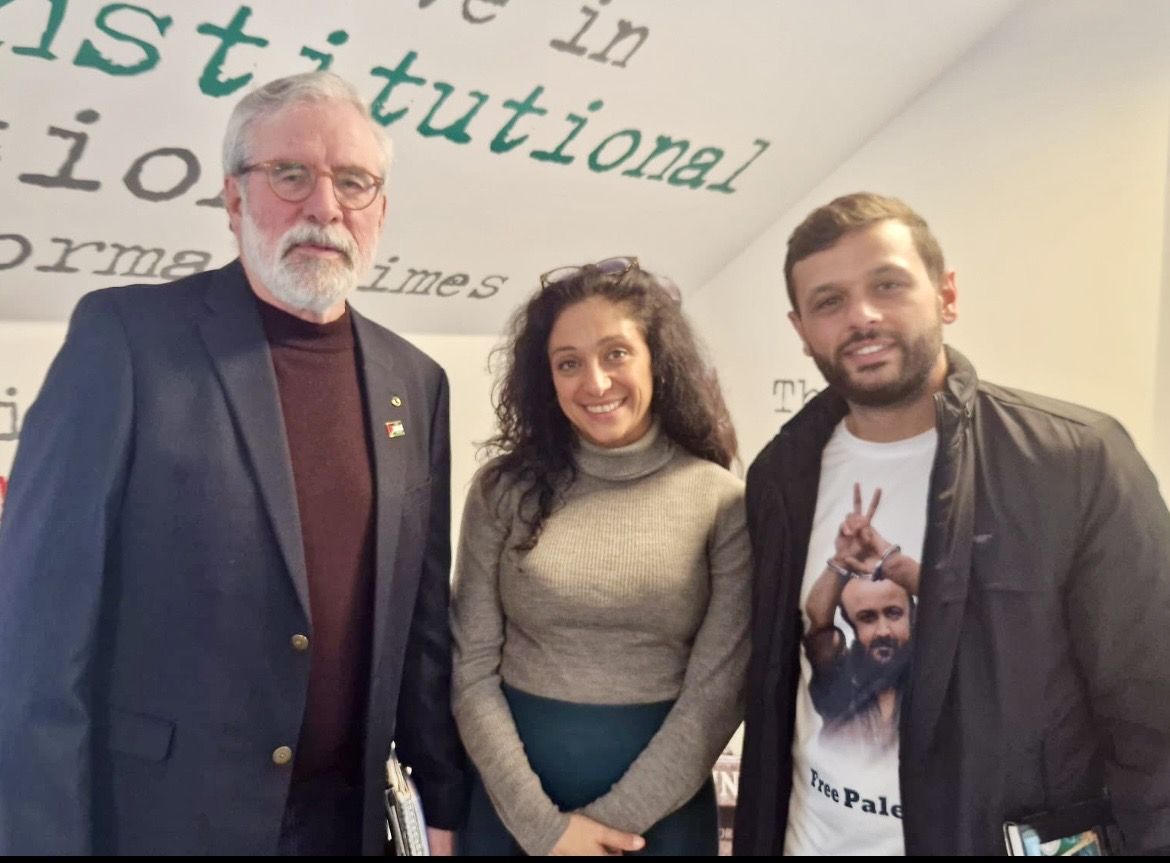

In a recent statement, Marmarelli reveals that in the past six weeks Marwan Barghouti has been subjected to three violent assaults. On March 24 guards entered his cell with a dog, forced him to the ground, and the dog repeatedly attacked him. The following day he was assaulted again. On April 8 he was severely beaten and left bleeding for more than two hours. He was denied medical treatment. These are not isolated incidents. Marwan has frequently suffered assault.
Why is Marwan especially singled out? Because he is widely recognised as the Palestinian leader who can unite the Palestinian organisations. He is also feared by Israel because he has demonstrated a willingness to seek an accommodation. Israel wants victory, not compromise.
Over the coming weeks I will write more about Marwan, about his life under Israeli occupation. His leadership and resistance. And his hopes for the future. Free Palestine. Free Marwan Barghouti.