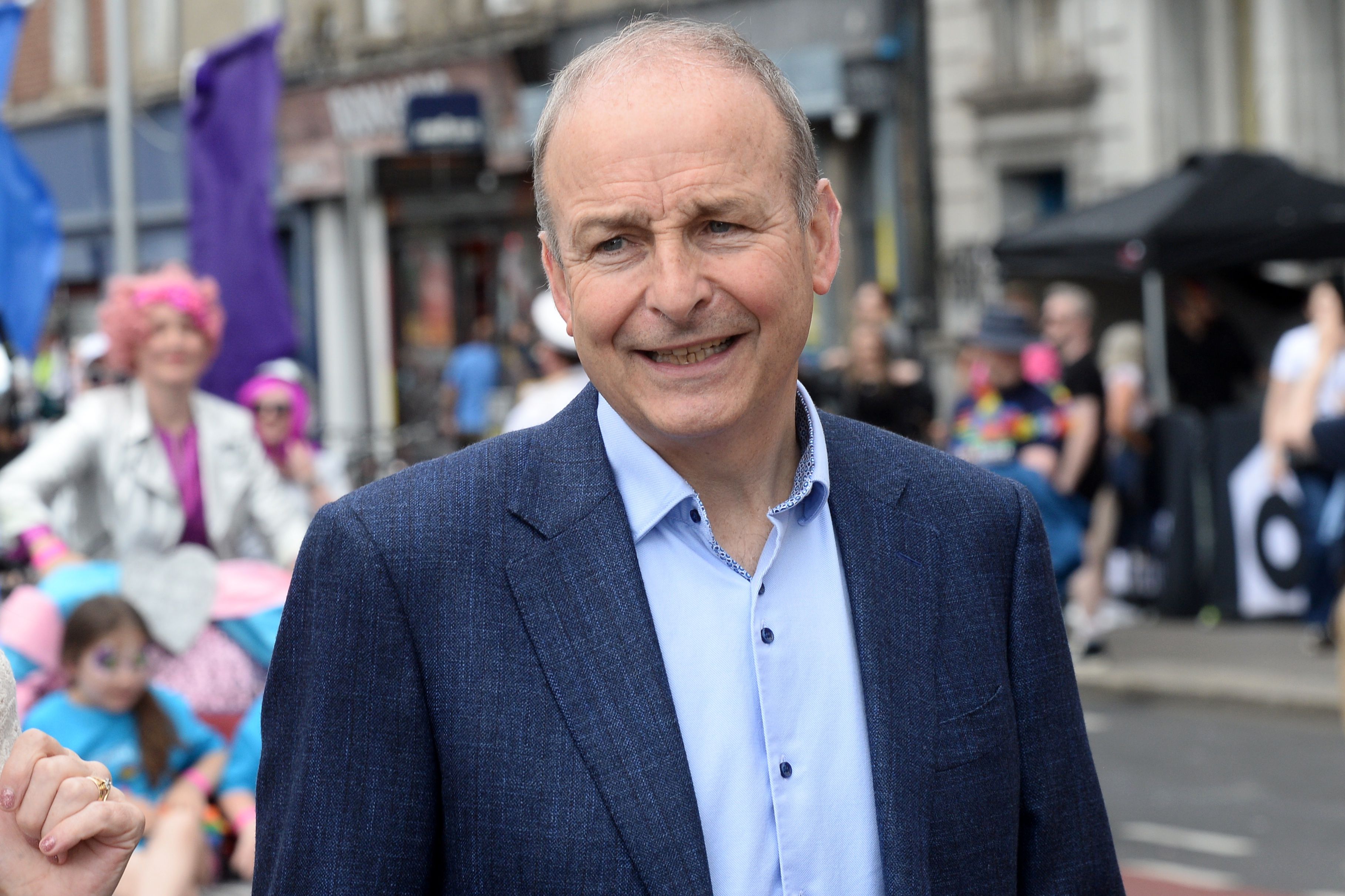
AN Taoiseach Micheál Martin was the first guest to participate in a new six part series of the podcast, ‘How to Gael’ under the title – ‘How to Unite Ireland.’
The 40 minute interview - can be heard on Spotify and was conducted by Doireann Ní Ghlacáin and Louise Cantillon, who in the opening commentary described their series as an exploration of the “lived experiences that shape how people feel about unity. It’s a complex and sensitive topic, and the series creates space for open, informed and respectful conversation.”
The interview with Micheál Martin provided an opportunity for the Fianna Fáil leader to restate his long standing position on issues as diverse as the history of Fianna Fáil, his refusal to work with Sinn Féin, the Shared Island project, reconciliation and Irish unity, the Good Friday Agreement, a border poll, and talking to loyalists.
The surprise of the two interviewers at Martin’s claim that Fianna Fáil is a republican party was genuine and an interesting insight into how that party is viewed by many young people. Time and again Martin returned to his central thesis of reconciliation as a pre-condition to reunification. He said: “My philosophy is it has to be about the unity of people, insofar as you can go, it’s not just about territory.”
Of course it is about unity of people. That is obvious. But making the end of the union with Britain conditional on reconciliation in Ireland turns logic on its head. How is this reconciliation to be measured? An Taoiseach doesn’t say. He ignores the most important aspect of the Good Friday Agreement – the right of the people of the island of Ireland to decide our own future through unity referendums. Nowhere in the GFA is reconciliation a pre-condition to unity.
Martin’s approach also ignores the lessons of history and of conflict resolution around the world. If reconciliation was a precondition for political agreements, I can think of none that would have succeeded. Had reconciliation been demanded of the parties and two governments in 1998 there would have been no Good Friday Agreement. The Good Friday Agreement was all of us signing up to a journey the outcome of which would be determined by the people, democratically and peacefully.
Addressing a recent meeting in the Oireachtas in Dublin, Reverend Karen Sethuraman of Ireland’s Future challenged the reconciliation first approach. She said: “Reconciliation is not a final destination. It is not a single moment in which everything is resolved. It is an ongoing, process, one that will continue, even in a new Ireland... the idea that we must wait for complete or perfect reconciliation before we can begin working toward Irish unity does not hold.”
That is how real reconciliation works. Planning for unity and working for reconciliation is not exclusive. They can be done together. Micheál Martin knows this. But he deliberately uses reconciliation as an impediment to the government undertaking the essential work of encouraging the conversation and the necessary planning for unity. Why? Because Martin is not committed to unity. Whatever his Fianna Fáil roots and the claims of that party to being republican, Martin is deeply entrenched in the politics of partitionism, of two states on the island of Ireland.
In March 2017 Martin announced that Fianna Fáil was working on a 12-point plan for a united Ireland which would be published within months. Almost ten years later the plan – if it was ever prepared – sits gathering dust on a shelf somewhere. What we got instead was the Shared Island project. While this is a useful initiative which has facilitated dialogue, co-operation and connectivity between North and South, it is not a plan for Irish unity. On the contrary, Micheál Martin has explicitly stated that the shared island project is not “a Trojan horse for unity”.
As if to underscore this, a few weeks ago the Fianna Fáil Minister for Public Expenditure, Jack Chambers, echoing his party leader, expressly told a meeting of the British-Irish Parliamentary Assembly in Tralee that the Shared Island programme cannot be used to push the cause of Irish unity.
This argument that now is not the right time to plan for unity is at odds with a Dáil- and Seanad-approved motion on Irish unity, unopposed by the government, in October last year. The previous year the joint Committee of the Oireachtas on the Implementation of the Good Friday Agreement (GFA) published a report recommending “preparation for a united Ireland to begin immediately” and a whole-of-government approach to make it work. Micheál Martin has ignored all of this.
In addition, his rationale for not working with Sinn Féin has really nothing to do with differences on policy matters. Building alliances – however temporary – is a regular feature of democratic politics. The truth is that Martin’s hostility to Sinn Féin is about the threat he believes it poses to Fianna Fáil’s political hegemony in southern politics.
Martin’s podcast did touch on important issues, like engaging with our unionist neighbours and winning support for a border poll, but his strategy is not about any of this. It is focused on stalling Irish unity and using reconciliation as the excuse.
A sensible strategy – a real plan – for unity should embrace and enhance all-island co-operation while creating public mechanisms that will facilitate dialogue, while addressing issues like taxation, pensions, health provision, identity and the economy.
Unity offers a new beginning for all of us. There is a momentum behind the desire for constitutional change. What is needed is unambiguous leadership, with a clear vision of the future and a national plan that seeks a new society based on equality, respect and parity of esteem. Micheál Martin does not offer that leadership. His strategy is trapped within the cul-de-sac of partition.
Lily reminder
EASTER is only days away. This Sunday will mark 110 years since the momentous events of Easter Week 1916 and the declaration of independence and equality contained in the Proclamation. It is also the centenary of the sale of the first Easter lilies, which were designed by Cumann na mBan to raise funds for the Irish Republican Prisoners’ Dependents Fund.
In the 100 years since then thousands of women and men have been imprisoned in defence of the Irish people’s right to national self-determination and each year Easter lilies are sold in their tens of thousands to support them and their families and to honour the sacrifice of those who died in pursuit of freedom.
WEAR IT WITH PRIDE: Joe Austin of the National Graves Association at the 2026 Easter lily launch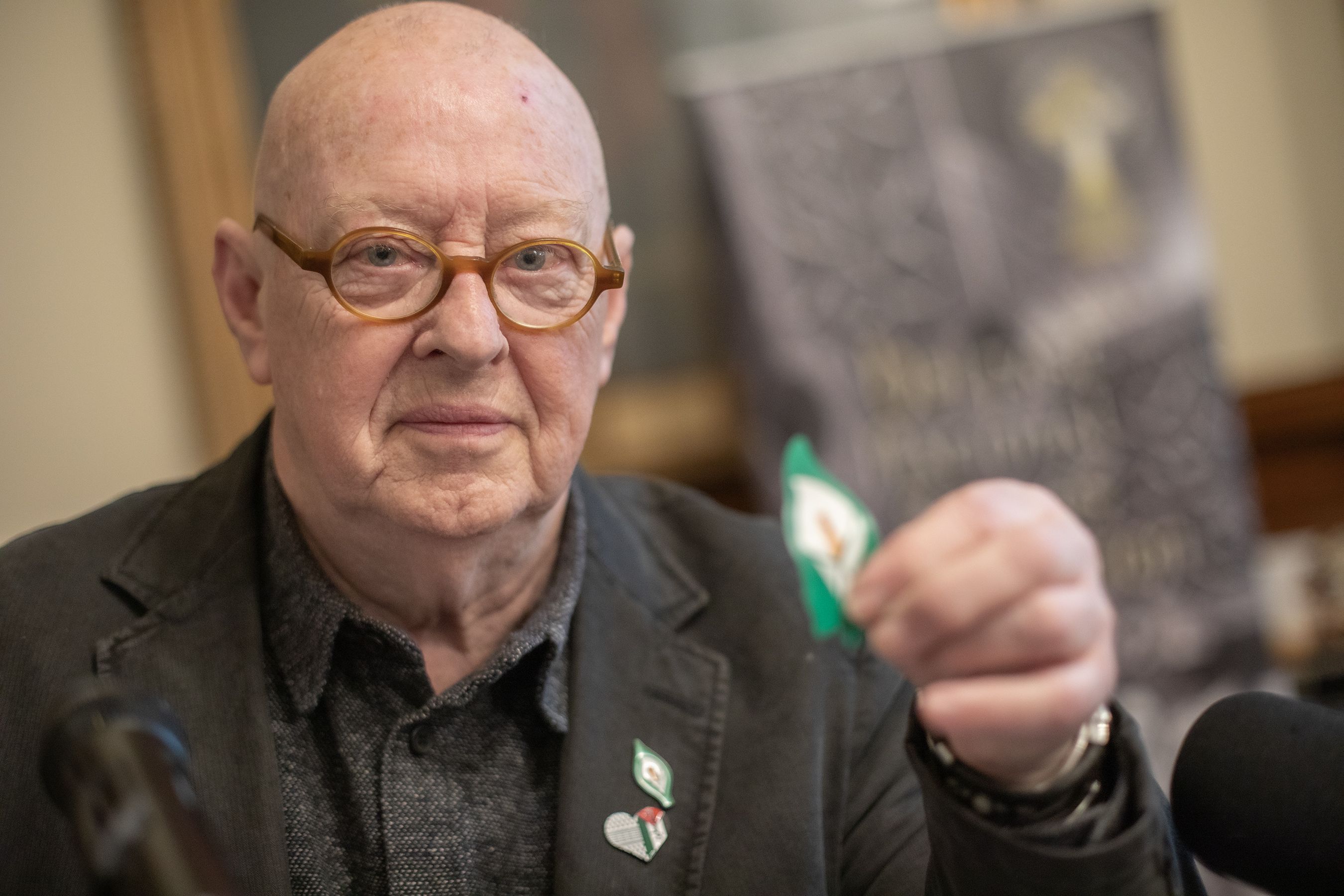

This weekend thousands of people in towns, villages and cities, at country crossroads and at lonely hillside graveyards across the island, will attend Easter commemorations. The diaspora too in Canada and the USA and Australia and other far flung places will hold their commemorations. They will gather to remember those republican revolutionaries who, in 1916 courageously challenged the might of the greatest empire the world has ever seen, and asserted in arms Ireland’s right to independence.
So, honour Ireland’s patriot dead and this Easter wear your Easter lily with pride.
Single-minded
NEXT week my first expedition into the recording world of music will be launched when singer and songwriter Davie Furey releases ‘Donegal/The Swallow’s Tail’, his first single of 2026.
I have known Davie a long time. When I sent him a copy of a small book of poems I had written he especially liked ‘Tir Chonaill Thuaith’. He asked me if he could include it in a new song he proposed writing around the poem. I said yes. But then he asked if he could record me reciting the poem as part of the single.
‘Donegal’ is a wonderful song. It was a delight to work with Davie and the musicians. I am a big admirer of Davie’s music and I wish him well with the song.
Davie Furey is the lead vocalist and he also plays guitar and bodhran; Mike McGoldrick (Mark Knopfler Band) plays flute; Éanna Ó Cróinin plays the uilleann pipes; Kane O'Rourke plays fiddle and whistle; Martin Quinn plays acoustic guitar and keys as well as producing the song for Jam Studios.
Donegal/The Swallow’s Tail by Davie Furie and featuring Gerry Adams is released on April 10.
Tír Chonailll Thuaith is from Poems For Hard Times. Published by An Fhuiseoig.